
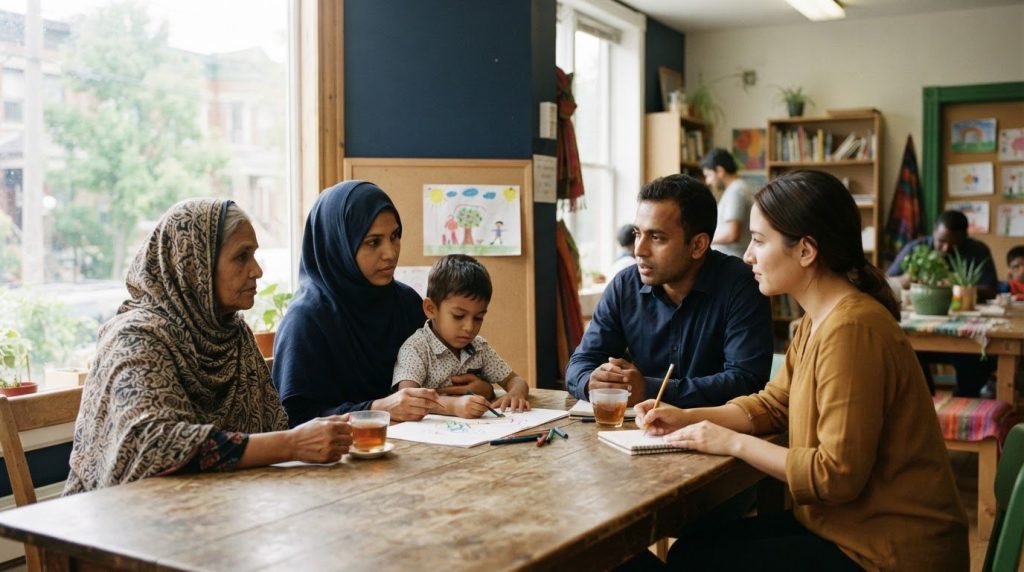
Safety can mark the start of rebuilding, but it doesn’t erase what came before or make every new challenge easy to name. The mental health challenges for refugees can be shaped by experiences before, during and after displacement, including loss, uncertainty and the pressures of resettlement. Each person’s experience is different.
Distress may be overlooked when someone has difficulty describing it, does not know how local services work or is unsure whom to trust. This article explains how displacement and resettlement may affect wellbeing, what respectful support can look like, and when professional mental healthcare may be important.
Stable, welcoming communities can help people feel connected as they rebuild. Rohingya Association UK (RAUK), a community-led charity based in Bradford, provides support in Bradford and beyond, including energy advice and support. RAUK works in partnership with Fuel Bank and HACT, and is a member of National Energy Action (NEA). Its community support can complement professional care. RAUK also raises funds for projects in Bangladesh.
Key Takeaways
- Mental health challenges for refugees can relate to experiences before, during and after displacement, but each person’s response is different and shouldn’t be assumed.
- Resettlement can bring new pressures. Stable housing, access to healthcare and social connection can all contribute to wellbeing.
- Language, unfamiliar systems, trust and practical constraints may make support harder to access; these barriers aren’t a sign that someone is unwilling to seek help.
- Listen without judgement, ask what support the person wants, and encourage them to contact a GP or appropriate NHS service when professional care may help.
- RAUK provides community support in Bradford and beyond, including energy advice and support. It works in partnership with Fuel Bank and HACT and is a member of National Energy Action (NEA). Community connection can complement professional mental healthcare.
What mental health challenges can refugees face after displacement?
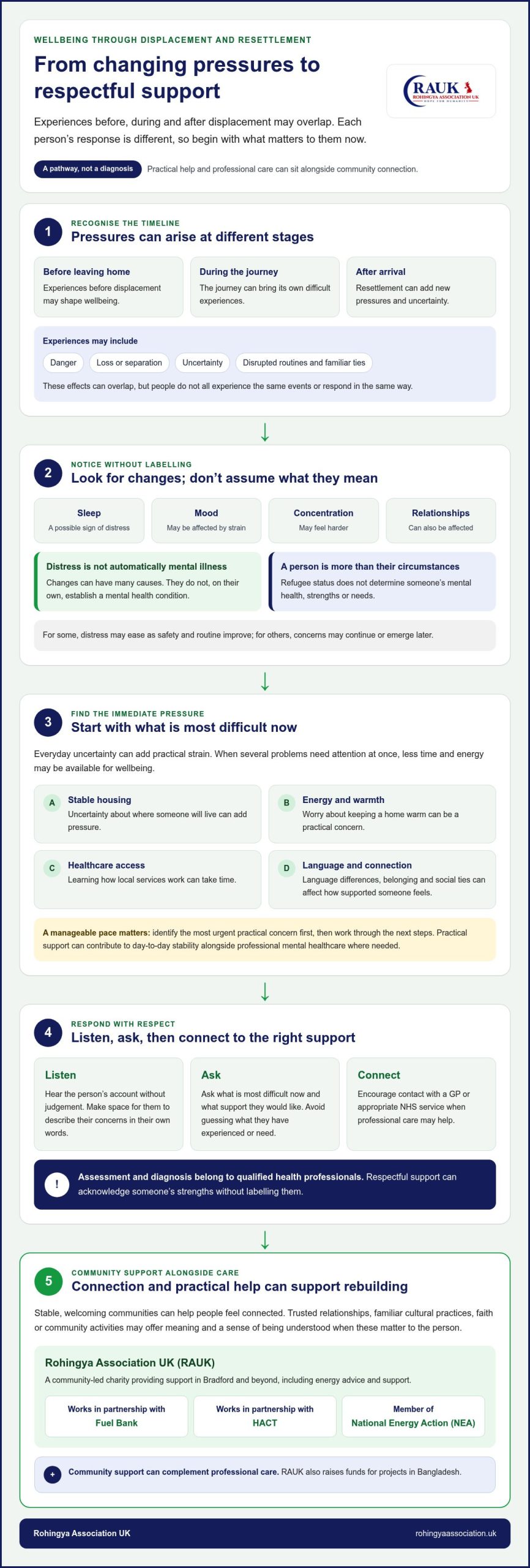
Refugee mental health challenges are emotional and psychological effects a person may experience in connection with displacement and the circumstances around it. The phrase describes possible experiences, not a diagnosis. Someone may feel anxious, low, unsettled or overwhelmed; another person may feel able to manage well or have different concerns altogether.
Displacement can involve danger, loss, separation from family and familiar places, and long periods of uncertainty. These pressures may affect sleep, mood, concentration or relationships, and make familiar routines harder to maintain. Such changes can be signs of distress, but on their own they don’t establish a mental health condition. This refugee mental health overview places these concerns within the wider health needs and care barriers people may encounter.
Refugee status alone does not determine a person’s mental health, strengths or needs. People bring different histories, relationships, resources and hopes to rebuilding their lives. Avoid assuming that someone has experienced trauma or needs the same response as another person. Ask about their own priorities rather than trying to interpret their behaviour for them.
How can displacement and forced migration affect wellbeing?
Stress may arise at different stages: before leaving home, during the journey and after arrival. These experiences are distinct, but their effects can overlap. Bereavement or separation from loved ones may sit alongside uncertainty about the future. Disrupted routines and familiar social ties can also make it harder to regain a sense of stability.
Not every refugee has faced the same events or will respond in the same way. For some, distress may ease as safety and routine improve; for others, concerns may continue or emerge later. Listen to the person’s account instead of fitting their experience to an assumption. A practical first step is to ask what is most difficult for them now and whether they would like help with it.
Are distress and mental illness the same thing?
No. Distress can be a human response to difficult circumstances, and it doesn’t automatically mean someone has a mental illness. Feelings and changes in behaviour can have many causes, so they shouldn’t be used by others to label or diagnose a person.
Only a qualified health professional can assess and diagnose a mental health condition. If someone is concerned about their wellbeing, professional advice can help clarify what support may be appropriate. Approach the conversation with respect: acknowledge the person’s strengths, let them describe what they need in their own words, and avoid presenting a guess as a diagnosis.
Why do refugee mental health needs continue during resettlement?
Arrival in a place of safety can be an important turning point, but it doesn’t resolve every pressure at once. Finding stable housing, accessing healthcare, learning how local services work and forming new relationships all take time. When these foundations remain uncertain, some people may find it harder to regain a sense of security, particularly if earlier adversity is still affecting them.
These pressures don’t affect everyone in the same way, and practical insecurity isn’t itself a diagnosis. The labels refugee, asylum seeker and stateless person describe different circumstances; none tells us what an individual has experienced or what support they need. Their priorities, family situation, health and personal strengths matter.
Emotional wellbeing is easier to sustain when everyday life offers safety, stability and meaningful connection.
How can housing, healthcare and energy insecurity add pressure?
Uncertainty about where someone will live, how to keep a home warm or how to access healthcare can add practical strain. When several problems need attention at once, less time and energy may be available for wellbeing. It can help to identify the most urgent practical concern first, then work through the next steps at a manageable pace. Addressing practical pressures can support day-to-day stability, alongside professional mental healthcare where needed.
Rohingya Association UK (RAUK) provides energy advice and support. It works in partnership with Fuel Bank and HACT, and is a member of National Energy Action (NEA). This practical support sits alongside RAUK’s wider community work and support in Bradford and beyond.
How do language, belonging and family relationships matter?
Language differences can make it harder to explain concerns, understand information or feel confident using services. Clear communication and appropriate language support can help people express their own priorities. Resettlement may also mean living apart from family, adjusting to changed responsibilities or finding new ways to maintain relationships. Experiences vary between individuals and families, so assumptions about culture or family roles can cause harm.
Belonging can grow through trusted relationships, familiar cultural practices, faith or community activities, when these matter to the person. Such connections may offer identity, meaning and a sense of being understood, alongside healthcare and other professional support. RAUK is a community-led charity supporting Rohingya refugees, families and young people in Bradford and beyond. Its community work offers a route to connection and practical support. Learn more about RAUK community support.
What can make mental health support harder for refugees to access?
Difficulty reaching support isn’t evidence that someone is unwilling to seek help. Access can depend on whether services are understandable, trusted and practically reachable, as well as on a person’s circumstances and preferences. Language differences, unfamiliar systems, appointment arrangements, transport, caring responsibilities or financial pressure may each create obstacles. When considering what might help, separate the barriers: for example, someone may understand the service but need help with communication or getting to an appointment.
Fear of being judged or discriminated against can also make it harder to speak openly. Some people may worry about who will hear what they share, or may have had experiences that affected their trust in institutions. Others may feel comfortable seeking help but face different barriers. Refugee experiences aren’t uniform, and no single explanation fits everyone.
How can stigma, trust and language affect help-seeking?
People may have different views about mental health, privacy and professional support, shaped by personal experience, family, community and many other influences. Avoid assuming that stigma is the reason someone hasn’t asked for help. Clear explanations about what a service does, how information is handled and what choices a person has can help them make an informed decision. If they are unsure, give them time to consider their options rather than pressing for an immediate answer.
Language matters, too. It may be difficult to describe complex feelings or understand unfamiliar terms in a second language. Appropriate language support can make communication easier, though arrangements vary between services. A trusted person may help someone explore options if they want that; don’t assume they want a relative or friend involved.
How can supporters respond without causing harm?
Begin with a respectful question, such as, “What would feel helpful right now?” Then listen, allow time and accept that the person may not wish to discuss everything. Support should reflect their priorities, pace and boundaries, rather than a supporter’s assumptions about what a refugee needs. If they do want practical help, agree on one next step together, such as finding information or making contact with a service.
In practice, a considerate response means:
- Ask permission before offering advice or helping to make contact with a service.
- Protect privacy by not sharing personal information without the person’s agreement, except where immediate safety concerns call for urgent action.
- Avoid pressure to recount traumatic events, and don’t minimise distress with phrases such as “you should be grateful” or try to diagnose what may be happening.
- Support informed choices by helping the person consider speaking with a GP or another qualified health professional when appropriate.
Culturally responsive support doesn’t rely on stereotypes or treat a community as having one set of beliefs. It asks what matters to the individual and respects their identity, values and decisions. Patience and clear communication can help preserve dignity and make a route to professional care feel more accessible.
How can refugees and communities find respectful, practical support?
Finding the right support can begin with a simple, person-led sequence: listen, ask permission, understand what matters most to the person, then explore suitable options together. They may want help with a practical concern before discussing emotional wellbeing, or they may prefer to take no further step just now. Respecting that choice helps preserve trust and agency.
Friends, family and community groups can offer steady companionship, help with everyday tasks and invite someone to culturally meaningful activities, if welcomed. Avoid promising that someone will recover, giving clinical advice or guaranteeing confidentiality if you can’t ensure it. Community relationships can provide connection and practical support alongside assessment or care from qualified mental health professionals.
When should someone seek professional mental health support?
If distress persists, worsens or begins to interfere with daily life, an individual assessment may help clarify what support is appropriate. A GP can be a starting point. NHS services and routes differ across the UK, so use current NHS guidance for the person’s location to find the appropriate service. If language is a concern, the person can explain what communication support would help them take part.
If someone is in immediate danger, call 999 or go to an accident and emergency department. For urgent mental health help that isn’t an immediate emergency, follow the current NHS guidance for the person’s area. A community organisation is not a crisis service.
What can friends, families and community groups do?
Practical, consistent support can make it easier for someone to pursue the help they choose. Ask whether they’d like company to an appointment, help understanding information or support with a day-to-day task. Don’t press for traumatic details or assume that a particular activity, belief or family arrangement will feel right. The person should remain in control of what they share and what happens next.
Rohingya Association UK (RAUK) is a community-led charity supporting Rohingya refugees, families and young people in Bradford and beyond. It provides energy advice and support, works in partnership with Fuel Bank and HACT, and is a member of National Energy Action (NEA). RAUK’s practical community work can contribute to connection and stability. Understanding the mental health challenges for refugees means recognising the value of trusted community support alongside appropriate professional care.
For community-based practical support, explore community support from RAUK.
How can trusted community support help refugees rebuild wellbeing?
Wellbeing is shaped not only by access to healthcare, but also by whether people can build relationships, take part in community life and find practical stability. Trusted community organisations can help create those conditions. They can offer connection and guidance while respecting each person’s priorities, identity and right to shape their own future.
Why can community connection matter after displacement?
For some people, familiar cultural connections, shared activities and relationships with others who understand aspects of their experience can ease isolation and strengthen a sense of belonging. Others may prefer different ways to connect, or need time before joining in. Good community support makes room for choice; it doesn’t define someone solely by displacement or expect them to represent an entire culture.
Rohingya Association UK (RAUK) is a community-led charity supporting Rohingya refugees, families and young people in Bradford and beyond. Its work includes practical assistance, healthcare access guidance, education and cultural events. English classes and skills development can also create opportunities to learn and participate. These forms of support can help people build connections and navigate everyday life, alongside assessment or treatment from qualified mental health professionals where needed.
For a wider perspective on belonging and practical support, readers can explore Community Support for Displaced Families: A Guide to Restoring Hope. For young people, Refugee Youth Empowerment Programmes: Building Brighter Future considers the role of education and empowerment as part of wider community support.
What does a respectful next step look like?
A useful next step begins with the person’s own priorities. They may want to learn about community activities, seek practical help or explore healthcare access guidance. Offer information without pressure, and let them decide what feels appropriate. If distress is persistent or worsening, community connection can sit alongside seeking advice from a GP or another qualified health professional.
RAUK provides energy advice and support, works in partnership with Fuel Bank and HACT, and is a member of National Energy Action (NEA). This work addresses practical circumstances that can affect day-to-day stability. Recognising the mental health challenges for refugees means valuing community relationships while understanding their role: they can support connection and agency, and professional care remains important when someone needs clinical help.
To learn more about this community-led work, discover RAUK’s community work.
Build support around dignity and connection
The mental health challenges for refugees can be shaped by experiences of displacement and by the conditions of rebuilding life. Each person’s needs are different, and distress should be met with respect rather than assumptions. Listening, recognising practical pressures and helping someone reach qualified care when needed can all contribute to a more supportive response.
Trusted community connections can offer belonging and practical guidance alongside clinical mental healthcare. Rohingya Association UK (RAUK) is a community-led registered charity based in Bradford, providing support in Bradford and beyond. It offers energy advice and support, works in partnership with Fuel Bank and HACT, and is a member of National Energy Action (NEA).
Every respectful step matters, whether it helps someone feel heard, access practical assistance or find appropriate professional support. Discover community support from Rohingya Association UK and learn how connection can help people move forward with dignity and choice.
Frequently Asked Questions
Do all refugees experience mental health challenges?
No. Refugees have varied experiences, strengths and needs, and refugee status alone doesn’t determine someone’s mental health. Some people may experience distress linked to displacement or resettlement, whilst others may not, or may find different forms of support helpful. Avoid assuming what someone has lived through or how they feel. Listen to the individual and let them guide conversations about their wellbeing and priorities.
What mental health challenges can refugees experience?
Some refugees may experience anxiety, low mood, distress, difficulty sleeping or trouble concentrating. These experiences can relate to events before, during or after displacement, but they don’t automatically indicate a mental health condition. People respond differently, and similar signs can have different causes. If someone is concerned about their wellbeing, a qualified health professional can assess their situation and discuss suitable support.
Can refugee mental health be affected after someone reaches safety?
Yes. Reaching safety can be an important step, but resettlement may bring continuing pressures, such as uncertainty about housing, healthcare, family relationships or belonging. These circumstances may affect wellbeing, and earlier difficulties can continue or become more noticeable over time. This isn’t inevitable, and people’s situations differ. Practical stability, trusted relationships and appropriate healthcare can all contribute to a person’s support and sense of security.
How can I support a refugee who may be struggling?
Listen without judgement, ask what would feel helpful and respect the person’s choices about what to share. Offer practical help only with their agreement, and don’t press for details of traumatic experiences, minimise distress or try to diagnose them. If they’re concerned about their wellbeing, encourage them to consider speaking with a GP or qualified health professional. Be honest about privacy and don’t promise confidentiality you can’t guarantee.
Can community support replace professional mental health care?
No. Community support can offer connection, practical help and a sense of belonging, but it doesn’t replace assessment or treatment from qualified mental health professionals. A trusted community member may help someone explore options or feel less alone while they seek care. If distress persists, worsens or affects daily life, encourage the person to speak with a GP or appropriate health service about their individual needs.
Where can refugees in the UK seek mental health support?
A GP can be a starting point for discussing mental health concerns and seeking an assessment. People can also use NHS guidance to find relevant mental health services for their location; pathways differ across the UK. If someone is in immediate danger, call 999 or go to an accident and emergency department. For urgent concerns that aren’t an immediate emergency, follow current local NHS guidance.
What practical support can help refugee wellbeing in Bradford?
Practical assistance, healthcare access guidance, education, English classes and cultural activities may help build stability and connection. Rohingya Association UK is a community-led charity providing support in Bradford and beyond, including energy advice and support. It works in partnership with Fuel Bank and HACT, and is a member of National Energy Action (NEA). Funds can also be raised for projects in Bangladesh. Community support complements specialist mental healthcare.