
A child can grow up without any country recognising them as a national. Under the 1954 Convention Relating to the Status of Stateless Persons, a stateless person is someone no state considers a national under its law. The effects of statelessness on children can reach far beyond legal status, shaping access to identity documents, family life, education, healthcare and future opportunities.
It’s easy to assume that a child’s nationality follows naturally from their birthplace or their parents. In reality, gaps in nationality laws and birth registration can leave children without recognised status. Barriers passed from one generation to the next can make that uncertainty harder to resolve.
This article explains what statelessness means for children, how it can affect daily life and why its consequences may continue across generations. It also explores legal and policy gaps that can leave children unprotected, and the role community support can play in helping families find stability, connection and a stronger sense of belonging.
Key takeaways
- Understand why a birth certificate and recognised nationality are distinct, and how missing records can complicate a child’s access to rights and services.
- See how gaps in nationality laws can allow statelessness to pass from parents to children, and why safeguards matter.
- Learn how documentation and accreditation barriers can disrupt schooling and limit future study and work opportunities.
- Explore how legal status can affect children’s access to education and healthcare, alongside the role of community support.
- Identify how inclusive nationality laws and effective birth registration can help prevent children from being left without a recognised nationality.
Children without birth certificates or recognised nationality
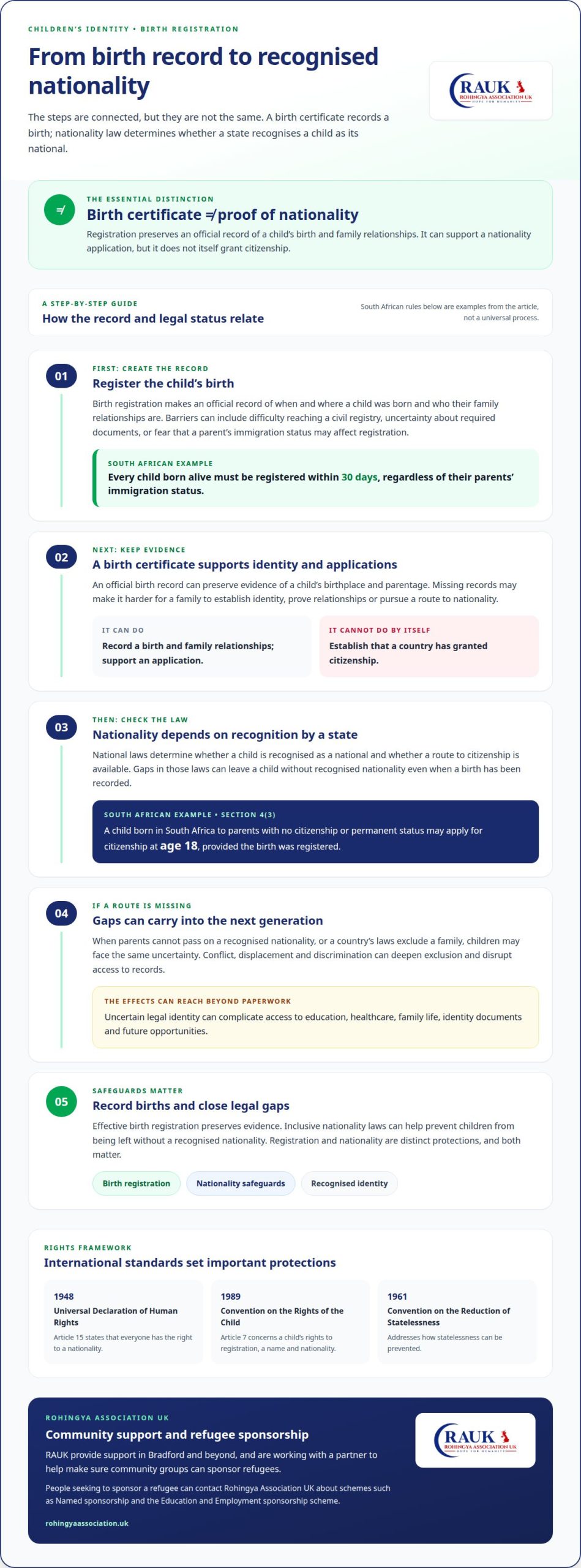
A birth certificate records a child’s birth, but it does not automatically establish nationality. If registration is blocked or nationality laws exclude a family, the child’s identity and legal status may remain uncertain.
Birth registration barriers for migrant families
Birth registration barriers arise when families cannot meet administrative requirements or reach the civil registry. Migrant parents may be unsure which documents are needed or fear that their immigration status will affect registration. In South Africa, every child born alive must be registered within 30 days, regardless of the parents’ immigration status. That requirement matters because an official record can preserve evidence of a child’s birthplace and parentage.
Birth registration and proof of nationality
Birth registration creates an official record of a child’s birth and family relationships. A birth certificate can support a nationality application, but it is not itself proof that a country has granted citizenship. Nationality laws determine whether a state recognises the child as its national. In South Africa, Section 4(3) allows a child born there to parents with no citizenship or permanent status to apply for citizenship at age 18, provided the birth was registered.
The right to birth registration and nationality
The right to birth registration means a child’s birth should be officially recorded; the right to nationality concerns recognition by a state. Article 15 of the 1948 Universal Declaration of Human Rights states that everyone has the right to a nationality. These rights matter when parents cannot pass on citizenship or laws leave a child without a route to nationality. Registration preserves evidence, but cannot by itself resolve every legal gap.
South African registration rules also set out who may record a birth. Under Section 12 of the Births and Deaths Registrations Act, only the mother may register a child born out of wedlock, unless an unmarried father meets the stated conditions. For children born in South Africa to permanent-resident parents, Section 2(3) of the Citizenship Act provides an application route. A child born there to parents with no citizenship or permanent status may apply at age 18 under Section 4(3), provided the birth was registered.
Missing records can affect families across generations. In Côte d’Ivoire, descendants of people who settled through colonial-era forced labour or migration have been born without Ivorian nationality since independence in 1960. Za Beda’s children have no birth certificates, and Myanmar does not recognise them as citizens. In northwest Syria, more than a quarter of children likely lack recognised birth registration documents, national identity cards or passports. These cases show why birth records and nationality recognition are distinct protections.
Intergenerational statelessness
Statelessness can pass from parents to children when nationality laws offer families no recognised route to citizenship. Conflict, displacement and discrimination can deepen exclusion across generations.
International conventions and children’s rights
International conventions set standards for nationality, birth registration and children’s rights. Article 7 of the 1989 Convention on the Rights of the Child concerns a child’s rights to registration, a name and nationality. The 1961 Convention on the Reduction of Statelessness addresses how statelessness can be prevented. These standards matter because national laws and their implementation determine whether families can secure those rights.
Family stress and statelessness
Intergenerational statelessness affects family life when parents cannot pass a recognised nationality to their children. Families may face ongoing uncertainty about identity documents and how to prove relationships, adding strain to ordinary decisions about a child’s future. For refugees and families affected by conflict or violence, displacement can disrupt access to records and widen existing gaps. The pressure is both legal and personal.
Where stateless children are concentrated
A single child-specific global figure isn’t available here; at the end of 2019, at least 10 million people worldwide were stateless. Thailand still has hundreds of thousands of stateless children, while northwest Syria has more than one million children, many affected by missing recognised documents. These examples show concentration in distinct settings, but the figures describe different populations and shouldn’t be conflated.
Effects on safety, family life and mental health
Statelessness can leave children more exposed to insecurity when their legal identity is difficult to establish. Worries about family separation, discrimination or access to protection may affect a child’s sense of safety and emotional wellbeing. These pressures can also strain family relationships, particularly when parents must manage prolonged uncertainty alongside displacement or conflict. A missing certificate is not just paperwork; it can shape daily life.
International protection relies on more than one agreement. The 1954 Convention Relating to the Status of Stateless Persons and Article 24 of the 1966 International Covenant on Civil and Political Rights are among the instruments related to statelessness. The 1997 European Convention on Nationality also addresses nationality. Together, these agreements provide standards, while each country’s laws and practices shape how families experience them.
USCRI recommends that governments implement the 1961 Convention on the Reduction of Statelessness, the Convention on the Rights of the Child and the 1954 Convention Relating to the Status of Stateless Persons. The African Union agreed to a treaty to eradicate statelessness on the continent in February 2024. Such agreements matter when governments translate commitments into nationality laws, birth registration and safeguards for children who would otherwise remain stateless.
Children of stateless parents face particular risks where nationality laws prevent their parents from passing citizenship on to them. Refugee children may also experience interrupted registration when conflict or displacement separates families from records and civil authorities. Discrimination in nationality laws can create further barriers. Breaking the cycle requires workable routes to nationality and registration systems that include children whose parents have fled violence or lack recognised status.
Barriers to schooling and future opportunities
Missing documents can create obstacles to school progression and later opportunities. The effects depend on which records an institution requires and whether a child can obtain them. A child may have studied for years but lack papers showing their identity, education history or legal status. This can make everyday transitions harder, from moving schools to demonstrating completed learning.
In northwest Syria, most children born after 2017 are not registered with the Syrian government. Families may therefore struggle to obtain records recognised by that government, even when children have grown up in the country. Without official documentation, proving a child’s identity or background can be difficult. That uncertainty may follow them into school processes and other situations requiring formal records.
Documentation requirements can also affect families beyond the classroom. Since December 2022, the Salvation Syrian Government has increasingly required its own documents for families to access salaries, school exams and car ownership transfers. A child’s ability to sit an exam may depend on a family’s access to paperwork. This can interrupt the path from lessons to recognised assessment and make educational progress harder to demonstrate.
Syria issued a new Civil Status Law in 2021, but barriers to recognised nationality and legal status remained for children in northwest Syria. A change in law does not automatically resolve the practical difficulties families face. Children may still lack accepted evidence, while families may have to deal with systems that do not recognise the same records. The distinction between a legal framework and a child’s lived situation matters.
Raghda’s family shows how documentation barriers can reach into future choices. One of her daughters was married off at age 15 after her children faced barriers linked to missing birth documentation. This example connects a child’s unresolved records with the choices available to a family. It also shows why missing papers should be understood as a barrier to opportunity, not simply an administrative inconvenience.
For families in the UK, keep together any records of a child’s learning and personal history, such as school reports, certificates or previous enrolment documents. If a record is missing, explain the circumstances clearly to the relevant school or organisation and provide any other evidence available. This will not settle nationality, but it can help clarify a child’s educational experience during a transition.
Schools and families can distinguish between attendance, learning and formal recognition. A child may have gained knowledge without receiving documents that enable progression. Keeping a record of completed work, exam attempts and previous study can provide a clearer account of that learning. In northwest Syria, barriers to exam access show how missing documents can prevent educational effort from being formally recognised.
How statelessness affects children’s access to education and health care
Statelessness means that no state recognises a child as its national under its nationality laws. Without recognised citizenship or identity documents, accessing education, health care and social protection can become harder.
School access and enrolment
School access can be affected when enrolment or progression depends on documents a child cannot provide. In some countries, stateless children may attend classes but be unable to graduate without documentation. The distinction matters: attending lessons alone may not lead to recognised qualifications or further study.
Recognition also shapes educational progression. A lack of accreditation can prevent children from moving into secondary or higher education, even when they have gained knowledge through lessons. Informal or non-formal education may provide learning when formal school is inaccessible, but it may not be an adequate substitute. Without recognised records, a child’s work may not count towards the next stage.
For families affected by migration, birth registration can help establish a child’s identity and support later access to services. Thailand provides an example of a registration measure: public hospitals launched e-registration in 2013, linking newborn information with civil registration and supporting birth registration regardless of parents’ nationality. Yet Thailand still has hundreds of thousands of stateless children. Registration systems can help, but they must reach families and connect records to recognition.
Healthcare and essential services
Access to health care can be affected when a service relies on identity, residence or eligibility records. A child without recognised documents may face extra barriers to proving who they are or which support applies. This matters for routine care as well as urgent needs, because delays in establishing identity can complicate communication between families and service organisations.
Social protection can bring similar practical difficulties. When access depends on records or formal status, missing documents may make it harder for a family to establish eligibility. Requirements differ between systems, but the underlying problem is clear: an unrecognised identity can create obstacles beyond nationality itself.
These barriers can reinforce one another. A child without a birth registration record may struggle to obtain identity documents; without them, progressing at school or accessing services can become harder. Thailand’s e-registration approach shows how hospitals can help record births, while the continued presence of stateless children there highlights that registration alone does not resolve every nationality question.
Education and health care can also support a child’s sense of belonging. A recognised school record can document learning, while a reliable identity record can make interactions with organisations clearer. Children excluded from formal education may rely on informal or non-formal systems that do not provide an adequate alternative. If access to health care is obstructed, families may struggle to seek timely support. Addressing documentation barriers alongside nationality questions helps prevent one missing record from narrowing a child’s choices in several areas of life.
Legal and policy gaps affecting stateless children
Legal gaps can leave children without practical protection, even where human rights principles recognise basic rights. What matters is whether national laws and public systems turn those principles into accessible pathways to nationality.
Discrimination in nationality laws can prevent parents from passing citizenship to their children. Syria is one of 24 countries whose laws discriminate against women in conferring nationality to their children. In Malaysia, women cannot automatically grant citizenship to children born abroad. A child’s entitlement can therefore depend on which parent can transmit nationality and where the child is born.
Written protections also depend on implementation. In Malaysia, poor implementation of constitutional protections undermines their effectiveness in preventing childhood statelessness, particularly for foundlings. A protection written into law may fail in practice if authorities cannot apply it consistently. A child’s situation can then remain unresolved despite constitutional safeguards intended to prevent exclusion.
International agreements provide standards, but governments must make them effective through domestic laws and procedures. The 1954 Convention Relating to the Status of Stateless Persons, the 1961 Convention on the Reduction of Statelessness and the Convention on the Rights of the Child address related protections. USCRI recommends that governments implement these instruments. Their impact depends on whether children can access registration, status determination and a route to nationality.
A key preventive measure is granting nationality to children who would otherwise be stateless. This safeguard addresses situations where neither parent’s nationality laws recognise the child as eligible. Clear nationality rules can prevent exclusion at birth, while accessible procedures help families establish a child’s legal position. Without both, displacement and missing records can leave children outside the protection the law intends to provide.
Regional agreements also require practical follow-through. The African Union agreed to a treaty to eradicate statelessness on the continent in February 2024. Turning that commitment into protection means addressing discriminatory laws, registration barriers and gaps between legal guarantees and administrative practice. The global challenge is not only creating agreements; it is ensuring children can benefit from them in their country and circumstances.
For stateless people, legal recognition shapes whether they can claim basic rights in practice. Governments can reduce intergenerational exclusion by reviewing nationality laws, removing discriminatory provisions and establishing safeguards for children who would otherwise have no nationality. These measures address the causes, rather than leaving each generation to face the same unresolved legal situation.
Community support can help refugee families understand the wider support available as they face displacement and uncertainty. Connect with support for refugee families while broader legal and policy protections are pursued.
Rohingya Association UK
Rohingya Association UK supports refugees and families facing the practical effects of displacement and uncertain status, with support in Bradford and beyond. Its community support and integration, education and youth empowerment, cultural events, and advocacy work can help families strengthen connections, access learning and maintain a sense of belonging. This is community-based support, not legal representation.
RAUK is working with a partner to help community groups sponsor refugees. People interested in sponsoring a refugee can contact Rohingya Association UK about schemes such as Named Sponsorship and the Education and Employment Sponsorship Scheme. For families seeking community connection, education support or advocacy around these challenges, contact Rohingya Association UK to discuss the support available.
Build a future rooted in recognition
A child’s sense of identity and possibility should not be limited by unresolved legal status. Addressing the effects of statelessness on children takes more than individual resilience: families, communities and governments all have a role in strengthening recognition and inclusion.
For families affected by displacement, a trusted community connection can offer a place to seek support, maintain cultural ties and encourage young people’s participation. Rohingya Association UK works with communities through Community Support & Integration, Education & Youth Empowerment, and Cultural & Community Events. These efforts complement the wider need for fair laws and systems that protect every child’s rights.
If you’re seeking community support, or exploring refugee sponsorship schemes such as Named Sponsorship or the Education and Employment Sponsorship Scheme, contact Rohingya Association UK to discuss your next step. Each act of support can help create stronger connections and a more hopeful path forward for children and families.
Frequently Asked Questions
What is Statelessness?
Statelessness is when no country considers a person its national under its law, as defined by the 1954 Convention Relating to the Status of Stateless Persons. The effects of statelessness on children can include uncertainty about which state recognises their nationality. A birth record or family history may help establish identity, but neither automatically determines citizenship. The relevant country’s nationality laws establish whether a child is recognised as a national.
How does statelessness affect children’s access to education and healthcare?
The effects of statelessness on children can include difficulty accessing education or healthcare when services require identity or status records. A pupil might attend lessons but lack the documents needed to show completed study. Families may also find service processes harder when a child’s identity is difficult to establish. Practical barriers vary between systems, so a child may face different requirements at school and in healthcare settings.
How does statelessness limit children’s freedom of movement and future employment?
Statelessness can complicate travel when a child cannot obtain or use identity documents required by the relevant authorities. Requirements depend on the countries and processes involved. Later, missing education records or qualifications may make it harder to show a prospective employer what a young person has studied or achieved. Keeping available records together can help preserve an account of their learning while nationality questions remain unresolved.
What laws and international rules protect stateless children’s right to a nationality?
International agreements recognise children’s rights relating to nationality and registration. Article 7 of the 1989 Convention on the Rights of the Child concerns a child’s right to acquire a nationality, while Article 15 of the Universal Declaration of Human Rights recognises everyone’s right to a nationality. The 1961 Convention on the Reduction of Statelessness addresses prevention. Governments translate these standards into national laws and procedures, which shape how protections work in practice.
What programmes and organisations help stateless children obtain nationality and essential services?
Government authorities determine nationality under the relevant country’s laws; community organisations can support families with integration, education and access to services. Rohingya Association UK provides Community Support & Integration, Education & Youth Empowerment, and advocacy and awareness campaigns. It does not determine a child’s nationality. Global advocacy initiatives and local support networks promote awareness and action on statelessness, helping families navigate day-to-day challenges.