

Gift Aid, explained for donors, starts with a clear eligibility test: you must have paid enough UK Income Tax or Capital Gains Tax in the current tax year to cover the tax reclaimed on your charitable donations. If you qualify and make a declaration, the charity can claim an extra 25p for every £1 you give, at no extra cost to you.
It’s understandable to wonder whether ticking a box is enough, especially when tax relief depends on your own tax position. A Gift Aid declaration authorises a charity to claim on eligible donations, while higher-rate taxpayers may be able to claim additional relief themselves.
This guide explains who qualifies, what a declaration means and how Gift Aid applies to donations. You’ll also learn how to claim higher-rate tax relief, so you can make an informed choice about giving and the support your contribution helps sustain.
Key Takeaways
- Compare the tax you’ve paid with the Gift Aid claimed across all your charitable donations to assess whether you qualify.
- Understand what your declaration authorises, including how it may apply to eligible donations from previous tax years.
- If you pay tax at a higher rate, find out how to claim the additional relief through your tax return.
- Use accurate donor name and address details so the charity can identify and record your declaration correctly.
- For community support in Bradford and beyond, Rohingya Association UK provides Community Support & Integration.
How do I claim the extra tax relief on gift-aided charity donations?
In the UK, eligible donors who pay tax above the basic rate can claim additional relief themselves. The process depends on the donation year and how you gave.
Claiming relief for past donations
Claiming relief for past donations means including eligible charitable donations from earlier tax years in a tax-relief claim. For the 2026/27 tax year, UK donors can claim relief on donations made as far back as the 2022/23 tax year. This matters if you paid higher-rate tax but did not include earlier Gift Aid donations in your claim.
Gather your donation amounts and the tax years they relate to, then report eligible gifts through your tax return. Keep records that identify each donation and its date. A Gift Aid declaration may cover eligible donations made in the previous four years where HMRC rules permit, but that does not, by itself, claim your personal higher-rate relief.
How Gift Aid increases a donation
Gift Aid allows a UK charity to reclaim basic-rate tax on an eligible cash donation, increasing the amount available to its charitable work. The charity can claim 25p for every £1 donated, at no extra cost to the donor. For example, a £20 donation becomes £25 for the charity when Gift Aid is applied.
Donated goods work differently from money gifts. A charity shop may use a Gift Aid system to claim on income from selling donated items; the claim is based on sale proceeds, not a donor’s estimate of an item’s value. If those proceeds exceed £1,000 in a tax year, the charity will contact the donor about available options before making a claim.
Adding Gift Aid to money donations
To add Gift Aid to a money donation, make a declaration to the charity confirming that you want it to claim tax back on eligible gifts. Declarations can cover future donations and, where HMRC rules permit, eligible donations from the previous four years. This is useful if you give regularly and want eligible gifts treated consistently.
Before making a declaration, consider whether the tax you have paid covers the Gift Aid claimed on all your charitable donations. A declaration does not create additional tax relief if your tax paid is insufficient to cover those claims. Keep a record of your giving so you can review the total when preparing your tax return.
Donations made through CAF or Payroll Giving cannot also have Gift Aid claimed, because those schemes already include tax relief. Check which method you used for each gift before including it in a Gift Aid claim. Keeping direct donations separate from CAF or Payroll Giving helps prevent the same contribution being treated as eligible twice.
Gift Aid declarations
A Gift Aid declaration records your agreement for a charity to claim tax on eligible donations. It connects your giving to the charity’s claim; it does not add another payment to your donation. Before making one, consider whether your tax payments cover Gift Aid claimed on all your charitable donations. This matters because a declaration has implications for your own tax position.
A declaration can cover eligible future donations and, where HMRC rules permit, donations made during the previous four years. This can be useful if you give regularly but have not made a declaration before. Read the wording carefully and make sure it reflects your intention. A declaration applies to eligible gifts, not automatically to every transfer or payment you make to an organisation.
You may make a Gift Aid declaration orally, but the charity must confirm it in writing and keep a copy. That confirmation gives both parties a record of what was declared. If you agree verbally during a conversation, listen to the explanation of the declaration’s effect, then read the written confirmation when it arrives. This helps you understand what your agreement covers.
There is a specific cancellation safeguard for oral declarations. The donor must be told about the entitlement to cancel the declaration retrospectively within 30 days. If you change your mind after giving an oral declaration, act within that period and communicate your cancellation to the charity. The 30-day period relates to cancelling an oral declaration retrospectively; it should not be confused with the period a declaration may cover.
Keep the declaration and any written confirmation with your donation records. If you make similar gifts to different charities, keep each charity’s declaration as a separate record. This helps you identify which organisation can make a claim and which donations fall within the declaration’s scope. Clear records also help you review your giving when preparing a tax return.
A declaration concerns eligible donations of money; it does not mean every gift of assets qualifies in the same way. For goods donated for sale through a charity shop, the Gift Aid process can involve the proceeds and options communicated by the charity. Keep that arrangement separate from a declaration covering money donations. Distinct records make it easier to understand what you agreed to and how each type of gift is treated.
Higher-rate taxpayer relief
Gift Aid gives higher- and additional-rate taxpayers a route to claim extra tax relief personally. The charity’s claim covers basic-rate tax; the donor may claim the difference between that and their own rate. The calculation uses the donation’s gross value, not simply the cash that left the donor’s account. It can reduce the effective cost of giving while preserving the amount available to the charity.
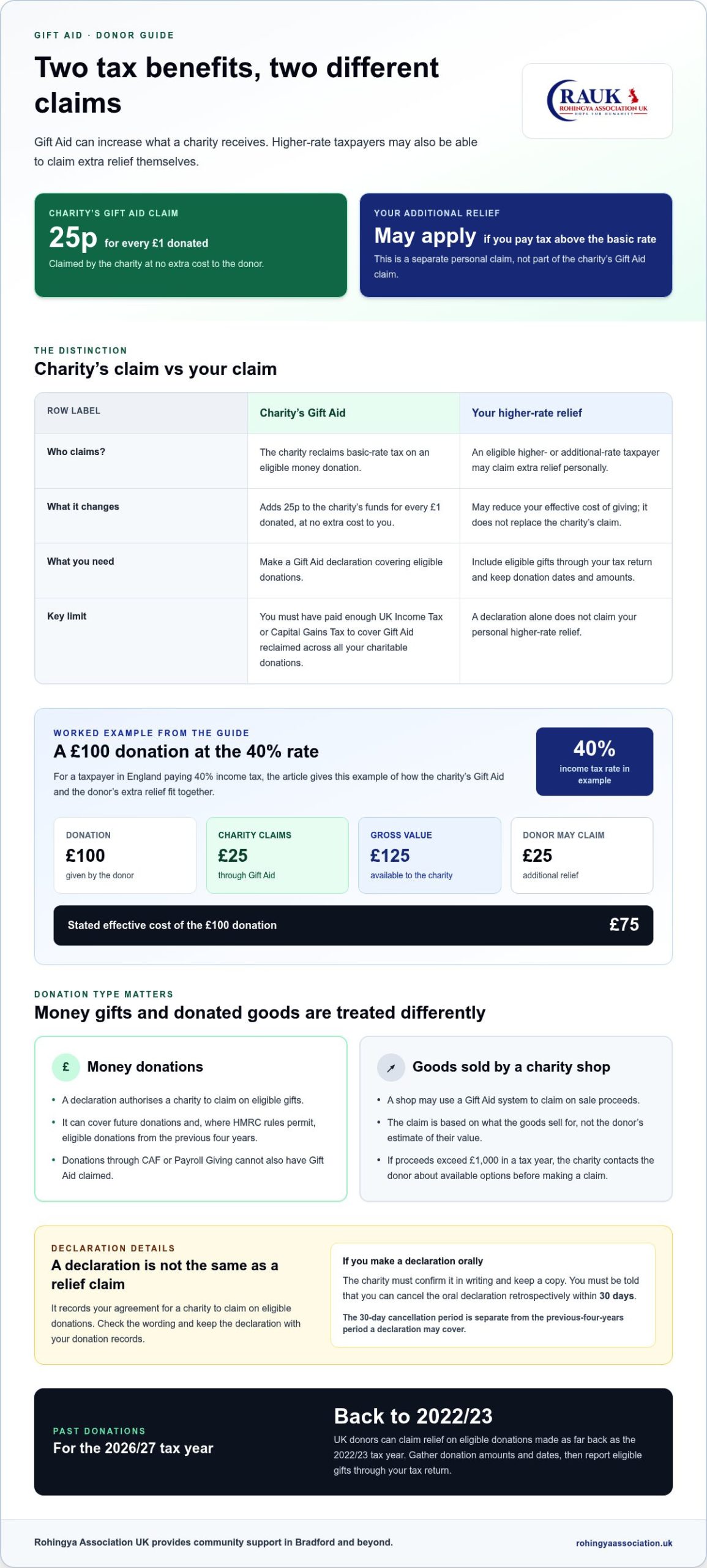
A higher-rate taxpayer paying 40% income tax can claim the remaining 20% relief on the gross value of a Gift Aid donation, according to HM Revenue & Customs. For a £100 donation, the charity’s Gift Aid claim makes the gross value £125. A taxpayer in England paying 40% can claim £25 in additional relief on that £100 donation. The stated effective cost is £75, while the charity receives the gross value.
Additional-rate taxpayers can claim a different amount because their income tax rate is higher. In the example for a taxpayer paying 45%, the extra relief on a £100 Gift Aid donation is £31.25. The stated net cost is £68.75. Use the correct tax rate for the relevant income, since the relief calculation relates to the grossed-up donation and the taxpayer’s rate.
Scottish taxpayers may have different rates and corresponding relief. A Scottish higher-rate taxpayer paying 42% can claim £27.50 in extra tax relief on a £100 donation. At Scotland’s top rate of 48%, the example gives £35 of additional relief on £100. These examples show why a donor’s nation and applicable tax band matter when working out personal relief.
To claim, include eligible Gift Aid donations in your tax return for the relevant tax year. Keep a record of donation amounts, dates and the charities involved, then use those details to report your giving accurately. If more than one person in your household donates, each person should record their own eligible gifts. You cannot treat a partner’s donations as yours simply because you share finances.
The charity and donor claim different parts of the relief. The charity reclaims basic-rate tax, whilst a higher- or additional-rate donor claims any personal balance through their tax return. Do not count the charity’s reclaim as your own tax relief. For example, a donor paying 40% can distinguish the charity’s claim from their £25 personal claim on a £100 donation, making the record clearer and the calculation easier to follow.
Income Tax and Capital Gains Tax requirements
If your Income Tax and Capital Gains Tax are lower than the Gift Aid claimed on your donations, you do not meet the tax requirement and may have to pay HMRC the shortfall. A UK taxpayer must have paid enough of either tax in the current tax year to cover Gift Aid claimed across all their charitable donations.
The test considers your total qualifying tax, not just one donation or one charity. For example, add the Gift Aid claimed on donations to different charities, then compare the total with the Income Tax and Capital Gains Tax you paid in the same tax year. A declaration does not remove this responsibility. It confirms that you understand the tax condition behind a charity’s claim.
Section 416 of the Income Tax Act 2007 sets out conditions for a qualifying Gift Aid gift to a UK charity. The gift must meet those conditions as well as the donor’s tax requirement. This means eligibility involves two separate questions: whether the donation qualifies, and whether your tax paid covers the claims on your charitable giving.
Both Income Tax and Capital Gains Tax count towards the test. The rule is not limited to Income Tax, so consider both types of tax paid during the current tax year. Your income or donation amount alone does not show whether you have paid enough tax. The key comparison is between Gift Aid claimed across your eligible donations and your qualifying tax paid.
To assess your position, gather your donation records and identify which gifts had Gift Aid declarations. Then consider the tax you paid in the same tax year, including Income Tax and Capital Gains Tax. Keep the calculation cumulative: reviewing each donation on its own can miss the combined effect of claims made by several charities. Clear records help you judge whether your total giving meets the requirement.
For example, you may have made Gift Aid donations to more than one UK charity. Each eligible claim contributes to the total that must be covered by tax paid in the current tax year. If your tax payment falls short, the condition is not met, even if each individual gift seems modest. Include all relevant donations when assessing the total.
A Gift Aid declaration is not protection against a tax shortfall. Before declaring, consider your expected charitable donations and the Income Tax or Capital Gains Tax you have paid. If your circumstances change during the tax year, review the overall totals again. The test applies to combined claims and tax paid, not simply your intention to give.
Donor name and address details
For a Gift Aid declaration, the charity needs details that identify you as the individual taxpayer making the donation. Give your own name and home address, not another household member’s details. The declaration relates to the donor, not simply the bank account or card used. Accurate information helps the charity link your consent to your contributions and keep a clear record.
Use the name the charity can recognise in its donation records. For example, if your bank payment shows a shortened name but your declaration uses your full name, provide enough detail for the charity to match them. Don’t put a partner’s name on a declaration for your gift. Each taxpayer’s giving and tax position are personal.
Your address helps distinguish your record from another donor’s. Enter your home address clearly, including the postcode, and update the charity if you move. An old address may make it harder to match a declaration with previous donations, especially if you have given more than once. Keep a copy of the details you submitted so you can remember what information you provided.
For household giving, separate contributions by donor. If two people each make a donation, record who gave each amount and make sure the declaration belongs to that person. Sharing an address does not make one person the donor for both gifts. This distinction matters because Gift Aid eligibility depends on each taxpayer’s own tax paid and eligible donations.
When completing a paper or online declaration, review your name and address before submitting it. Check the spelling, postcode and that the details refer to you, not a family member. If a charity confirms an oral declaration in writing, read the confirmation and correct any identifying details that do not match your records. Consistent details make it easier to review your giving later.
Donated goods need careful record-keeping too. If you give assets for a charity shop to sell, keep that arrangement distinct from a cash donation and its declaration. The charity’s records may need to connect the donor’s details with the goods and the sale process. If proceeds exceed £1,000 in a tax year, the charity will contact the donor about available options before making a Gift Aid claim.
Clear donor details support accurate charitable records, but they don’t replace the tax eligibility test. Keep your donation records alongside the name of each charity and the relevant tax year. If your address changes, update the charity’s record rather than assuming earlier details will change automatically. For readers looking to connect charitable giving with local community support, explore community support and integration.
Rohingya Association UK: Community Support & Integration
Rohingya Association UK provides Community Support & Integration for people seeking connection and practical support. Its work also includes Cultural & Community Events, Education & Youth Empowerment, and Advocacy & Awareness Campaigns, helping preserve heritage, support young people and raise awareness of issues affecting Rohingya communities.
This work responds to needs beyond tax relief: building belonging, widening educational opportunities and raising awareness of issues affecting Rohingya communities. Consider what best reflects the needs of you or your community, from opportunities for young people to shared culture and connection.
You’re welcome to contact Rohingya Association UK or visit rohingyaassociation.uk.
Let informed giving lead to meaningful connection
Gift Aid explained for donors in plain language can help make charitable giving a more deliberate choice. The next step is to decide which forms of support reflect your values and the kind of community you want to help strengthen. You can make that decision thoughtfully, practically and with respect.
Giving is one way to stand alongside people and communities; learning, cultural connection and mutual support also help sustain belonging. Keep your tax decisions separate from the cause you choose, and let each be guided by accurate information and your priorities. This makes room for informed generosity without pressure.
If you’d like to learn more about Rohingya Association UK’s work, contact the association. A considered conversation can be a simple starting point for exploring how to take part. Each thoughtful act of solidarity can help strengthen a more connected future.
Frequently Asked Questions
Am I eligible for Gift Aid?
You may qualify if you’re a UK taxpayer and have paid enough Income Tax or Capital Gains Tax in the current tax year to cover Gift Aid claimed on all your charitable donations. Gift Aid explained for donors starts with your overall tax position, not one gift in isolation. If you give to several charities, include all eligible donations when considering the combined claims.
How does Gift Aid work?
Gift Aid lets an eligible UK charity reclaim basic-rate tax on a donation after you make a declaration. The charity makes that claim; you claim any additional relief linked to a higher tax rate. In practical terms, Gift Aid explained for donors means keeping the two claims distinct. Your records should identify your donations, the charities involved and any personal relief you claim.
What is Gift Aid and how does it work for UK charitable donations?
Gift Aid is a UK tax scheme that allows eligible charities to reclaim basic-rate tax on qualifying donations. For each £1 donated, the charity can claim 25p when the donor qualifies and has made a declaration. The donor doesn’t pay that extra amount. The charity’s reclaim increases the funds available for its work, while any further personal relief is a separate matter.
Who is eligible to use Gift Aid as a donor?
An individual can use Gift Aid for an eligible donation to a UK charity if they meet the tax requirement and make a declaration. Eligibility depends on that donor’s own tax paid, not another person’s income or tax status. If two people in one household donate separately, each should consider their own gifts and tax position rather than combining them under one person.
How much extra does Gift Aid add to a donation?
Gift Aid adds 25p to the charity’s funds for every £1 donated, making a qualifying £1 gift worth £1.25 to the charity. The donor doesn’t pay the additional amount. The charity claims it through Gift Aid after the donor’s declaration. This uplift is separate from any extra relief a higher-rate taxpayer may claim personally through their tax return.
How does a donor make a Gift Aid declaration?
Make a declaration to the charity, in writing or orally, giving permission to claim Gift Aid on eligible donations. For an oral declaration, the charity must confirm it in writing and keep a copy. The donor must also be told about the right to cancel it retrospectively within 30 days. Read the written confirmation to understand which donations the declaration covers.
What UK taxes must a donor have paid to cover a Gift Aid claim?
The relevant taxes are Income Tax and Capital Gains Tax paid in the current tax year. The total paid must cover Gift Aid claimed on all your charitable donations. To assess this, compare the claims relating to your gifts across charities with the tax you paid during that year. Your income or donation total alone does not establish whether you meet the requirement.
Can donors use Gift Aid for donations made through payroll giving or fundraising platforms?
Gift Aid can’t also be claimed on donations made through CAF or Payroll Giving, because those schemes already include tax relief. A fundraising platform is a way to make a donation, but using one does not automatically make a gift eligible. The donation must still meet the usual conditions, and you must make a declaration for the charity’s claim.