

What makes a donation meaningful: the cause you care about, or confidence that support can contribute to practical work? If you want to donate to a good cause UK communities can rely on, look beyond persuasive appeals. Consider what the charity does, who it supports and how the donation is intended to be used.
You don’t need to resolve every question at once. This guide explains how to connect your values with a cause, check a charity’s identity and activities, and compare different forms of giving. The practical checks can help you choose a next step without feeling pressured.
Rohingya Association UK (RAUK) is a community-led charity based in Bradford, supporting people in Bradford and beyond. RAUK provides energy advice and support in partnership with Fuel Bank and HACT, and is a member of National Energy Action (NEA). Donations support aid projects in the UK, Myanmar and Bangladesh, and funds can be raised for causes in Bangladesh. This is one example of community support addressing immediate needs alongside longer-term integration and empowerment.
Key Takeaways
- Choose a cause with a clear purpose, a meaningful connection to the people it serves and an understandable use of support.
- Before giving, check a charity’s registration, mission, activities and available information about its work.
- Compare local support, education, humanitarian aid and advocacy, then choose the approach that fits your priorities.
- Check where a donation is directed, whether it is one-off or regular, and whether the amount is affordable for you.
- RAUK is a community-led registered charity in Bradford, supporting communities through integration, education and crisis intervention.
What makes a good cause to donate to in the UK?
Choosing where to give can feel difficult. An appeal may explain the need without making clear what your support could fund. Start by distinguishing three things: a cause is the issue or purpose you care about; a charity is an organisation working towards charitable purposes; and a fundraising platform is a channel through which donations or appeals are presented. A platform can make giving easier, but it doesn’t tell you whether a cause reflects your values.
A good cause is one whose purpose matters to you, whose connection to the people affected is clear and whose use of support is explained. There is no single measure that applies to every kind of work. Some initiatives address urgent needs; others focus on education, integration or wider change over time. Look for a clear explanation of the issue and how the organisation responds to it.
For a general introduction to charity oversight in England and Wales, see the Charity Commission for England and Wales. A regulator’s role and a charity’s purpose are different, but understanding both can help you make a considered choice.
To explore the topic further, watch this video:
Which causes can a UK donation support?
Humanitarian aid can respond to hardship; education can support learning and opportunity; community integration can strengthen connection and participation; and human rights advocacy can seek recognition and systemic change. These areas may overlap, but not every charity works across all of them. Decide whether you want to prioritise support close to home, international work or an organisation connecting local and global needs. The useful question is which purpose you understand and want to support.
Why does community connection matter?
A community-led organisation can draw on relationships and lived experience to understand local priorities, barriers and strengths. This context can help explain why a response is relevant, particularly for displaced families building safety, belonging and continuity. Community participation is evidence of connection, not proof on its own that every activity is effective. Look for a clear account of what the organisation does, whose perspectives shape its work and how it describes progress. This gives you a more grounded basis for deciding whether to donate to a good cause UK.
Giving with confidence starts with informed judgement, not certainty about every outcome. A clear purpose, meaningful community connection and understandable description of the work provide a sound starting point.
How to assess a charity before you donate
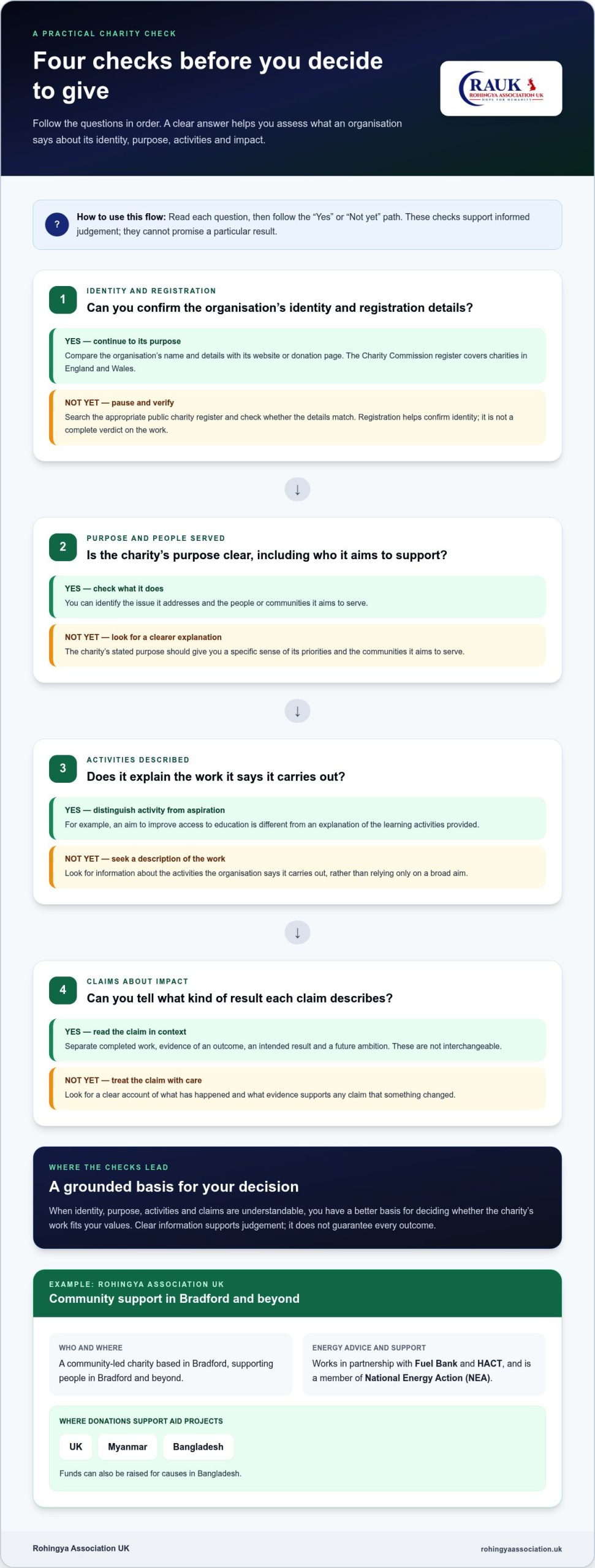
Assess a charity by looking separately at its identity, stated purpose and reported work. Ask: is this the organisation you intend to support, what does it aim to do, and what information does it provide about its activities? These checks won’t predict every result, but they can help you make an informed decision.
Use this sequence as a practical starting point:
- Check its identity and registration. Search the appropriate public charity register and compare the organisation’s name and details with those on its website or donation page. The Charity Commission register covers charities in England and Wales. GOV.UK provides official government guidance on charity regulation.
- Read its stated purpose. Look for a clear description of the issue the organisation addresses and the people or communities it aims to serve. The wording should give you a specific sense of its priorities.
- Look for described activities. Identify the work the organisation says it carries out. For example, an aim to improve access to education is different from an explanation of the learning activities it provides.
- Examine claims about impact. Distinguish completed work, evidence of an outcome, an intended result and a future ambition. Each can provide context, but they are not interchangeable.
Transparency means explaining a charity’s purpose, activities and use of support in terms people can understand; it doesn’t mean promising a particular result. Social challenges are complex, and a charity can describe its work responsibly without claiming control over every outcome. Clear information gives you a basis for judging its work on its own terms.
What should a donor look for in a charity’s information?
Look for a consistent account of the charity’s purpose, activities and use of donations. Pay attention to how it describes results. “We aim to” signals an intention; a statement about completed work describes an activity; a claim that something changed should explain what evidence supports it. Personal stories can help illustrate people’s experiences, but polished presentation or organisational size alone doesn’t establish effectiveness.
How can you choose between local and international causes?
Compare the issue addressed, the communities served, the activities described and the locations covered. A charity’s scope should be clear in its information. For international work, consider the context of the communities involved rather than assuming one response suits every situation. These questions can also guide your review of Rohingya Association UK’s published work, alongside the donation information relevant to your contribution.
Registration helps confirm an organisation’s identity; it is not a complete verdict on its work. Read the available information carefully, distinguish evidence from aspiration and decide whether its purpose is one you want to support.
Compare donation choices by purpose, reach and type of support
Different causes respond to different needs, so compare them by purpose, communities served and geographical reach rather than looking for a single “best” option. The table is a starting point; each charity’s actual activities and scope will vary.
| Type of support | Purpose | Potential reach |
|---|---|---|
| Local support | Help people access community support, practical guidance or opportunities for belonging. | A neighbourhood, town or local community. |
| Education | Support learning, skills and young people’s development. | A local area or communities served by a wider programme. |
| Humanitarian aid | Respond to hardship through practical assistance for people affected by crisis or displacement. | Communities in the UK or overseas, depending on the charity’s work. |
| Advocacy | Raise awareness and seek change on issues affecting rights and equality. | Local, national or international, according to the organisation’s focus. |
A donation’s intended use depends on the appeal wording and the work of the organisation receiving it. A general contribution may support wider charitable activities, while a donation described for a particular appeal is directed towards that stated purpose. Read the wording rather than assuming every gift funds the same service or reaches every location.
Which type of giving fits your priorities?
If your priority is responding to hardship, crisis intervention may align closely with your aims. If you’re drawn to sustained opportunity, education or community integration may be a better fit. Advocacy can address rights and justice beyond immediate material assistance. These approaches can complement one another: urgent help, learning and efforts to tackle inequality each have a role.
You can also choose how to give. A one-off gift lets you respond to an appeal or give when it suits you. Regular donations can provide continuing support for an organisation’s work, if that option is offered and suits your circumstances. Fundraising lets you invite others to contribute. Consider the purpose, the commitment involved and what feels manageable.
What is the difference between local and international giving?
Local support may help people connect with community services, access practical guidance and build belonging. International aid is shaped by the places and communities a charity serves, and its activities may differ from its work in the UK. Some organisations work in both local and international contexts, but that doesn’t mean every donation supports every project.
Before giving, read the charity’s stated geographical scope and the appeal description. If you’re considering whether to donate to a good cause UK or support international work, use the published purpose to guide your choice. Matching your priorities to the donation’s stated destination is a practical way to give with confidence.
Practical checks before giving to a good cause
Before contributing, check that the appeal matches your intention and your budget. These questions can help you make a considered choice without giving more than is comfortable.
- Purpose: What work does the donation description say it will support?
- Destination: Does it identify a project, community or location?
- Frequency: Is the contribution one-off or recurring?
- Affordability: Can you give this amount without financial pressure?
How can you understand where a donation goes?
Read the donation page and appeal wording closely. The description may refer to a specific project or to the organisation’s wider work. Don’t assume a contribution is reserved for a particular activity unless the wording says so. Check what the organisation says about the donation’s intended use. A stated purpose describes intent, not a guaranteed result for an individual.
If the wording doesn’t make the intended use clear, pause and review the information available on the donation page. Clear language should help you understand the purpose without needing to infer details that aren’t provided.
Should you make a one-off or regular donation?
A one-off contribution is made once; a regular donation is an ongoing commitment. Consider your circumstances and choose only a frequency and amount you’re comfortable sustaining. Neither option is automatically more suitable. You may also encounter Gift Aid: eligible UK taxpayers can authorise a charity to reclaim 25p for every £1 donated. Read the declaration carefully and make one only if you meet the current eligibility requirements.
Giving should be voluntary, not a source of strain. If you’d like to support RAUK’s community-led work, explore the donation options and read the stated purpose before contributing.
Donate to RAUK and support communities in Bradford and beyond
Rohingya Association UK (RAUK) is a community-led registered charity supporting Rohingya refugees, families and young people. Its work brings together practical assistance and longer-term community priorities. Understanding the breadth of its mission can help donors assess whether it reflects their values; the purpose shown with a donation is the best guide to what that contribution is intended to support.
How does RAUK connect practical support with longer-term community needs?
Crisis intervention and humanitarian aid address immediate pressures, while education, youth empowerment and integration focus on opportunity, participation and community connection. Advocacy and awareness work draw attention to wider issues affecting Rohingya people. These strands serve different purposes, but together recognise both urgent needs and the importance of building a stronger future. Donors interested in young people can consider how refugee youth empowerment programmes fit within that broader purpose.
What can donors do next?
Explore RAUK’s work and consider which part of its mission reflects your values. Read the stated purpose alongside the donation option so you understand what your contribution is intended to support. Choose freely and within your means.
A considered gift can express solidarity and shared responsibility, without promising a particular outcome for an individual.
Let your values guide your next step
A thoughtful decision to donate to a good cause UK communities can benefit from doesn’t need to be dramatic or perfect. Start with a clear understanding of the work, a purpose that reflects your values and a contribution that feels right for your circumstances. Giving is one way to stand alongside communities; learning about the work and sharing its purpose can also help build understanding and connection.
RAUK’s community-led work offers a way to put shared responsibility into practice. Read the stated purpose of the donation and consider how it aligns with the priorities that matter to you. Then choose freely, with confidence in the purpose you’re supporting.
Donate to support RAUK’s community-led work and help sustain a collective commitment to care, opportunity and belonging.
Frequently Asked Questions
Is RAUK a registered charity?
Yes. Rohingya Association UK (RAUK) is a community-led registered charity based in Bradford, with charity number 1211433. Search that number on the appropriate public charity register to check you have found the right organisation. A matching record confirms identity, but doesn’t endorse a particular appeal or guarantee a donation’s result. Consider separately whether the work and stated donation purpose fit your priorities.
Can I donate to a good cause if I can only give a small amount?
Yes. Give only what feels manageable, and don’t let a donation create financial pressure. If you want to donate to a good cause UK-wide, you can make a thoughtful choice by comparing the work and selecting a contribution that suits your circumstances. A one-off gift may be appropriate, or you might choose another form of support. Don’t assume a contribution will fund a specific service or outcome unless the charity says so clearly.
How do I know whether a charity is trustworthy?
No single sign settles that question, but checking information from more than one place can help you form a clearer picture. Compare the charity’s name on the public register with the name on its donation page, and read its reports or accounts if available. Check whether descriptions of its activities are consistent and whether claims are explained rather than presented as certainty. These checks support an informed judgement, not a guarantee of impact or a perfect fit for every donor.
What happens if I want my donation to support a specific project?
Check the donation page for wording that identifies a particular appeal or project, and distinguish this from a contribution described as general support. Don’t infer that your gift is restricted to one activity unless the charity says so. RAUK accepts public financial contributions for aid projects in the UK, Myanmar and Bangladesh. Read the donation information to understand the stated purpose before contributing.
Can I support a UK charity whose work also reaches Bangladesh?
Yes. A charity can work in the UK and overseas, though its activities and the communities it serves may differ by location. RAUK supports communities in Bradford and beyond, with projects in the UK, Myanmar and Bangladesh. That geographical scope doesn’t mean every donation is shared across every place or project. Read the information attached to a specific contribution to understand its intended destination and decide whether it reflects what you want to support.
Is Gift Aid automatically added to every charity donation?
No. Gift Aid isn’t automatic: it depends on the donor’s eligibility and the charity’s donation process. If you see a Gift Aid declaration, read it carefully and complete it only if the statements apply to you. Don’t treat it as a routine box to tick without understanding it. If you’re unsure about eligibility or the tax implications, check current official guidance before making a declaration.