
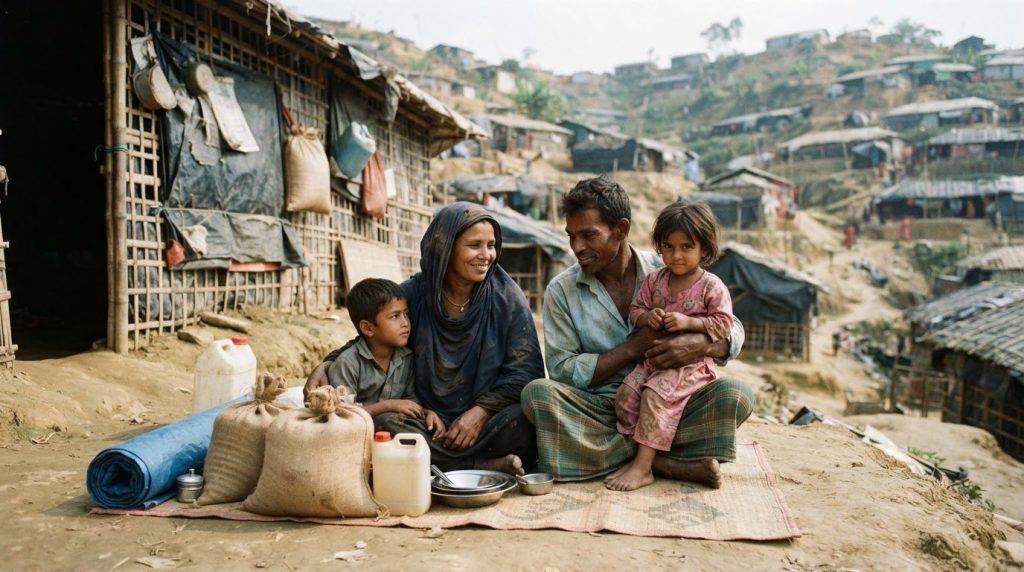
Rohingya refugees in Bangladesh face urgent needs for safe shelter, reliable food and access to education. If you want to donate emergency aid to refugee camps, it is reasonable to ask which assistance is most urgent, which organisation’s work fits your priorities and how your support can help Rohingya families today and in the future.
Emergency support can help families obtain food and shelter when living conditions are difficult. Continued investment in education helps children and young people learn, develop skills and maintain hope while their families remain displaced. Shelter, food and education are connected priorities in a protracted crisis.
This article explains the needs of Rohingya refugees in Bangladesh, with particular attention to shelter, food and education. It also outlines what to consider before making a voluntary donation and how RAUK connects humanitarian aid with longer-term community support. Read on to make an informed contribution while recognising that one donation cannot meet every need.
Key Takeaways
- Rohingya families in Bangladesh need safe shelter, dependable food and access to education.
- Emergency assistance can address immediate hardship, while education supports children and young people over time.
- Before donating, consider an organisation’s purpose, activities and geographic focus.
- RAUK accepts voluntary contributions for aid projects in Bangladesh, as well as in the UK and Myanmar.
- Support should respect Rohingya people’s dignity, agency, culture and aspirations.
Why donate emergency aid to refugee camps and displaced Rohingya families?
Emergency aid responds to urgent humanitarian needs when people face immediate hardship or have been forced to leave their homes. For Rohingya families in Bangladesh, this can mean support with safe shelter and food, alongside access to education for children and young people. If you are considering whether to donate emergency aid to refugee camps, start by understanding these needs and the people behind them.
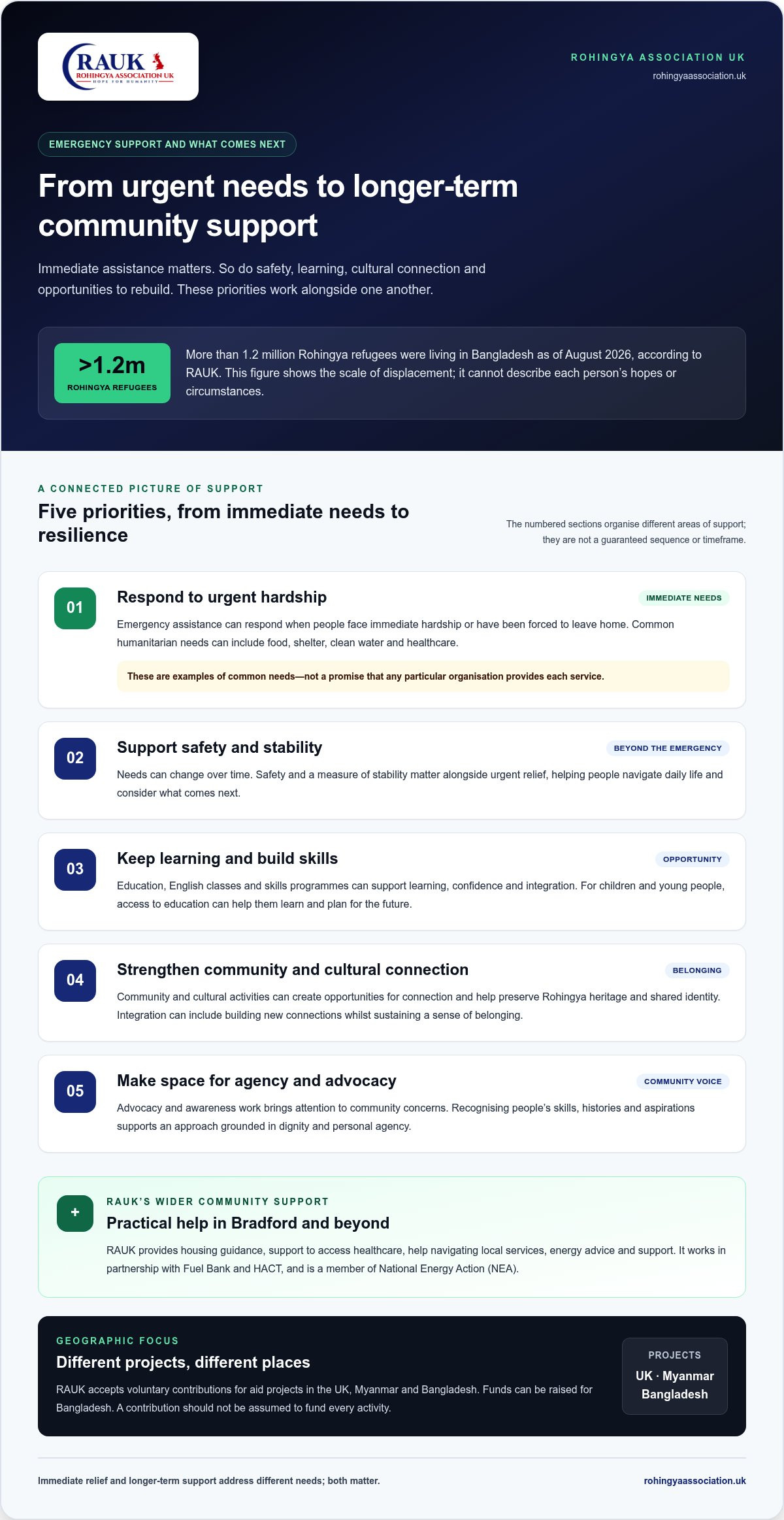
Rohingya Association UK states that more than 1.2 million Rohingya refugees were living in Bangladesh as of August 2026. Displacement affects people in different ways, and urgent needs can exist alongside the need for stability, learning and connection to cultural identity. Rohingya people are not defined by displacement alone: they have families, skills, histories and aspirations.
What can emergency aid mean for displaced people?
For Rohingya refugees in Bangladesh, urgent assistance can include help with shelter and food, depending on people’s circumstances and the organisation’s work. Education is also essential: children and young people need opportunities to learn and develop skills during displacement. These priorities are connected, but they are not a promise that any particular organisation provides each service.
A refugee camp is one setting where displaced people may seek shelter and support, but it cannot capture everyone’s experience. Needs can change over time, too. Help with immediate hardship matters, while education, safety and the chance to regain a measure of stability remain important beyond the first emergency.
Why is the Rohingya context important?
The Bangladesh context gives these needs a specific human reality. The scale of Rohingya displacement places pressure on shelter, food provision and educational access, while each person and family has different circumstances. Any response should recognise people’s dignity and agency rather than reducing them to a statistic.
Safety and hope involve more than immediate survival. Safe shelter protects families from exposure and instability, while reliable food helps people meet their daily needs. Access to education supports children and young people as they learn and plan for the future, and preserving cultural identity helps communities maintain heritage and belonging.
RAUK’s humanitarian approach connects emergency assistance with dignity and hope. Supporting shelter and food matters alongside sustained attention to education, cultural identity and the possibility of rebuilding.
How emergency support connects with longer-term refugee needs
Urgent assistance and longer-term support respond to different needs, but both belong in the same picture. Immediate help with shelter and food can address a crisis; education, skills and community connections can help Rohingya people navigate what comes next. Treating these priorities as competing choices overlooks how safety and stability can create space for learning and future plans.
For Rohingya families, rebuilding begins with practical needs such as safe shelter and sufficient food. It also includes access to education, maintaining cultural identity, strengthening community ties and having opportunities to shape the future. RAUK’s work brings together humanitarian support, education and youth empowerment, community integration, cultural activities and advocacy. These are distinct areas of work, so a voluntary contribution should not be assumed to fund every activity.
Why do emergency aid and long-term support belong together?
Immediate assistance responds to pressing circumstances, including the need for shelter and food, while longer-term support can help people pursue goals beyond the emergency. Education and skills development support learning and can help individuals build confidence and explore opportunities. This does not replace urgent help; it recognises that people need support in the present as well as the chance to plan ahead.
For RAUK, immediate relief responds to urgent needs, while ongoing community support helps uphold dignity, nurture hope and create space for people to rebuild. This distinction reflects the organisation’s approach, not a promise of a particular result or timeframe. It places safety, education and personal agency within a broader commitment to community resilience.
How can community support help families rebuild?
Practical guidance can make unfamiliar systems easier to navigate. RAUK provides housing guidance, support to access healthcare and help navigating local services. English classes and skills programmes support learning and integration, helping people build knowledge and participate more confidently in their communities. Each person’s circumstances differ, so this support is part of a wider process rather than a single solution.
Community and cultural events also create opportunities for connection and help preserve Rohingya heritage and shared identity. Alongside these activities, advocacy and awareness work brings attention to community concerns. Integration need not mean setting aside one’s heritage; it can include building new connections while sustaining a sense of belonging.
In the UK, RAUK provides support in Bradford and beyond, including energy advice and support. It works in partnership with Fuel Bank and HACT, and is a member of National Energy Action (NEA). These are examples of its wider community support, alongside aid projects in the UK, Myanmar and Bangladesh.
To support this work, explore voluntary support for Rohingya communities and donate now. Your contribution is voluntary and supports the organisation’s charitable work.
How to assess a donation to emergency aid for refugee camps
A considered donation starts with understanding what an organisation does, whom it supports and where it works. These details give you a clearer basis for deciding whether its purpose aligns with your priorities, without relying on dramatic appeals or assuming a contribution will produce a particular result.
Before you donate emergency aid to refugee camps, read the organisation’s donation information. Look for a clear description of its activities and geographic focus, and distinguish a voluntary contribution from a purchase or payment for a specified service. A donation supports charitable work; it does not buy a guaranteed outcome for a particular person or family.
What should donors understand before contributing?
Rohingya Association UK is a community-led registered charity supporting Rohingya refugees and families through humanitarian aid, community support and integration, education and youth empowerment, cultural activities and advocacy. It accepts voluntary contributions for aid projects in the UK, Myanmar and Bangladesh. These details explain the organisation’s focus, but do not mean that every contribution funds every area or has a specified use.
Consider the organisation’s stated purpose, activities and regions of work. Keep both immediate humanitarian needs and sustained community support in view. This can help you make a choice that reflects your priorities without treating urgent and longer-term work as interchangeable.
- Purpose: Is the organisation’s mission clear, and does its work relate to the needs you hope to support?
- Activities: Can you understand the broad kinds of work it undertakes, such as humanitarian aid, education or community integration?
- Geographic focus: Does the organisation explain where its projects operate?
- Donation information: Is the contribution described as voluntary, without promises of a particular individual outcome?
How can donors give with care and respect?
Giving thoughtfully also means considering how an organisation speaks about displaced people. Refugees are individuals with agency, identities and varied experiences, not a single story of hardship. Respectful communication recognises urgent needs without relying on distressing imagery, pity or unsubstantiated claims.
Look for language that treats people as members of families and communities, and recognises their aspirations as well as the challenges they face. Aid is not only about a present crisis; it is also about supporting dignity, safety and the possibility of a future shaped by the people concerned.
Informed giving does not require you to resolve every question about humanitarian work. It means reading available information, understanding an organisation’s stated focus and making a voluntary choice without expecting a guaranteed result. This approach respects both urgent need and long-term dignity, while helping you decide whether the organisation’s work fits your values.
How RAUK supports Rohingya communities in Bradford and beyond
Rohingya Association UK (RAUK) is a community-led registered charity supporting Rohingya refugees and families through community support, education, cultural activities, advocacy and crisis intervention. Its work links local support in the UK with aid projects in Bangladesh and Myanmar, recognising that needs differ across places and circumstances.
RAUK provides support in Bradford and beyond. Its UK partnerships and energy advice are part of this community work, while its aid projects in Bangladesh and Myanmar address needs in those locations. These different strands sit within the organisation’s wider focus, and a contribution should not be assumed to fund every activity.
What does RAUK do in the United Kingdom?
For people navigating life in the UK, practical guidance can make unfamiliar systems more manageable. RAUK provides housing guidance and support to access healthcare, helps people navigate local services, and offers support with essential needs. This assistance sits alongside community integration, education and youth empowerment, responding to practical concerns while creating room for people to connect and pursue their goals.
Education is part of that wider picture. English language classes support communication and participation in daily life, while youth skills development helps young people build knowledge and confidence. Cultural and community events also provide space for connection and for Rohingya heritage to be shared and preserved. Integration and cultural identity can strengthen one another.
RAUK provides energy advice and support as part of its UK work. These partnerships and membership relate to its UK community support.
How does RAUK’s wider work connect with Bangladesh?
RAUK’s project scope includes the UK, Myanmar and Bangladesh. According to the organisation’s published information, more than 1.2 million Rohingya refugees were living in Bangladesh as of August 2026. That dated figure conveys the scale of displacement, while each person’s circumstances and needs remain individual.
RAUK accepts voluntary contributions for aid projects in these locations. A contribution supports the organisation’s charitable work; it is not a promise that a particular amount will be assigned to one activity, reach a particular person or achieve a specific result. Read the donation information to understand the stated purpose and decide whether it reflects your priorities.
If you want to support RAUK’s work, donate now to support Rohingya communities. Your voluntary contribution can be part of a collective commitment to humanitarian support, education, cultural preservation and advocacy, grounded in respect for the people and communities involved.
Donate now to support emergency aid and Rohingya community resilience
Supporting Rohingya communities means recognising the urgent need for safe shelter and food, as well as the importance of education, hope and the ability to shape the future. Emergency assistance matters, while opportunities to learn, maintain cultural identity and build connections also support dignity. A voluntary contribution is one way to support this wider work, without assuming it will fund a particular activity or produce a guaranteed result.
What can a voluntary contribution support?
Rohingya Association UK accepts voluntary contributions for aid projects in the UK, Myanmar and Bangladesh. Its stated areas of work include crisis intervention, humanitarian support, education and youth empowerment, community integration, cultural activities and advocacy. For Rohingya refugees, these areas relate to different needs, including shelter, food and learning; a contribution should not be understood as restricted to a named camp, a specific item or an individual beneficiary.
Understanding this distinction helps donors consider the organisation’s broader focus without making assumptions about how a particular contribution will be allocated. Read the donation information, consider the stated project geography and decide whether the work aligns with your priorities. Giving should be an informed choice, not a response to pressure or a promise of a specific outcome.
Rohingya communities have their own identities, knowledge and aspirations. Support that respects people’s agency can stand alongside efforts to address urgent needs, strengthen education, sustain cultural heritage and encourage integration. Advocacy and awareness also form part of the wider picture, helping keep community concerns visible beyond the immediate moment of crisis.
How can readers take the next step?
If you’ve considered the purpose and scope of the work and would like to contribute, use RAUK’s donation route to make a voluntary contribution. Donate now if that feels right for you. This invitation does not set a required amount or promise a fixed result for any individual contribution.
You can also engage with the wider issues through thoughtful advocacy and by learning about Rohingya communities beyond headlines about displacement. Listening to community voices and sharing information with care can help uphold dignity, cultural identity and the principle that people affected by crisis should be recognised as active participants in their futures.
Shared responsibility does not mean speaking for Rohingya people; it means standing alongside them with respect for their agency, heritage and hopes. A contribution can be part of that commitment, supporting work across the UK, Myanmar and Bangladesh without reducing a community’s future to a single act of giving.
Donate now to support Rohingya communities and stand alongside Rohingya families through practical support and respect for community leadership.
Let your support stand with Rohingya communities
Choosing to donate emergency aid to refugee camps can be one part of a wider commitment to stand alongside Rohingya people with respect. Giving can support work that addresses immediate needs for shelter and food while also helping sustain education, dignity and the opportunity to shape the future.
RAUK brings humanitarian support together with community-led efforts. It is a registered charity, number 1211433, and its UK work includes support in Bradford and beyond, energy advice and support, partnerships with Fuel Bank and HACT, and membership of National Energy Action. These efforts sit alongside projects supporting Rohingya communities in Bangladesh and elsewhere.
A voluntary contribution is a personal choice. If you’re ready to take that step, donate now to support Rohingya communities. Every act of solidarity can affirm a simple principle: people affected by displacement deserve safety, dignity and the opportunity to shape their own futures.
Frequently Asked Questions
What does emergency aid for refugee camps usually include?
Emergency aid can include support for urgent needs such as food and shelter, depending on people’s circumstances and the organisation’s work. Education is another important priority for Rohingya children and young people living in displacement. RAUK accepts voluntary contributions for aid projects in the UK, Myanmar and Bangladesh, alongside its community and education work. Read the organisation’s donation information to understand its stated focus rather than assuming a contribution covers a particular form of aid.
Can I donate to support Rohingya refugees in Bangladesh?
Yes. RAUK accepts voluntary contributions for aid projects in Bangladesh, as well as in the UK and Myanmar. This describes the organisation’s project scope, not a promise that an individual donation will reach a particular camp, person or service. If you’ve read the donation information and wish to support its work, donate now through RAUK’s donation route. Your contribution is voluntary and does not guarantee a specific outcome.
How can I tell whether a refugee aid donation is trustworthy?
Start by checking whether the organisation clearly explains its purpose, the communities it supports, its activities and where its projects take place. Read its information carefully and separate published facts from assumptions about how a particular contribution will be used. RAUK describes work including community support, education, cultural events, advocacy and crisis intervention. These details can help you assess whether its stated focus aligns with your priorities before you choose to give.
Does emergency aid only provide short-term help?
No. Emergency assistance can address immediate needs such as shelter and food, while education, integration, skills development and cultural connection support different needs over time. These forms of help can sit alongside one another without being interchangeable. RAUK’s stated activities include crisis intervention, education and youth empowerment, community support, cultural events and advocacy for human rights protection and justice.
How many Rohingya refugees are living in Bangladesh?
Rohingya Association UK’s published information states that more than 1.2 million Rohingya refugees were living in Bangladesh as of August 2026. The date matters: this figure is a snapshot from the organisation’s published information, not a timeless or continuously updated total. It offers context for understanding the scale of displacement, but cannot describe individual circumstances, experiences or aspirations. Respectful support recognises both the wider context and the agency of Rohingya people.
What does Rohingya Association UK do to support refugees?
RAUK supports refugees through practical guidance and community programmes. Its activities include housing guidance, healthcare access, support with essential needs and help navigating local services, alongside education, English classes and skills development. Cultural and community events help sustain heritage and connection, while advocacy and awareness campaigns promote human rights protection and justice. RAUK also provides energy advice and support, works in partnership with Fuel Bank and HACT, and is a member of National Energy Action.