
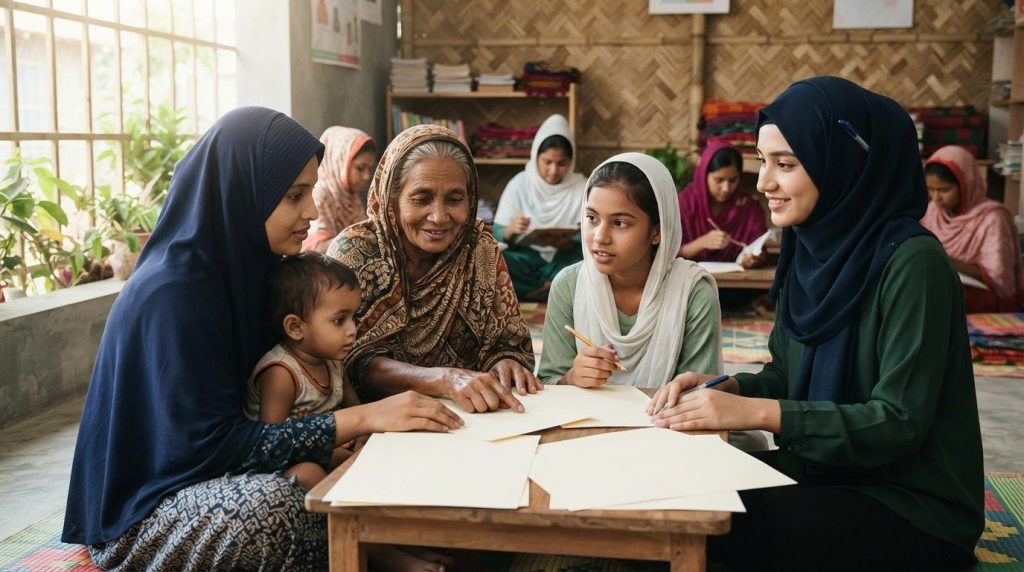
What if the challenges facing Rohingya women and girls are not one story, but many, shaped by displacement, gender and unequal access to safety, education and support? The challenges for Rohingya women and girls can differ across age, family circumstances and place of residence.
It’s understandable to focus on urgent needs, but immediate hardship is only part of the picture. Barriers can also affect women’s and girls’ choices and opportunities over time, while community knowledge, leadership and resilience remain central to how they respond.
This article explores the intersecting pressures women and girls may face, the differences in their lived experiences and the ways agency is expressed. It also considers what practical, respectful support can do to uphold dignity, access and rights, without reducing people to their needs.
In the UK, Rohingya Association UK (RAUK) is a community-led charity providing support in Bradford and beyond, including energy advice and support. RAUK works in partnership with Fuel Bank and HACT, and is a member of National Energy Action (NEA). Its wider community, education and advocacy work sits alongside fundraising that can support projects in Bangladesh.
Key Takeaways
- Understand how the challenges for Rohingya women and girls can differ according to age, family circumstances, location and access to support.
- Consider safety, education, health and participation as connected areas, while distinguishing documented evidence from general context.
- Compare barriers in Bangladesh and the UK carefully; different settings call for different forms of support and evidence.
- Use a respectful approach: listen, reduce access barriers, support choice and review what works with participants.
- RAUK provides support in Bradford and beyond, including energy advice and support; it works in partnership with Fuel Bank and HACT and is a member of National Energy Action (NEA).
Why challenges for Rohingya women and girls must be understood in context
The challenges for Rohingya women and girls are shaped by more than gender alone. Displacement, access to education and services, family responsibilities, age and personal circumstances can interact in different ways. Understanding that context helps avoid a single story of vulnerability and recognises women and girls as people with knowledge, relationships, choices and agency.
Rohingya people have experienced persecution and violence in Myanmar, followed by displacement. The Rohingya genocide page provides historical background on this violence and its consequences. For families living in Bangladesh, including in Cox’s Bazar, displacement may mean adapting to unfamiliar or temporary living conditions while facing uncertainty about the future. The circumstances of people resettled in the UK are different: they are building lives in a new country, where language, services, community connections and settlement needs may shape daily experience. These settings should not be treated as interchangeable.
How displacement can shape everyday life
Displacement can disrupt familiar routines, work and learning, and may separate relatives or weaken access to established support networks. Uncertainty can also affect how families plan for education, health and daily responsibilities. These are possible pressures, not a description of every household. People’s experiences differ according to where they live, their family circumstances and the support they can access; one person’s account cannot stand for an entire community.
Why age, gender and circumstance matter
Girls and adult women may encounter different barriers and have different priorities. A girl’s access to learning, safety and opportunities to participate may be shaped by her age and family situation, while adult women may also be balancing caregiving, health needs and decisions affecting the household. Neither group is uniform, and these examples should not be assumed to apply to everyone.
Intersectional challenges arise when factors such as age, gender, displacement, disability or access to resources overlap and shape a person’s opportunities and barriers. This is a way to understand how circumstances can combine, not a claim that every Rohingya woman or girl faces the same combination. Listening to individual priorities, rather than making assumptions based on identity, is essential to understanding what support may be appropriate.
A dignified, evidence-led account therefore holds two truths together: displacement can create serious constraints, and women and girls retain agency, skills and varied ambitions. That distinction provides a sounder basis for understanding their experiences and responding with respect.
How barriers can affect safety, education, health and choice
Barriers to safety, education, health care and participation can reinforce one another, but they are distinct concerns. Their effects depend on a person’s circumstances and the systems around them, not on any personal failing. For some women and girls, restricted access to information or services may narrow available choices; others may have different priorities, resources and support.
Education, information and opportunities to participate
Displacement or limited access to learning can interrupt education and make it harder for young people to build skills or consider future opportunities. The reasons may vary by context and individual circumstances. Clear, accessible information and supportive learning environments can help young people understand their options and take part in decisions that affect them. Education is not only about attending classes; it can also support confidence, connection and the ability to make informed choices. For related context on young people in the UK, read about refugee youth empowerment programmes.
Safety, wellbeing and access to support
Safety concerns and experiences of harm can affect wellbeing, yet it’s important not to assume that every woman or girl faces the same risks. The Council on Foreign Relations discusses risks for women and girls in the refugee crisis, including concerns related to health, sanitation and violence. Such concerns need careful attention without defining people solely by vulnerability or asking them to recount distressing experiences to be heard.
Help-seeking can also be shaped by whether information is understandable, support feels trustworthy and services are practically accessible. Language differences, unfamiliar systems, concerns about privacy or difficulty reaching a service may affect whether someone seeks help. These are potential barriers, not assumptions about any individual. Respectful support makes room for people to explain what they need and how they wish to proceed.
Health and participation are connected
Health needs may intersect with safety, daily responsibilities and access to reliable information. At a general level, barriers to reaching or understanding support can make it harder to seek advice or make informed decisions. Participation matters too: women and girls should be able to express their priorities in discussions about services and community life, rather than have others speak for them by default.
In the UK, community support can help people access information and feel more connected as they settle. Rohingya Association UK provides support in Bradford and beyond, including energy advice and support; it works in partnership with Fuel Bank and HACT, and is a member of National Energy Action (NEA). Readers can learn more about Rohingya Association UK’s community support.
What can make support harder to reach in Bangladesh and the UK?
Support is shaped by where a person lives and how services are organised. Bangladesh and the UK are different settings, with distinct systems, pressures and forms of assistance; comparing them does not mean treating Rohingya women’s and girls’ experiences as the same. Nor does resettlement automatically remove every barrier. Language, unfamiliar processes, household pressures and the time needed to build social connections may still affect access after arrival.
Displacement and access barriers in Bangladesh
In Bangladesh, displacement and location can influence how people reach learning, health and protection services. In camps, distance, service availability and changes in humanitarian provision may affect access, but the impact on an individual depends on her circumstances. Avoid assuming that one camp or family’s experience represents all Rohingya women and girls. The Rohingya refugee camp guide offers wider context on camp life.
Resettlement, inclusion and practical barriers in the UK
In the UK, families may be learning how to use unfamiliar services whilst adapting to a new community. Language access, understanding processes, transport, caring responsibilities and limited social connections can each affect whether support feels reachable. These are possible barriers, not a checklist that applies to every household. Practical needs can also include energy advice and support as families settle. Rohingya Association UK provides support in Bradford and beyond, works in partnership with Fuel Bank and HACT, and is a member of National Energy Action (NEA). For broader UK context, see this guide to community support for displaced families.
The table highlights questions to consider, rather than claiming that every barrier is present. Evidence should be specific to the place, service and people concerned.
| Context | Possible access barrier and evidence needed |
|---|---|
| Bangladesh, including camp settings | Location or service availability may affect access. Check current, location-specific information about service provision and access before drawing conclusions. |
| UK resettlement | Language, unfamiliar systems or household pressures may make support harder to use. Evidence should reflect the experiences of the people and communities concerned. |
A careful account of the challenges for Rohingya women and girls distinguishes documented conditions from possibilities, and asks whose experience the evidence represents. That makes it easier to recognise gaps without turning assumptions into facts.
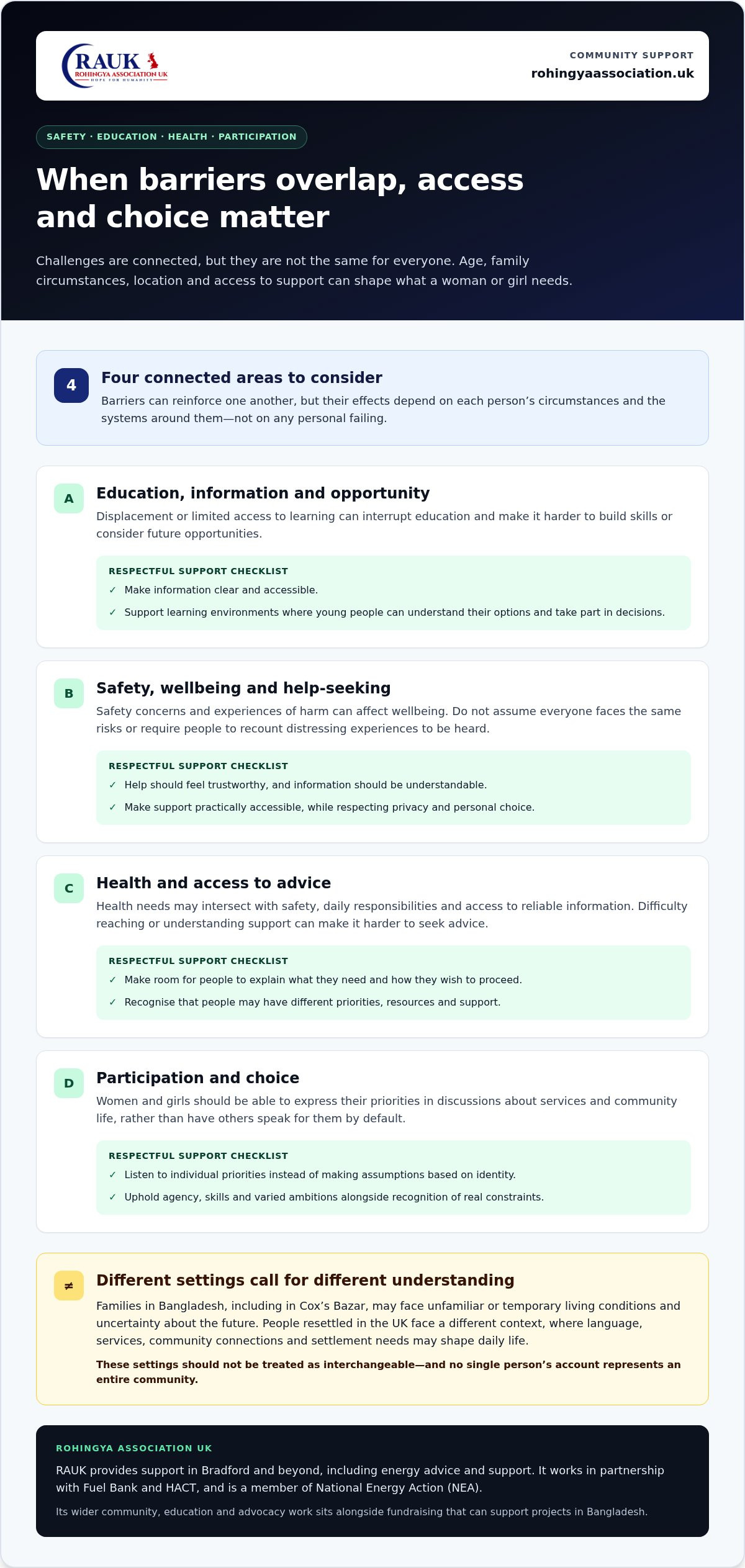
What does respectful, effective support for Rohingya women and girls involve?
Support is most respectful when it responds to people’s stated priorities rather than assumptions about what they need. The challenges for Rohingya women and girls can vary, so a sound approach protects dignity, respects cultural identity and makes room for different perspectives. Outside supporters can offer resources and remove barriers, but decisions should not be made on women’s and girls’ behalf.
Put women’s and girls’ voices at the centre
Listening means more than inviting people to a meeting. Consultation has limited value if priorities are already fixed or participants cannot influence how support is designed and delivered. Meaningful participation gives women and girls appropriate ways to share views, understand the choices available and shape decisions that affect them. For girls, participation should also take account of age and circumstances.
Trust matters. Clear explanations, accessible communication and respect for privacy can help people decide what they wish to share. Confidentiality should be treated carefully, with information handled respectfully and without pressuring anyone to disclose personal experiences. Participation must be genuine, not a symbolic gesture.
Support is most effective and respectful when it strengthens women’s and girls’ agency, rather than replacing their judgement with someone else’s.
Connect immediate support with long-term opportunity
Practical assistance can address an immediate concern, while access to education, skills development and community life can support people to pursue their own longer-term priorities. These areas may complement one another, but no single form of support guarantees a particular outcome. Families and community networks can provide connection and encouragement; their role should sit alongside, not override, each person’s choices.
A useful sequence is:
- Listen: Ask what matters to the person and how they prefer to take part.
- Remove access barriers: Make information and participation as accessible as possible, taking account of language and practical circumstances.
- Support choice: Explain options clearly and respect a person’s decision, including their choice not to participate.
- Review together: Invite participants to say what is useful, what is not working and what should change.
This approach applies across different settings, but the practical response should reflect local circumstances. In the UK, community support and education can contribute to inclusion and access; wider advocacy can also keep attention on human rights and accountability. For further context, read about justice for Rohingya people.
Rohingya Association UK is a community-led charity providing support in Bradford and beyond, including energy advice and support. It works in partnership with Fuel Bank and HACT, and is a member of National Energy Action (NEA). Explore community-led support and advocacy.
How community-led support in Bradford and beyond can contribute
Community-led organisations can help make support more accessible by understanding local circumstances and building connections with the people they serve. Rohingya Association UK (RAUK) is a community-led charity providing support in Bradford and beyond. Its work includes community integration, education, skills development, cultural events, crisis intervention and human-rights advocacy. This wider approach recognises that the challenges for Rohingya women and girls can differ between individuals and families.
Community support that recognises different needs
Integration involves practical matters as well as a sense of belonging. Access to housing guidance, healthcare, English classes and skills development can all affect how people settle and take part in community life. These areas are connected, but each family’s needs and priorities are different. Support should help people understand options and access relevant information without making decisions for them.
Education and skills development can create opportunities to build knowledge and confidence. Cultural and community events can also offer space for connection and help preserve heritage across generations. These forms of support are most meaningful when they respect individual choice and recognise the strengths people bring to their new communities. They can complement women’s and girls’ own agency, not replace it.
For families settling in the UK, energy advice and support can be one practical part of community integration. RAUK provides this support, works in partnership with Fuel Bank and HACT, and is a member of National Energy Action (NEA). These relationships sit alongside its broader community work; no single form of assistance addresses every need.
From local understanding to wider advocacy
Community-led support can connect day-to-day concerns with sustained efforts to advance human rights. RAUK’s advocacy and awareness work spans the UK, Myanmar and Bangladesh. This wider focus matters because practical support and public attention serve different, complementary purposes: one can help people engage with immediate needs, whilst advocacy keeps human-rights protection and the circumstances of Rohingya communities in view.
Local understanding also helps prevent broad assumptions from shaping how needs are described. Listening to people, respecting their choices and recognising differences within the community can make support more responsive. Community organisations can contribute through connection, education and advocacy, while the voices and priorities of Rohingya women and girls remain central.
To learn more about RAUK’s community-led work, explore its support and advocacy in Bradford and beyond.
Support dignity, choice and opportunity
The challenges for Rohingya women and girls are shaped by displacement and unequal access, but their experiences are not all the same. Age, family circumstances and location matter. So does recognising women’s and girls’ agency: respectful support listens, reduces barriers and gives people meaningful influence over decisions that affect them.
Practical help and sustained advocacy each have a role. Community-led support can strengthen access to information and connection, whilst broader human-rights advocacy keeps attention on the conditions Rohingya communities face. Neither should replace people’s own priorities or choices.
Rohingya Association UK is a community-led registered charity based in Bradford, providing support in Bradford and beyond. Its work includes energy advice and support, in partnership with Fuel Bank and HACT; RAUK is also a member of National Energy Action (NEA).
Learn about RAUK’s community support and advocacy. Respectful action begins by listening and grows through partnership, dignity and shared commitment.
Frequently Asked Questions
What are the main challenges for Rohingya women and girls?
Challenges can include displacement, interrupted learning, difficulty accessing healthcare or reliable information, safety concerns and limited influence over decisions. These are among the challenges for Rohingya women and girls, but they don’t describe every person’s experience. Age, family responsibilities, location and available support all matter. For a clear picture, distinguish documented conditions in a specific place from general possibilities, and avoid presenting women and girls only as vulnerable.
Why may Rohingya women and girls face distinct challenges during displacement?
Displacement can unsettle familiar routines, separate people from support networks and interrupt education or access to services. Gender and age may shape how a person experiences these changes, whilst family circumstances and location also matter. These pressures arise from conditions and barriers around people, not from Rohingya identity itself. Women and girls have varied skills, priorities and choices, so explanations should recognise agency as well as hardship.
How can displacement affect education for Rohingya girls?
Displacement may interrupt schooling or make continuing education harder when routines, learning arrangements or access to information change. The effect depends on the individual and setting, so don’t assume the same barriers or outcomes for all girls. Accessible information and supportive learning environments can help young people understand their options and participate. Listening to girls themselves is essential: their interests and ambitions should inform how education and opportunity are discussed.
What barriers can Rohingya women face when seeking support in the UK?
Possible barriers include language differences, unfamiliar services, practical household pressures and limited social connections, though these don’t apply to everyone. Clear information, respectful communication and space to explain individual priorities can make support easier to approach. Rohingya Association UK (RAUK) is a community-led charity providing support in Bradford and beyond. It provides energy advice and support, works in partnership with Fuel Bank and HACT, and is a member of National Energy Action (NEA).
How can people support Rohingya women and girls respectfully?
Start by listening to Rohingya women and girls, respecting their choices and treating their knowledge of their own lives seriously. Protect privacy, share information responsibly and support reliable, community-led work. Avoid sensational language and images or stories that compromise dignity. Practical support should make information and opportunities more accessible, whilst leaving decisions with the people concerned. Respectful action strengthens agency rather than speaking over those it aims to support.
Why is community-led support important for Rohingya families?
Community-led support can connect families with practical assistance, learning and community life while drawing on an understanding of local circumstances. Rohingya Association UK supports families in Bradford and beyond through work that includes housing guidance, healthcare access, education, English language classes and skills development. Its community and advocacy work can complement wider efforts, but it cannot by itself resolve structural barriers or replace people’s own decisions.