

Community cohesion is built through more than one-off events: it grows when people can contribute, connect and see their voices reflected in local decisions. Community cohesion projects in Bradford show how volunteering, shared cultural activities and meaningful community engagement can help strengthen belonging.
It’s understandable to look for evidence that a project makes a difference, not just brings people together for a day. This article explores Bradford examples of projects that support volunteering, engage communities, fund events and measure cohesion outcomes. You’ll see how partnerships and sustained participation can build stronger local connections, and which practical outcomes organisers can track. Rohingya Association UK supports refugees, families and young people in Bradford and beyond through community support, education and cultural activities.
Key takeaways
- See how volunteering and community networks can create lasting opportunities for people to connect and contribute.
- Learn why trust, partnership and residents’ perspectives matter when shaping community cohesion work.
- Explore ways to assess outcomes, including whether participation and connections between communities grow over time.
- Discover examples of Bradford initiatives and the different roles organisations can play in supporting local engagement.
- Find out what to consider when planning an event or project so it reflects community needs and encourages meaningful involvement.
Table of Contents
Belonging, community networks and volunteering
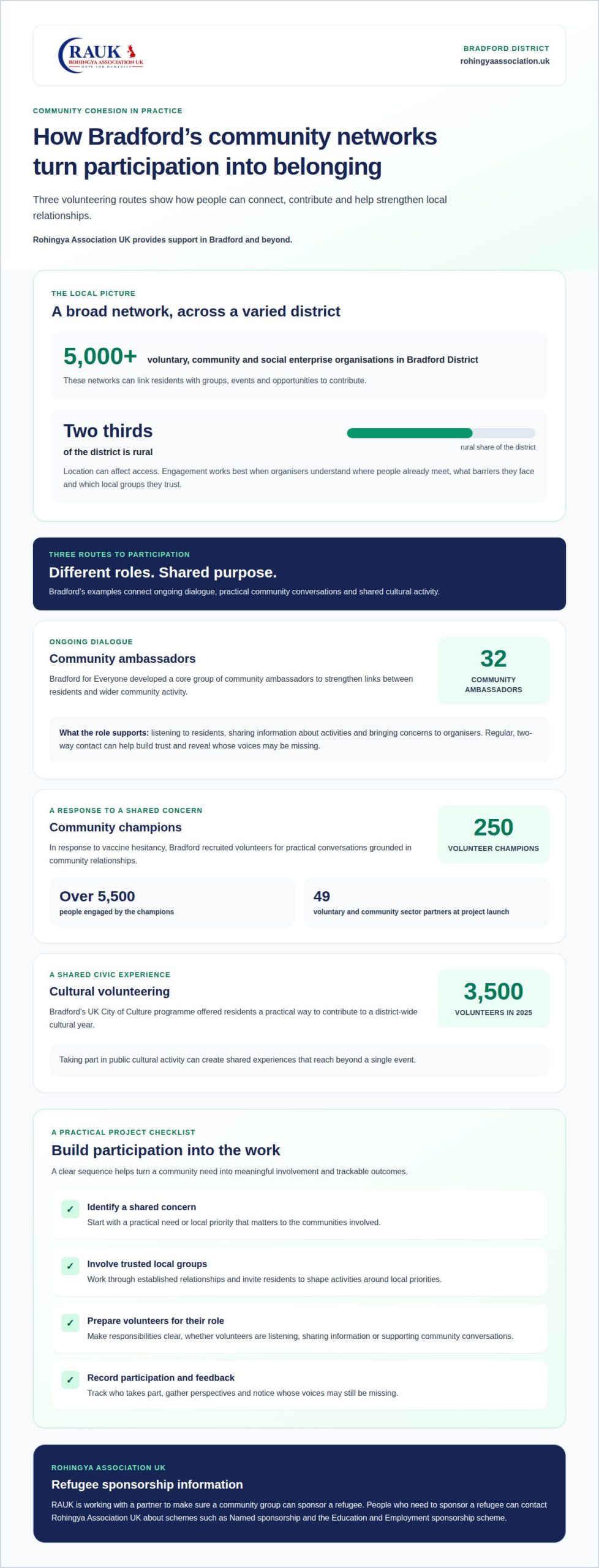
Bradford’s community projects build belonging through shared activity and local participation. Bradford District has more than 5,000 voluntary, community and social enterprise organisations. These networks can connect residents with groups, events and opportunities to contribute. They also provide routes for communities to shape activities around local priorities, rather than relying on one-way outreach.
The examples span Bradford District, bringing residents together in urban and rural communities. Two thirds of the district is rural, so location can affect access to activities and volunteer roles. Effective engagement starts with understanding where communities already meet, what barriers limit participation and which local groups residents trust.
Community ambassadors connect residents
Situation: Bradford for Everyone sought ways to strengthen links between residents and wider community activity. Action: It developed a core group of 32 community ambassadors. Result: The network provides a recognisable route for sharing local perspectives and encouraging participation. Ambassadors can help make engagement more accessible by drawing on relationships within their own communities.
A practical ambassador network needs clear roles. Members can listen to residents, share information about activities and bring concerns to project organisers. Regular contact helps organisers identify who is participating and whose voices may be missing. The value lies not only in sharing messages, but also in building trust through consistent, two-way communication.
Community champions mobilise volunteers
Situation: Vaccine hesitancy required communication grounded in community relationships. Action: Bradford recruited a volunteer team of 250 community champions. Result: The champions engaged with over 5,500 people. This example shows how a defined public need can bring volunteers together around practical conversations, with engagement recorded as a tangible outcome.
During the pandemic, Bradford’s community champions project launched with 49 voluntary and community sector partners. Partnership gave local organisations a role in reaching residents through established relationships. For future projects, organisers can apply the same sequence: identify a shared concern, involve trusted groups, prepare volunteers for their role, then record participation and feedback.
Volunteering creates shared experiences
Situation: Bradford’s UK City of Culture programme created opportunities for residents to contribute to a district-wide cultural year. Action: The programme brought together 3,500 volunteers in 2025. Result: Volunteering became part of a large shared civic programme, giving residents a practical way to participate in public cultural activity.
These cases show different routes to belonging: ambassador roles support ongoing dialogue, champions respond to a specific concern, and cultural volunteering creates shared experiences. Together, they show how community networks can turn participation into relationships that last beyond a single event.
Community cohesion and engagement
Bradford’s Cohesion and Inclusion Framework sets a vision for a more cohesive, fair and confident district from 2025 to 2030. Its approach connects partnership, trust and community engagement, recognising that residents should help shape the work affecting their lives.
The available local examples do not support ranking Bradford’s projects against initiatives in other West Yorkshire towns. A more useful comparison is how each area responds to its communities. Bradford’s framework brings partners and residents into that process.
Residents help shape local priorities
Situation: Bradford Council needed a district-wide approach to cohesion and inclusion. Action: It developed its strategy with partners from health, policing and civil society, alongside perspectives from organisations and residents. Result: The framework sets a shared direction for 2025 to 2030, linking community experience with wider public-sector planning.
Consultation also informed Bradford’s Stronger Communities refresh and Bradford for Everyone, involving 1,500 respondents. In June 2025, stakeholder engagement and community consultations reached an additional 400 respondents across the district. These figures show two practical ways to involve people: gather views during strategy development, then extend engagement through district-wide conversations.
Bradford’s schools have 165 languages spoken among their communities. That context makes accessible communication important: organisers need ways to hear from residents with different experiences, not simply count attendance. Consultation is more useful when people can describe local priorities and understand how their input contributes to decisions.
Address challenges through connected work
Situation: Cohesion work intersects with issues that shape daily life. Action: Bradford Council’s strategy treats worklessness, women’s safety and space for difficult conversations as cross-policy issues. Result: These concerns form part of a wider cohesion approach, rather than being separated from community relationships.
These issues can also affect engagement. A meeting may not feel accessible to residents with safety concerns, while difficult conversations can undermine trust if people feel unheard. Projects can respond by setting clear purposes, making space for differing views and connecting community feedback with relevant policy work.
A practical engagement cycle starts by identifying affected communities and inviting their perspectives through suitable local channels. Organisers can record who contributed, which themes emerged and how those views shaped decisions. Bradford’s consultations show how to reach people at both strategy and district level. The next step is to maintain those relationships as plans develop.
Well-designed community-led engagement gives residents a practical way to contribute local knowledge, influence activities and remain involved as projects develop.
Bradford was selected as one of the government’s five integration areas. Bradford Council’s Cohesion and Inclusion Framework aligns with the Anti-Poverty Strategy for 2022-27, linking cohesion with action on hardship.
Bradford for Everyone’s Partner Forum meets four times a year, giving partners a regular place to share perspectives and sustain dialogue. These connections can keep community engagement linked to wider policy work.
Measuring cohesion and community outcomes
Counting attendance shows reach, but it cannot alone establish stronger community relationships. Bradford for Everyone offers a documented example of outcome measurement: an independent evaluation found a 12% increase in residents reporting the measured outcome across 2018-2023. That result indicates change in a specific measure over time. Its meaning depends on understanding what was measured and how residents responded.
Situation: Bradford for Everyone needed to assess whether its work related to residents’ reported experiences. Action: An independent evaluation examined outcomes over 2018-2023. Result: Residents reporting the measured outcome increased by 12%. This is evidence of change in that measure, not a count of people attending events or volunteering.
Separate activity from change
For community cohesion projects in Bradford, distinguish what happened from what changed. Attendance records show an event’s reach; feedback can show whether participants felt heard or made new connections. A volunteering initiative can record involvement, then explore whether volunteers stayed involved or built relationships beyond the activity. These measures capture different things, so label them clearly in reports.
Counting attendance shows reach. It does not show whether a community is actually stronger than it was.
A practical measurement plan can follow these steps:
- Set a starting point. Record participants’ views before an activity, using the same questions planned for later feedback.
- Track participation. Note attendance, repeat involvement and which groups the activity reached.
- Gather reflections. Ask participants what changed in their sense of connection, trust or ability to take part.
- Review over time. Compare later responses with the starting point, while describing who took part.
These steps distinguish an immediate response from a lasting pattern. Positive comments after one gathering reflect participants’ immediate experience; continued involvement in later activities suggests ongoing engagement. Neither measure alone proves district-wide cohesion, so reports should state the scale and limits of each finding.
Use findings to improve delivery
Bradford for Everyone’s evaluation illustrates why a defined outcome matters. A reported increase is meaningful when readers can identify the measure, period and population represented. The 2018-2023 finding gives a period and a change; future reporting can be clearer by explaining the question asked and who responded. This gives communities a stronger basis for interpreting results.
For community cohesion projects in Bradford, findings can guide practical decisions. If feedback identifies barriers to participation, organisers can adjust how activities are communicated or delivered, then gather feedback again. If repeat involvement is low, they can explore participants’ reasons before changing the programme. Recording decisions alongside findings shows how evidence informed action.
Examples of community cohesion projects in Bradford can report reach, participant experience and evidence of change separately. Bradford for Everyone’s evaluation offers a concrete outcome example. A consistent measurement plan can help other initiatives understand whom they serve and where engagement needs strengthening.
What community cohesion projects are currently active in Bradford?
Bradford’s Cohesion and Inclusion Framework covers 2025 to 2030, providing a current district-wide direction for this work. Practical initiatives sit alongside that framework, including community-based coordination and employer engagement. Their focus ranges from connecting residents with local support to encouraging fairer participation at work.
Area Officers support community-level connections
Situation: Bradford District needs cohesion work that reflects different local circumstances. Action: Five Area Officers are embedded in communities across the district. Result: This provides local points of connection for understanding community priorities and supporting engagement. Their role links district-wide aims with neighbourhood experience.
For residents and community groups, local coordination matters because it is close to everyday concerns. An Area Officer can connect community perspectives with wider activity, rather than treating every neighbourhood as having the same needs. To assess whether an initiative is relevant, consider its stated purpose, the communities it engages and how local views inform its work.
Employers take part in inclusion work
Situation: Workplace participation is one part of wider community inclusion. Action: More than 40 employers joined Bradford’s inclusive employer toolkit initiative. Result: Employers became involved in a shared approach to inclusion. The initiative shows how cohesion activity can reach beyond events and neighbourhood settings into working life.
Employers can use inclusion tools to consider how workplace practices affect participation and belonging. When exploring this example, ask which employers took part, what the initiative sought to change and how progress was assessed. These details distinguish participation in a programme from evidence of a changed workplace experience.
Separate current work from earlier programme results
Bradford District Council’s community cohesion programme launched more than 70 projects and engaged 25,000 people. These figures describe the programme’s reach, but they do not establish that every project remains active. Treat them as evidence of previous delivery, not as a live directory of opportunities.
Situation: A district-wide programme sought to expand community cohesion activity. Action: It launched projects and engaged residents. Result: Its reported reach exceeded 70 projects and 25,000 people. This example demonstrates scale; a current framework or initiative needs separate evidence of its present activity.
Bradford for Everyone launched in March 2019 and was scheduled to run until 2022, so it should be understood as a time-limited programme. For a current picture, distinguish that legacy from the 2025-2030 framework, the five embedded Area Officers and the employer toolkit initiative. Checking each project’s purpose, delivery partners and recent activity helps readers identify what is operating now, rather than relying on historic reach alone.
Which organizations run community cohesion projects in Bradford?
Bradford Council, voluntary organisations and community partners all contribute to local cohesion work. Their roles differ: the council can set a district-wide direction, while community organisations bring local knowledge and relationships. Health services, police and civil society partners can also contribute when projects address shared community concerns.
Bradford Council sets direction and coordinates partners
Situation: Bradford needed a shared approach to cohesion and inclusion across the district. Action: Bradford Council developed its Cohesion and Inclusion Framework with partners from health, police and civil society. Result: The framework sets a vision for a more cohesive, fair and confident district from 2025 to 2030. It gives organisations a common direction without making every local project identical.
To understand who is responsible, distinguish strategy from delivery. Bradford Council’s framework sets out a district-wide vision; individual projects may be delivered through partnerships or local organisations. This explains how the council can coordinate priorities while community groups shape activities around residents’ experiences.
Partner networks connect organisations
Situation: Bradford for Everyone brought organisations together around integration and cohesion. Action: Its Partner Forum engaged more than 600 organisations and met four times a year. Result: The forum created a recurring structure for organisations to share information and maintain connections. Its scale illustrates how partnership can extend beyond one lead organisation.
Bradford has more than 5,000 voluntary, community and social enterprise organisations. That broader network means local initiatives can draw on distinct community relationships and expertise. A useful partnership begins by agreeing each organisation’s role, the community or issue it will engage, and how partners will share learning.
Community groups bring local knowledge
Situation: District strategies need insight into how policies affect residents and communities. Action: Bradford’s cohesion strategy was shaped by partnership, trust and community engagement, with contributions from organisations and residents. Result: Community experience informed the framework’s development, connecting institutional planning with local voices.
Voluntary and community organisations can make that connection practical. They can gather views, share project information through trusted relationships or bring residents together around shared activities. Their contribution is strongest when residents can influence decisions, not simply attend events planned elsewhere.
To understand a project’s structure, identify its lead body, delivery partners and how residents can get involved. Bradford’s examples combine council coordination, cross-sector partnership and community participation. Each plays a different role in sustaining cohesion work across the district.
Rohingya Association UK
Rohingya Association UK supports community connection through Community Support & Integration, Education & Youth Empowerment, Cultural & Community Events, and Advocacy & Awareness Campaigns. These activities help refugees, families and young people participate in community life and build local connections.
Community groups interested in sponsoring a refugee can contact Rohingya Association UK. The organisation works with partners to help community groups sponsor refugees through schemes such as Named Sponsorship and the Education and Employment Sponsorship Scheme. These options can help groups identify a route that suits their plans.
If you’re exploring community support, events or refugee sponsorship, contact Rohingya Association UK to discuss your needs.
Turn shared priorities into lasting connection
The next step for Bradford’s community cohesion projects is to keep participation open beyond a single meeting or event. A local priority can become the starting point for sustained collaboration when residents, community groups and partners have clear ways to contribute and stay involved.
Start with an issue that matters locally. Bring together the people affected, agree what progress would look like and make space to review changes as the work develops. This approach treats residents as active partners, not simply recipients of decisions made elsewhere. It also gives community groups a practical way to turn concern into constructive action.
Rohingya Association UK can be a point of contact for people exploring community participation and support in Bradford. If you have an idea, a local concern or want to discuss how to contribute, contact Rohingya Association UK. Stronger connections grow through steady effort, shared responsibility and the conviction that every voice can help shape what comes next.
Frequently Asked Questions
What are the goals and activities of Bradford community cohesion initiatives?
Bradford initiatives aim to strengthen belonging, participation and relationships across communities. Activities can include shared cultural events, volunteering, community conversations and projects that help residents contribute to local priorities. An event might bring people together around shared interests, while a discussion can make space to raise concerns and exchange perspectives. Strong projects make participation meaningful, rather than treating attendance alone as evidence of connection.
How can residents join or volunteer with community cohesion projects in Bradford?
Residents can start by contacting a local community organisation or activity organiser and asking about available roles and ways to participate. Volunteering might involve welcoming attendees, helping with an event or contributing local knowledge to a project. Explain the time you can offer and the causes or communities you want to support. Organisers can then discuss suitable ways to get involved.
What funding and grants support community cohesion projects in Bradford?
The article does not specify any current funding or grants available in Bradford for community cohesion projects. Groups should check current opportunities directly with Bradford Council and relevant funders, as availability and eligibility may change. Before applying, they should confirm the fund’s criteria, deadlines and eligible costs, and explain the local need, planned activities, intended beneficiaries and how progress will be reported.
How does Bradford Council measure the impact of community cohesion projects?
Bradford Council can assess a project by considering whether its activities advance the district’s cohesion priorities and what residents report about their experience. For accountability, a project record can link its original aims with delivery decisions, feedback and changes made in response. This explains not only what happened, but how learning shaped the next stage and whether the project remained responsive to community needs.
Which neighbourhoods and communities in Bradford do these projects serve?
The projects span Bradford District’s urban and rural communities; two thirds of the district is rural. Engagement includes residents with varied experiences, and Bradford schools have 165 languages spoken among their communities.