

Policy change begins when concern becomes organised action. Understanding how to advocate for refugee rights means supporting fair asylum policies, contacting elected representatives with clear, specific requests, bringing community groups together and sharing accurate information. Consistent, informed advocacy helps keep protection, dignity and safety at the centre of public decisions.
It can be hard to know where to begin, especially when policy debates feel complex or distant from everyday life. But people can make a meaningful contribution by learning about the issues, listening to refugees and working with others committed to fairness.
This article explains practical ways to support humane refugee and asylum policies in the UK, make your views heard by elected representatives, bring faith and community groups together, and educate others with care. It also shows how local action can strengthen wider advocacy and keep support respectful, informed and sustained.
Key takeaways
- Turn concern into a clear policy request by identifying the change you want and explaining how it would protect refugees and people seeking asylum.
- Focus advocacy on laws and practices that uphold safety and prevent people from being returned to places where they face serious threats.
- Bring faith groups and local communities together to share accurate information, listen to refugees and build sustained support.
- Make calls to elected officials more effective by being concise, specific and clear about the action you want them to take.
- Rohingya Association UK supports people in Bradford and beyond. Community groups interested in refugee sponsorship can contact the organisation about schemes such as Named Sponsorship and Education and Employment Sponsorship, which RAUK is working on with partners.
Advocacy for fair and humane refugee and asylum policies
In the UK, effective advocacy turns concern into a specific request for policy action. Ask decision-makers to support fair asylum processes, humane treatment and practical help for people rebuilding their lives. Keep your request focused: name the change you want, explain who it affects and give a clear example. A community group might ask its MP to raise a local barrier faced by families seeking safety.
Use accurate language when discussing people’s circumstances. An asylum seeker is seeking protection, while “refugee” describes someone recognised as needing protection. These terms reflect different circumstances, not different levels of dignity. Before sharing a leaflet or speaking at a meeting, check that descriptions are accurate and do not present one person’s experience as typical of everyone seeking safety.
Families seeking safety may need practical support and clear information. Advocates can ask local representatives how public services address barriers to access and what could improve communication with families. For example, a community meeting might identify difficulties understanding appointment letters and develop a focused request for clearer information in accessible language.
Keep policy advocacy separate from advice about individual cases. A campaign can call for fair procedures and humane treatment without making assumptions about someone’s immigration circumstances. If a person raises a case-specific legal concern at a public event, protect their privacy and do not offer a legal opinion. Instead, frame the broader issue for decision-makers without sharing personal details.
Protect people’s privacy before using their stories. Obtain informed consent, explain where and how an account may appear, and let the person choose which details to withhold. Never publish identifying information without permission. Their safety and control over their experience matter more than a compelling campaign example.
Access to qualified immigration advice is also a relevant policy concern. Advocates can ask decision-makers how people seeking asylum can understand procedures and access appropriate advice. For example, a local organisation could collect general feedback about confusing information, without gathering sensitive case files, and present it as a practical barrier requiring attention.
To turn concern into sustained action, agree a clear process with your group: identify a policy issue, gather relevant community views and prepare a concise request for the responsible representative or public body. Record responses and follow-up actions. In UK advocacy, focus on UK policies and people’s lived circumstances rather than importing examples or rules from elsewhere.
Advocating for laws and policies that protect displaced people
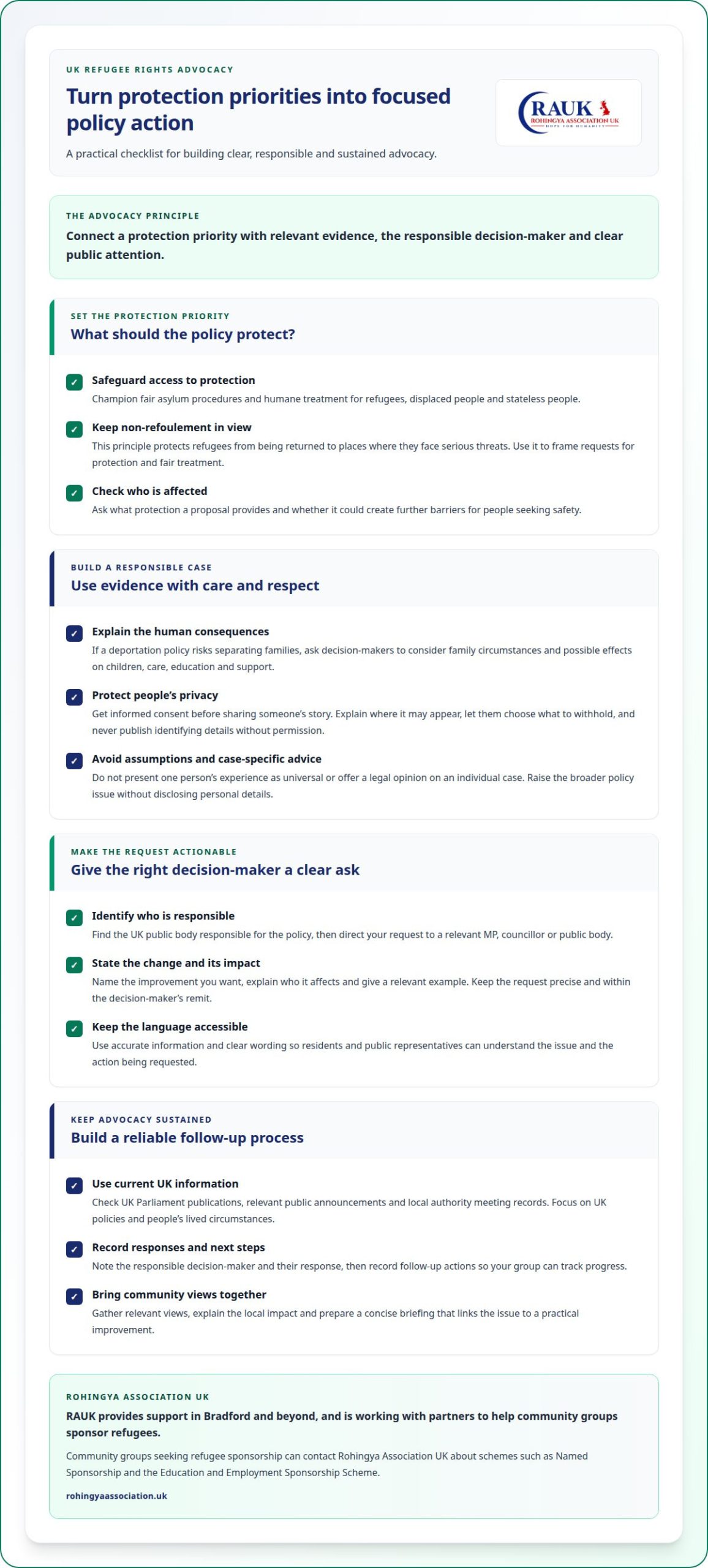
A practical approach to how to advocate for refugee rights links a protection priority with evidence, decision-makers and sustained public attention. In the UK, identify the public body responsible for the policy, then make a focused request explaining its effects on displaced people.
Policy priorities for protection
The principle of non-refoulement protects refugees from being returned to places where they face serious threats. Use it to frame requests for policies that safeguard access to protection and fair treatment. Effective advocacy champions laws, policies and practices that protect refugees, displaced people and stateless people.
Assess a proposal by asking who it affects, what protection it provides and whether it could create further barriers. For example, a community briefing could explain how a policy affects families seeking safety and propose a practical improvement. Keep the request precise so a councillor, MP or relevant public body can respond within its remit.
Opposing family-separating deportation policies
When a deportation policy risks separating families, focus advocacy on its human consequences and the safeguards decision-makers should consider. Use evidence that respects people’s privacy rather than presenting one family’s experience as universal. A campaign could ask decision-makers to consider family circumstances and the likely effects on children.
Direct concerns to the UK public body responsible for the policy. Ask an elected representative to raise the issue and explain how separation could disrupt care, education or family support. Keep the request centred on protection and dignity, not assumptions about people’s migration histories or immigration status.
Policy advocacy
If you are considering how to advocate for refugee rights, start by identifying a policy, its effects and a realistic improvement. Follow UK Parliament publications, relevant public announcements and local authority meeting records. Note the date, responsible decision-maker and any response so your group can track progress and base follow-up on current information.
Community-led refugee rights advocacy campaigns can connect public awareness with policy concerns and lived experience. A useful campaign briefing sets out the issue, explains its local impact and gives the decision-maker a clear action to consider. Keep its language accessible so residents and public representatives can understand the request.
Rules for protests, lobbying and nonprofit advocacy
For a UK protest, plan for safety, access to the venue and the impact on the surrounding community. When lobbying, identify who is speaking, state the action you want and use accurate information. These steps keep advocacy focused and responsible, whether you are contacting representatives or raising a concern at a public meeting.
Nonprofit organisations should keep advocacy consistent with their purpose and governing documents. The relevant considerations depend on the organisation and activity, so distinguish public education and policy campaigning from support for a political party. Clear records of decisions, spending and campaign materials help the organisation explain its approach.
Mobilizing faith communities and grassroots advocates
A faith community can turn shared concern into practical assistance and sustained public action. Begin with a meeting involving local congregations, neighbourhood groups and people with lived experience. Agree on a focused aim, such as improving welcome, challenging harmful language or strengthening local support for displaced people. A clear purpose helps participants decide where their time and skills can make a useful contribution.
To find local refugee services and advocacy groups, ask your local council, library or faith leader about organisations working with refugees. Contact groups to learn about public meetings, volunteering and community priorities. Listen to their experience and needs before proposing joint activity. This helps avoid duplicating existing work and makes collaboration more responsive to local circumstances.
Community mobilisation needs clear responsibilities. One congregation might arrange a venue, another coordinate invitations and another prepare accessible information about an issue. Regular meetings let participants share updates, identify gaps in assistance and plan follow-up. Record agreed actions and who will take them forward, so new members can contribute and the work does not depend on one organiser.
For a community event, invite a knowledgeable speaker to discuss refugee protection, local integration or the effects of policy decisions. Someone with lived experience may choose to speak, but participation must be voluntary. Agree the subject, format and boundaries beforehand, and let speakers decide what to share. A chaired discussion can help attendees turn what they learn into practical community action.
Community sponsorship arrangements depend on the UK scheme involved. Before making plans, establish which scheme your group is considering, its criteria and the responsibilities participants would take on. Do not assume that requirements from programmes in America or elsewhere apply in Britain. Discuss your group’s capacity and approach to welcoming newcomers before making commitments.
Groups considering sponsorship can discuss how members might contribute to social connection, education, employment support or everyday participation. Agree who will coordinate each contribution and how the group will communicate with the newcomer. Do not promise help the group cannot sustain. Clear roles and regular conversations can help volunteers address practical concerns and build a respectful relationship.
Grassroots action can connect neighbourhood priorities with national and global discussions while keeping local needs in view. For example, a congregation could host a discussion, gather attendees’ concerns and take a focused request to an elected representative. Keep the message accurate: explain the change sought and how it could support people seeking safety.
When public debate or government priorities shift, local groups can provide a steady space for informed discussion. Share reliable updates, welcome questions and respond carefully to misleading claims. Each event should leave participants with a clear next step, such as joining a meeting, contributing to an awareness activity or building stronger connections with displaced families.
Calling elected officials
A focused call gives your elected representative a direct account of a policy concern. In the UK, contact your MP about a national decision or your councillor about a local issue. Before calling, identify the relevant policy, the change you want and its effects on people seeking safety. A precise request is easier to understand than a general appeal.
Prepare a short opening that gives your name, constituency and purpose. For example: “I’m a constituent calling about refugee support. Please raise the need for fair, humane policies with the relevant minister.” Then explain your reason in plain language. A local example, such as a community group struggling to connect newly arrived families with assistance, can show why action matters.
Keep the conversation respectful and specific. Ask whether the representative supports your proposed action, what steps they can take and when you might expect a response. If a staff member answers, ask how best to send supporting information. Record the date, office contacted and any agreed follow-up so your group can track its advocacy consistently.
- Before the call: Write one clear request and gather a reliable example.
- During the call: State your connection to the constituency and keep to the issue.
- After the call: Send a brief note summarising your request and any response.
For a coordinated campaign, agree on a shared message before individuals call. A community group might ask members to contact their own MPs about the same humanitarian priority while explaining its local impact in their own words. Avoid identical scripts that sound impersonal. A consistent request, supported by different experiences, shows why the issue matters across a constituency.
Use a call to seek policy action, not to ask an MP to decide an individual’s immigration case. Anyone needing case-specific advice should speak with a qualified UK immigration solicitor; “attorney” is more commonly used in the United States. Representatives can raise broader concerns, such as access to support or the effects of a government programme, without replacing legal advice.
If you do not receive an immediate answer, follow up calmly in writing and keep the correspondence. Ask the office to explain its position or whether it will raise the issue with the relevant department. Keep your request proportionate: one clear policy question is more useful than several unrelated demands.
Finally, share the response with the people who helped shape the call. Explain what the representative said, what action they offered and what remains unresolved. This helps people decide whether to follow up, write collectively or raise the concern at a public meeting. Consistent contact makes advocacy an ongoing responsibility, not a single conversation.
Educating yourself and others
Accurate knowledge gives advocacy a stronger foundation and helps communities discuss protection without reducing people to stereotypes. Start with the international frameworks and terms that shape refugee rights, then share what you learn in clear, respectful language.
Learning about refugee rights
The 1951 Refugee Convention and 1967 Protocol are international instruments governing refugees’ rights. Learn what these frameworks cover before explaining them at a community meeting or sharing information online. Distinguish refugees from asylum seekers: people seeking asylum are asking for protection, while refugee describes a recognised protection status. Precise language helps audiences understand different circumstances without treating individuals as interchangeable.
Build a short learning plan around a defined topic, such as protection, status or access to education. Use material from recognised organisations and government sources, and check its publication date before sharing. For example, a local discussion could compare how “refugee” and “asylum seeker” are used, then invite questions about respectful communication.
Education should also involve listening. If a refugee or asylum seeker chooses to contribute, let them decide what to share and how their words may be used. A community session can pair their perspective with an explanation of the international framework, rather than asking one person to represent every experience.
Countering misinformation and anti-refugee rhetoric
Respond to misinformation by separating the claim from the person making it. Ask what evidence supports the statement, then offer a reliable source or explain what remains unclear. Avoid repeating inflammatory language unnecessarily. A calm correction can keep the discussion focused on facts, policy and people’s rights.
For example, if a post confuses asylum seekers with refugees, explain the difference in status and link the correction to the 1951 Convention or 1967 Protocol. If a claim concerns a government policy, identify the policy and use current official material. Don’t present a single individual’s story as proof of a wider trend.
In public conversations, acknowledge genuine questions without endorsing harmful assumptions. A useful response might clarify a term, provide a source and invite further discussion. If someone shares an inaccurate claim, correct it privately where appropriate, or offer a concise public response that others can understand.
Share learning through a community event, a youth discussion or an accessible information sheet. Use plain language, explain specialist terms and make translations available where possible. For practical learning that supports young people’s participation, explore refugee education and youth empowerment as a way to connect knowledge with community involvement.
Rohingya Association UK: Refugee Settlement and Integration
Rohingya Association UK supports refugee settlement and integration in Bradford and beyond. Its Community Support & Integration work offers housing guidance, healthcare access, help with essential needs and local services. Education & Youth Empowerment and Cultural & Community Events also support participation and belonging.
Rohingya Association UK is working with partners to help community groups sponsor refugees through schemes such as Named Sponsorship and Education and Employment Sponsorship. This gives groups exploring sponsorship a practical way to learn about options and how they may contribute.
For support with settlement, community connection or youth education, contact Rohingya Association UK to discuss your needs or your community group’s plans.
Turn commitment into lasting change
Lasting change grows when concern becomes a sustained commitment in community life and public decision-making. How to advocate for refugee rights cannot be answered by one call or campaign alone. Keep listening, learning and acting alongside people affected by policy, while respecting their choices and dignity.
Rohingya Association UK offers Community Support & Integration, Education & Youth Empowerment, and Cultural & Community Events. These activities can help refugees and neighbours build relationships, share knowledge and take part in community life. Advocacy gains depth when policy action is joined by practical solidarity.
If you would like to explore community support, education or cultural activities, contact Rohingya Association UK. Each thoughtful action can help make welcome and protection part of a stronger shared future.
Frequently Asked Questions
How can individuals advocate for refugee rights through local and federal government?
In the UK, raise local concerns with councillors and national policy concerns with your MP or relevant parliamentary representatives. The UK has devolved administrations rather than a federal government, so the responsible decision-maker depends on the policy area and location. For example, residents could ask a councillor to discuss local integration barriers, then write to their MP about a national policy affecting displaced people. Keep each request focused on the official’s responsibilities.
How can I contact elected officials about refugee resettlement and asylum policies?
Use the official contact details for your MP, councillor or relevant devolved representative, and say that you live in their constituency or area. Set out the policy issue, its local effect and the action you want them to take. For example, ask whether they will raise a specific concern at a meeting or write to the responsible minister. Include your contact details and keep a record of any reply or follow-up.
How can people support refugees through community sponsorship, mentoring, or resettlement programmes?
Find out what a local group needs, then agree on a practical contribution, such as helping newcomers build social connections or access community activities. Rohingya Association UK is working with partners to help community groups sponsor refugees through schemes such as Named Sponsorship and Education and Employment Sponsorship. Discuss your group’s capacity and responsibilities before making commitments.
What are the main challenges and risks refugees face when seeking legal help or public support?
People seeking protection may face confusing processes, language barriers, difficulty explaining personal circumstances and concerns about privacy. Sharing someone’s story without informed permission can expose sensitive details and undermine their control over their experience. Community supporters can help identify practical needs but should not interpret an individual’s legal case. Case-specific questions call for advice from a qualified immigration solicitor, while public advocacy should protect personal information.