
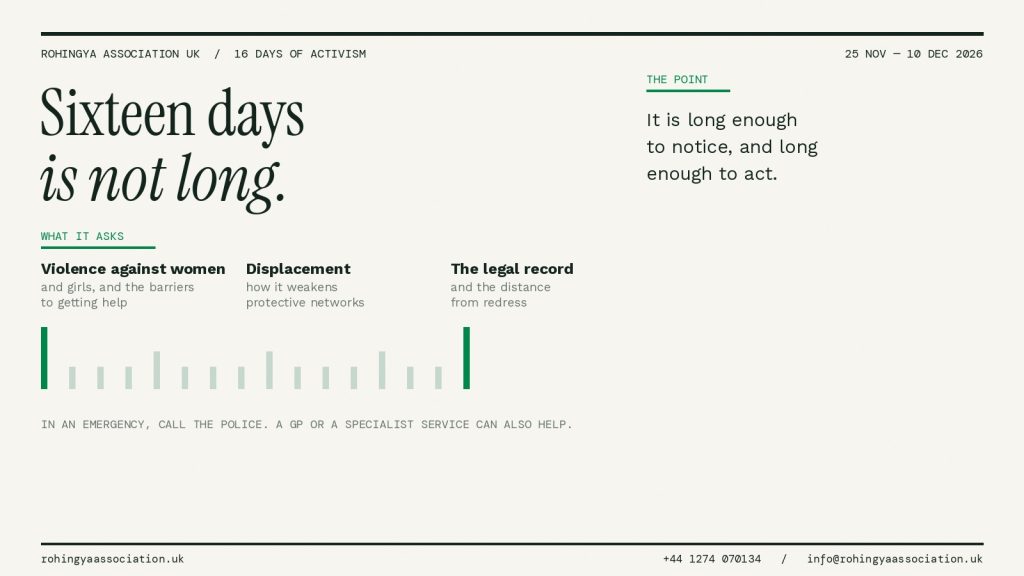
The 16 Days of Activism against Gender-Based Violence is an annual international campaign. In 2026, it runs from 25 November, the International Day for the Elimination of Violence against Women, to 10 December, Human Rights Day. It asks us to pay attention to violence and the barriers that can prevent women and girls from getting help.
For Rohingya women and girls, that conversation must include both the violence recognised in the recent ICJ judgment and the realities of displacement. It must also recognise that gender-based violence happens in the UK, and that women here can face barriers to reporting and support. Here is what the campaign means, what remains unresolved, and what we can do.
Key takeaways
- The 16 Days of Activism runs from 25 November to Human Rights Day on 10 December.
- The ICJ’s finding of widespread sexual violence during the 2016–17 clearance operations is now part of the legal record, but survivors have no claims process or compensation.
- Displacement can weaken protective networks and make it harder to access help, especially where people face insecure accommodation, language barriers or financial dependency.
- Women in the UK can also face barriers to reporting, including language, immigration-status fears and not knowing how the system works.
- We can notice, listen, believe, and help someone find support without pressuring them to share more than they choose.
Table of contents
- What the 16 Days of Activism asks of us
- The ICJ finding matters, but it is not redress
- How displacement can increase barriers to safety
- Violence happens here too: finding help in the UK
- What we can do, and how RAUK works
- Frequently asked questions
What the 16 Days of Activism asks of us
The 16 Days of Activism connects two international days: 25 November, focused on the elimination of violence against women, and Human Rights Day on 10 December. The dates frame a campaign to bring attention to gender-based violence and the responsibility to uphold the rights and dignity of women and girls.
For us, this is not only a general call to awareness. It is a reason to consider what violence and displacement mean for Rohingya women and girls, and to keep listening to women in our own community. It is also a reminder that people who experience violence should be able to seek help without blame, shame or pressure.
Awareness matters, but it is not enough on its own. Listening to people’s choices, knowing where to direct someone for support and asking decision-makers to take human rights seriously are practical ways to make the campaign meaningful.
The ICJ finding matters, but it is not redress
On 19 November 2026, the International Court of Justice found Myanmar responsible as a state for genocide against the Rohingya. The Court’s finding followed evidence that included widespread sexual violence during the 2016–17 clearance operations. Around 10,000 Rohingya civilians were estimated killed in those operations. Over 700,000 Rohingya fled to Bangladesh, where around 1.3 million Rohingya now live.
This finding puts widespread sexual violence into the legal record. It matters because the Court has formally addressed evidence of what happened. But a legal record is not the same as redress for survivors.
The judgment is binding on Myanmar, but the Court has no enforcement power of its own. Myanmar must make reparations, but the amount and the way they will be delivered are to be settled later. No payment or claims process exists for survivors. The judgment also does not change anyone’s immigration status or create a right of return.
A legal record is not the same as redress.
For more on what the judgment says and what remains unresolved, read our ICJ ruling explainer. We also explain why the ruling still needs the Security Council.
How displacement can increase barriers to safety
Displacement does not mean that every woman or girl will experience violence. But it can make it harder to find safety, maintain supportive relationships and get help when it is needed. The loss of familiar community networks can leave people with fewer trusted connections. The long wait of displacement can also shape daily life and the choices available to families.
Specific barriers may include:
- The loss of protective networks that a community would normally provide.
- Shared or insecure accommodation, where privacy and control may be limited.
- Lack of documentation, which can make it harder to navigate services.
- Language barriers when trying to understand information or explain a concern.
- Dependency on others for money or paperwork, which may limit someone’s options.
- The prolonged uncertainty of displacement and the strain of waiting for a stable future.
These are barriers, not defining features of Rohingya women’s lives. Women and girls make choices, support one another and build community, including under difficult conditions. Any response must respect their agency and avoid treating them as passive recipients of help.
Violence happens here too: finding help in the UK
Gender-based violence is not only an issue in Myanmar or in displacement settings. It happens in the UK too. Women here may face barriers to reporting, including language, fears about immigration status, not knowing how the system works and community pressure. These barriers can affect women from different backgrounds. They should not be used to stereotype any community or suggest that one community is more violent than another.
A person does not need to explain or prove everything before asking for help. If someone chooses to talk, listening without judgement can matter. Do not pressure them to share details or make decisions before they are ready.
In the UK, a GP can be a place to raise concerns and ask about support. Specialist domestic abuse services and local councils can also help someone understand what options may be available. Citizens Advice can provide guidance on navigating practical issues. Anyone in immediate danger should call the police.
What we can do, and how RAUK works
During the 16 Days of Activism, we can each take simple steps. We can notice when someone may need support, listen without judgement, believe what they choose to share and know where to direct them. We can share reliable information, speak about the limits of the ICJ judgment as well as its importance, and challenge language that blames or shames survivors.
Women in our own community are not passive. They run sessions, learn English and support one another. Their work and choices deserve recognition. Respectful advocacy means listening to women and making space for their voices, without asking anyone to share a personal experience publicly.
Rohingya Association UK is a community-led charity. Its services include Community Support & Integration, Education & Youth Empowerment, Cultural & Community Events, Advocacy & Awareness, and Crisis Intervention. In Bradford, RAUK also provides energy advice and mental health and wellbeing support. Its refugee sponsorship schemes include Named Sponsorship and Education and Employment Sponsorship. These services are not a substitute for specialist domestic abuse support.
Learn more about Rohingya Association UK, Rohingya history and context and RAUK’s projects, including work in the UK, Myanmar and Bangladesh.
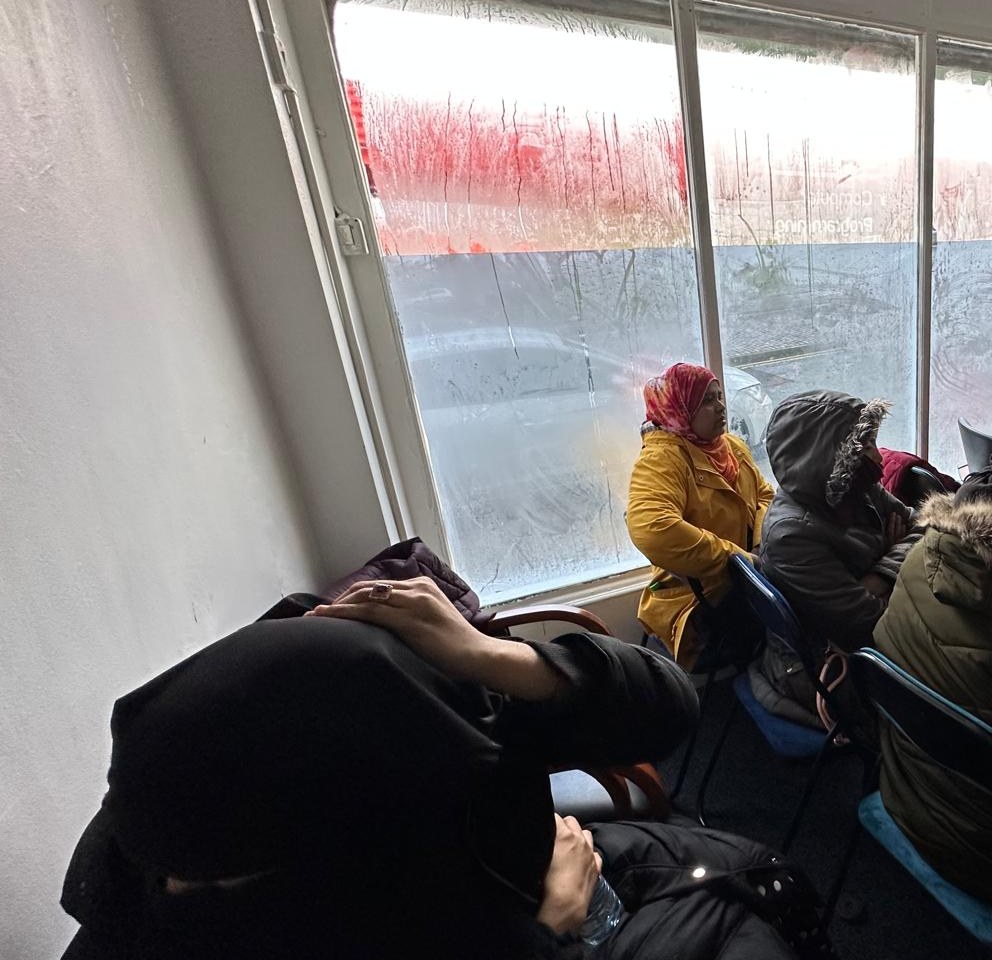
Adults at a support session in Bradford
What you can do
Notice. Listen. Believe. Know where to send someone. Share accurate information about the ICJ judgment and what it has not yet delivered. If you would like to support RAUK’s work, you can donate or contact us.
Frequently asked questions
What are the 16 Days of Activism?
The 16 Days of Activism against Gender-Based Violence is an annual international campaign. In 2026, it runs from 25 November to 10 December, Human Rights Day.
Why is the ICJ judgment relevant to Rohingya women and girls?
The ICJ’s 19 November 2026 judgment found Myanmar responsible as a state for genocide against the Rohingya. Its finding followed evidence that included widespread sexual violence during the 2016–17 clearance operations. The judgment puts this evidence into the legal record, but it has not created a claims process or compensation for survivors.
Where can someone get help with gender-based violence in the UK?
A person can speak to their GP, a specialist domestic abuse service or their local council. Citizens Advice may help with practical questions. Anyone in immediate danger should call the police.
Does the ICJ judgment create a right to return or an immigration route?
No. The judgment does not change anyone’s immigration status or create a right of return. The judgment is binding, but the Court has no enforcement power of its own, and reparations are still to be settled.