

A generous gift can still miss the mark if it doesn’t reflect what people need or how an organisation works. The ethical considerations of donating go beyond good intentions: they include whether a charity explains how gifts are used, shares support fairly and respects the choices and dignity of people receiving help.
If you want your contribution to make a considered difference, look beyond a compelling appeal. This article explains how to assess gift policies and fundraising costs, consider equitable sharing and geographic focus, and weigh whether support responds to people’s stated needs. These questions can help you give with care, clarity and respect.
Key takeaways
- Read a charity’s gift policy carefully and clarify any restrictions in writing so your contribution can be used as intended.
- Consider fundraising costs in context: responsible administration can support effective programmes, so overhead alone does not show whether a charity makes a difference.
- Think about how support is shared, where it is directed and whether it reflects the priorities of the people receiving it.
- Rohingya Association UK provides support in Bradford and beyond through community support, education, youth empowerment and other community-focused work.
- RAUK is working with a partner to help community groups sponsor refugees. If you need to sponsor a refugee, contact Rohingya Association UK about schemes such as Named Sponsorship and Education and Employment Sponsorship.
Gift acceptance policies and written agreements
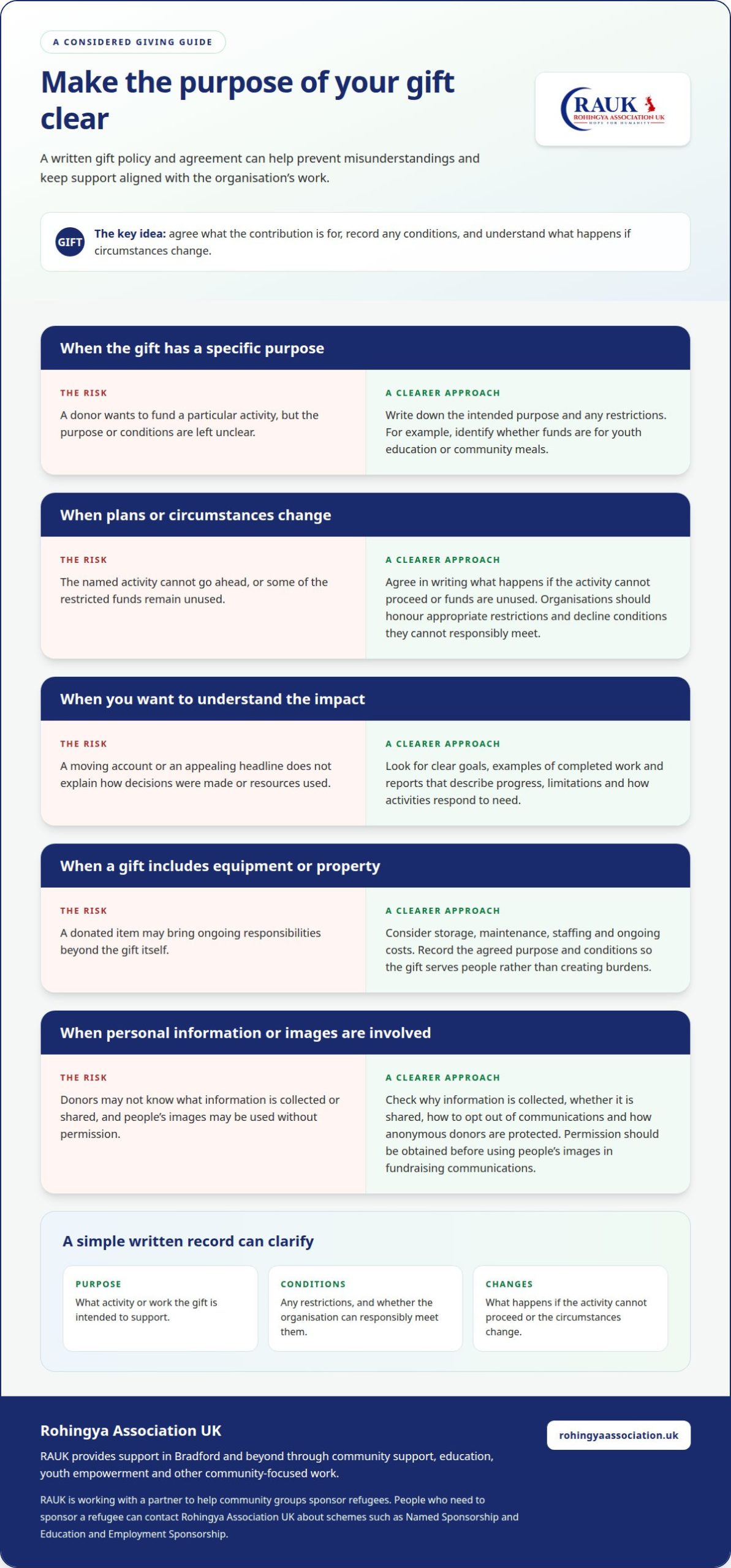
A gift acceptance policy explains which contributions an organisation can accept and how it manages them. It may cover cash, equipment, property, gifts with conditions and donations that could create conflicts of interest. For example, a charity might accept funds for youth education but decline a gift that requires it to promote a donor’s private interests. A clear policy helps donors understand the boundaries before giving.
Read the policy for rules on restricted gifts, refusal, unused funds and changing circumstances. If you want to support a specific activity, the written agreement should identify that purpose and explain what happens if the activity cannot proceed. Organisations should honour appropriate restrictions and decline conditions they cannot responsibly meet. Keeping a written record can prevent misunderstandings later.
To assess impact and effectiveness, look for clear goals, examples of completed work and reports showing how activities respond to need. Compare the purpose of a restricted gift with the organisation’s updates, such as whether funds supported the named education programme. Impact reporting should describe progress and limitations. A moving account alone cannot show how decisions were made or resources used.
Before giving, check what donor information an organisation collects, why it collects it and whether it shares details with others. A sound policy explains how to opt out of communications and how anonymous donors are protected. Organisations should collect only the information needed for their mission and donor relationships. They should also obtain permission before using people’s images in fundraising communications.
Donating to a religious, political or controversial organisation calls for attention to its stated mission, activities and gift conditions. Consider whether your contribution supports a specific service, advocacy work or broader operations, and whether that use aligns with your principles. For example, a restricted gift for community meals differs from unrestricted support for an organisation’s wider work. Read its policies and reports before deciding.
Giving to address injustice may involve supporting services and advocacy that challenge exclusion or unfair policies. The ethical considerations of donating include asking who sets priorities, whose experiences shape decisions and whether the organisation explains its approach. For example, a programme tackling barriers to education should describe both its practical support and how affected families inform its work.
Operational policies matter because a gift can bring responsibilities beyond its intended purpose. Before accepting donated equipment or property, an organisation may need to consider storage, maintenance, staffing and ongoing costs. Donors can ask for the agreed purpose and conditions to be recorded clearly. This simple step supports accountable decisions and helps ensure a gift serves people rather than creating burdens.
Disclosure of fundraising costs
Fundraising costs cover what an organisation spends to invite, receive and process donations. They can include campaign materials, payment systems, staff time and events. A high figure alone doesn’t prove that a charity is ineffective. The useful question is whether the organisation explains its spending and connects it to clear fundraising activity.
In the United States, according to the Internal Revenue Service, tax-exempt organisations report their annual fundraising costs on IRS Form 990. This is a US reporting detail, not a UK filing rule. For UK giving, donors can still examine a charity’s published accounts and annual report for explanations of income, spending and fundraising.
To assess legitimacy and financial transparency, compare the charity’s published accounts, annual report and stated activities. Check that its name and purpose are consistent across those materials, and look for a clear explanation of fundraising expenditure. A detailed account helps donors understand what was spent, what the fundraising supported and how the organisation describes its results.
Don’t treat the proportion spent on fundraising as a complete measure of effectiveness. A campaign to attract new supporters may cost more initially, while regular giving can involve different administrative work. Context matters: a charity should explain its approach and how fundraising supports its mission. If a report gives only a total, look for a breakdown in the published materials.
Scams and coercive appeals often try to rush a decision. Pause before giving, especially if a request relies on intense pressure, unclear claims or an unfamiliar payment route. Confirm the organisation’s identity using its own published information, and avoid sharing financial details through a message or page you can’t confidently connect to it. A responsible appeal allows time for a considered choice.
Fundraising can mislead when images or personal stories appear without permission, or when an appeal implies that every gift goes directly to one person. Consider whether the message explains the donation’s purpose and how it will be used. You should be able to tell whether a contribution supports a named activity or broader operations, rather than relying on an emotional headline alone.
A practical review can centre on three questions: what does the organisation spend on fundraising, what activity does that spending support, and what does it report afterwards? The answers help distinguish transparent explanations from vague promotion. If the accounts use unfamiliar terms, focus on whether the charity explains them plainly and connects spending to its work.
Concern about overheads is understandable, but cutting every administrative expense can weaken the systems that support safe, accountable services. Assess financial transparency by considering purpose, explanation and results together. This helps you make an informed decision without assuming that the lowest fundraising cost automatically delivers the strongest impact.
Altruistic donation and equitable sharing
Altruistic giving aims to benefit others without expecting a personal return. Yet good intentions alone don’t ensure that help reaches people fairly. Australia’s ethical guidelines for human cell, tissue and organ donation say these gifts should be treated respectfully, shared equitably and used effectively for everyone’s benefit. The principle also offers a useful lens for charitable giving: consider who benefits, who decides and whether support responds to need.
Equitable sharing doesn’t always mean dividing a donation into identical portions. A family facing displacement may need safe accommodation, while another household may prioritise healthcare or education. Fair allocation considers urgency, barriers and the likely usefulness of support. For example, a programme might direct more resources towards people with limited access to essential services, while explaining how it identifies those barriers.
Ask how decisions are made and whose knowledge shapes them. A local committee that includes people affected by a crisis may identify overlooked needs, such as accessible information or culturally appropriate support. Donors can look for a clear explanation of how priorities are set and reviewed. That matters when circumstances change and the original distribution plan no longer fits people’s needs.
Equity also involves weighing a restricted gift against wider needs. A donation limited to school materials may help children directly but leave transport or language support unfunded. Consider whether a flexible contribution would let an organisation respond to changing priorities. A written purpose should guide how funds are used without preventing practical adjustments when needs shift.
Some giving decisions compare possible benefits across different causes. One example estimates that spending $7,500 on malaria protection could protect families and likely save at least three children’s lives. Such comparisons can prompt reflection, but they don’t capture every value: community trust, local leadership and lasting capacity also matter. Treat estimates as one consideration, alongside the people affected and the context of the programme.
Respectful giving avoids treating recipients as passive. A food distribution, for instance, can be planned with community input on suitable items, access and collection arrangements. This recognises people’s experience and protects their agency. Look for organisations that explain how affected individuals contribute to decisions, rather than relying only on external assumptions about what a community needs.
Equitable sharing is an ongoing practice, not a single allocation decision. A responsible organisation can explain its priorities, listen to feedback and adapt support as circumstances develop. Understanding these processes helps donors consider whether their gift supports dignity as well as immediate relief. The measure is not simply how much is distributed, but whether assistance is relevant, accessible and fairly directed.
Choosing a geographic focus for donations
A donation’s location shapes who can access support and how quickly help can respond. Giving in a familiar area, such as Bradford, may feel direct; supporting an international appeal may address urgent needs beyond the UK. Neither choice is automatically more ethical. Consider your principles, the specific need and whether the organisation explains why it works in that place.
Local giving can support work rooted in a community’s daily realities. For example, a neighbourhood food project may understand which residents face barriers to access and where distribution is practical. A local focus can also make it easier to follow updates. Still, proximity alone doesn’t demonstrate effectiveness: the organisation should explain its purpose and how it serves people in the area.
International aid can be necessary when conflict, displacement or a natural disaster overwhelms local resources. Distance, however, can make it harder for donors to understand changing conditions or how assistance reaches people. Look for explanations of local partnerships, delivery arrangements and plans to adapt support. A donation intended for emergency shelter, for instance, should have a clear connection to shelter needs in the affected area.
Disaster relief and international aid raise questions about whether assistance is timely, appropriate and shaped by people affected. An appeal may focus on immediate supplies, while communities also need recovery support, accessible services or locally led planning. Consider whether the organisation explains how it coordinates aid and adapts as the emergency develops.
Geographic boundaries deserve scrutiny too. An appeal for one town may exclude nearby people facing the same crisis, while a broad regional fund may give organisers more room to respond. Read how the area is defined and whether the stated focus reflects practical access, not just a compelling place name. A clear explanation helps donors understand who may benefit.
Local knowledge can guide respectful assistance. In a flood-affected district, residents may identify which routes remain usable and which households need accessible delivery. Organisations that work with local groups can draw on this knowledge when planning distribution. Donors should also consider whether an appeal describes local people as participants and decision-makers, rather than portraying them only as recipients.
Before choosing a geographic focus, compare the stated location with the organisation’s purpose and the need described. Ask whether the appeal names a specific community, explains why that place is prioritised and describes how support can reach it. For a UK-based donor considering an overseas appeal, these details clarify how local insight, practical delivery and wider solidarity fit together.
Timing can also affect where a gift goes. Consider whether the organisation explains when funds are allocated and whether support can be directed to the stated place at the intended time.
Compassionate giving and giving to people in greatest need
Compassionate giving responds to people’s circumstances rather than assumptions about what they need. Assessing need alongside access, urgency and recipients’ choices can help make support more relevant.
Giving to people in greatest need
Giving to people in greatest need means directing support towards those facing the most serious barriers to safety, health or daily essentials. This matters because a donation can make a greater practical difference when it reaches people with limited options. For example, a family displaced from home may need stable accommodation before it can benefit from longer-term education support.
Need is not always visible in an appeal photograph or brief description. A person with a disability may face additional barriers to collecting food, while a family without secure housing may need help beyond immediate supplies. Consider whether an organisation explains how it identifies unmet needs and reaches people who might otherwise be overlooked. Accurate descriptions provide context without reducing people to their hardship.
Urgency also changes over time. After a flood, clean water and safe shelter may be immediate priorities; later, families may need help restoring routines and accessing education. A useful donation supports the stage of recovery described, rather than assuming the first response remains the only need. Ask whether the appeal explains how priorities are reviewed as circumstances change.
Recipients’ dignity and wishes
Respecting recipients’ dignity and wishes means treating people as decision-makers, not simply as subjects of aid. Support this principle by favouring programmes that involve affected people in shaping assistance. For example, families choosing between food, transport or school supplies may identify what will help them most. This makes giving more responsive and recognises people’s knowledge of their own lives.
Donors can also consider how an appeal portrays the people it serves. A respectful account explains the issue without exposing private details or implying that recipients lack agency. For instance, a fundraising image should not be used as a substitute for a clear explanation of the programme. Thoughtful communication protects privacy and helps audiences understand the purpose of support.
For donated goods, practical questions matter: are the items suitable, usable and wanted by recipients? Unrequested clothing, for example, may require sorting and storage when a community needs essential supplies. Flexible support lets organisers respond to stated priorities rather than directing resources towards goods that don’t fit local circumstances.
Before giving, look for evidence that recipients’ views inform programme decisions, such as consultation or feedback processes. The ethical considerations of donating include how support is delivered, described and adapted. For compassionate, community-informed support, connect with community-led giving.
Questions about how an organisation uses donations can be part of careful giving, but a single measure should not replace attention to the people reached and the support provided. In 2013, Guidestar, BBB Wise Giving Alliance, and Charity Navigator issued an open letter to donors about the Overhead Myth. Donors can look for clear information about an appeal’s aims, how assistance is delivered, and whether recipients’ needs and choices guide decisions. This keeps financial questions connected to the purpose of giving.
Rohingya Association UK
Rohingya Association UK offers Community Support & Integration, Education & Youth Empowerment, and Cultural & Community Events. These activities support Rohingya refugees, families and young people while keeping community needs and cultural belonging in view.
RAUK is working with a partner to help community groups sponsor refugees. People seeking to sponsor a refugee can contact Rohingya Association UK about schemes such as Named Sponsorship and Education and Employment Sponsorship.
For a considered conversation about supporting community-led work or refugee sponsorship, contact Rohingya Association UK.
Let your next gift reflect your values
A thoughtful gift can begin a longer relationship shaped by listening, trust and attention to what people say they need. The ethical considerations of donating are not simply questions to settle before giving; they can guide how you stay engaged as circumstances and priorities change. Consider what kind of connection you want your support to create, and whether the work continues to respect people’s agency.
Rohingya Association UK’s work includes Community Support & Integration, Education & Youth Empowerment, and Cultural & Community Events. These areas support community-led connection, opportunity and cultural belonging. Choose the form of involvement that reflects your priorities and the communities you hope to stand alongside.
If you’d like to explore how your values could connect with this work, contact Rohingya Association UK. A considered act of giving can help make solidarity a sustained practice.
Frequently Asked Questions
What ethical principles should guide charitable donations?
Let respect, fairness, accountability and responsiveness guide your giving. For example, if an appeal supports children’s learning, consider whether it respects families’ choices and explains how the programme responds to their circumstances. You can also consider whether the organisation communicates honestly, protects personal information and treats people receiving support as participants in decisions, rather than passive recipients.
What percentage of donations do reputable charities spend on programmes versus overhead?
There is no single percentage that reliably separates reputable charities from others. The balance depends on the organisation’s work, fundraising approach and accounting choices. For instance, a charity delivering services across several communities may need coordination and staff support alongside direct programme spending. Read its accounts and explanations together, and consider whether the spending supports its stated purpose and is reported clearly.