
What can corporate sponsorship for a refugee charity involve beyond a one-off donation? Companies can contribute money, goods, services or employee expertise, or build an ongoing partnership with a charity. The right approach depends on the charity’s priorities and the support it can use effectively.
Giving time, expertise or resources can help a company put its values into practice. This article explains practical ways businesses can support refugee services, shape a partnership around a charity’s work and agree clear responsibilities.
Rohingya Association UK (RAUK) provides support in Bradford and beyond, including community support and integration, education and youth empowerment, and cultural and community events. RAUK is working with a partner to help community groups sponsor refugees. If you’re looking to sponsor a refugee, contact RAUK about schemes such as Named Sponsorship and the Education and Employment Sponsorship Scheme.
Key takeaways
- Match your company’s support to the practical needs of refugee and asylum seeker services, rather than choosing a contribution in isolation.
- Explore partnerships that bring together funding, employee skills and in-kind resources for sustained support.
- Use your corporate social responsibility priorities to shape a partnership with clear, meaningful aims.
- Consider whether a Charity of the Year programme can build staff engagement and maintain support over time.
- Plan how you will communicate the partnership’s progress and learn from the people and communities it supports.
Corporate support for services to refugees and asylum seekers
Companies can strengthen UK community support through funding, practical resources and employee volunteering. Effective support complements local services and respects each refugee’s choices.
Sponsor responsibilities and support periods
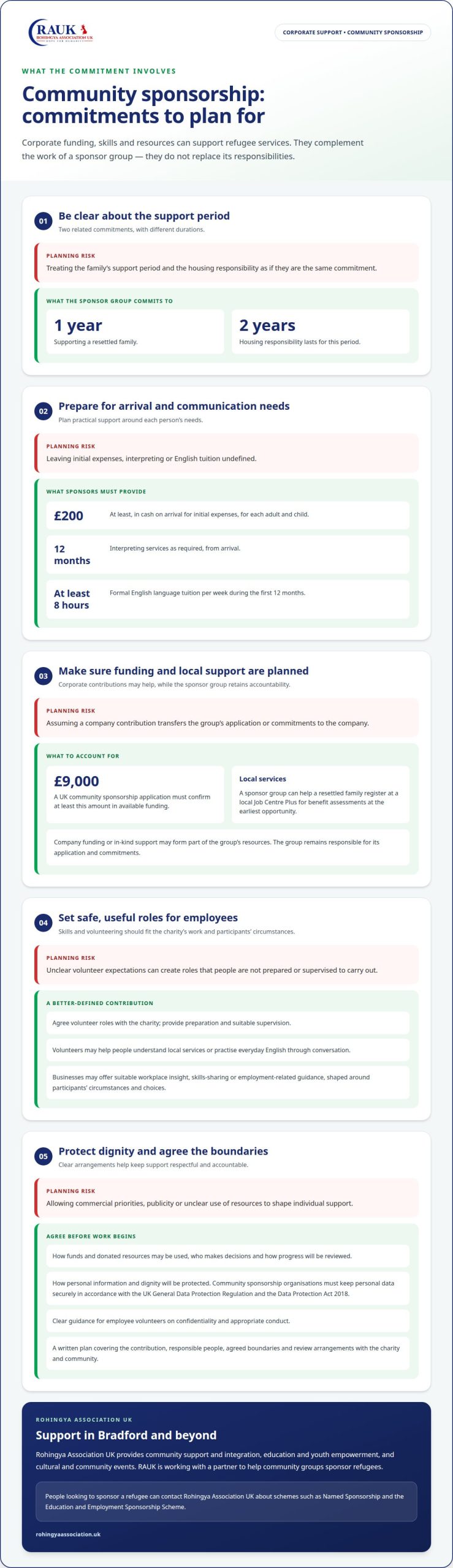
In UK community sponsorship, sponsor groups support a resettled family for one year, while housing responsibility lasts for 2 years. Their work can include helping with local Job Centre Plus registration for benefit assessments at the earliest opportunity.
Sponsors must provide each adult and child with at least £200 in cash on arrival for initial expenses. They must also provide interpreting services as required for 12 months from arrival, and formal English language tuition for at least 8 hours per week during the first 12 months.
First, clarify whether the contribution will support a particular activity or the charity’s wider work. Funding and staff time can complement support already in place, but should not be presented as replacing another group’s responsibilities.
Sponsorship risks and restrictions
Before accepting corporate sponsorship, agree how funds and donated resources may be used, who will make decisions and how the partnership will be communicated. Clear boundaries help keep branding and commercial priorities from influencing individual support.
Refugees’ personal information and dignity need careful protection. Community sponsorship organisations must keep personal data securely in accordance with the UK General Data Protection Regulation and the Data Protection Act 2018; employee volunteers should receive clear guidance on confidentiality and appropriate conduct.
Financial support can help community sponsorship stakeholders plan housing, welcome arrangements and integration support. A UK community sponsorship application must confirm that at least £9,000.00 in funding is available. Corporate contributions may form part of a group’s resources, alongside in-kind support, but the group remains responsible for its application and commitments.
Employment and benefits support can help people build greater independence in their new community. A sponsor group can assist a resettled family with registration at a local Job Centre Plus site for benefit assessments at the earliest opportunity. Businesses may contribute through suitable workplace insight, skills-sharing or employment-related guidance, with activities shaped around participants’ circumstances and choices.
Volunteers can provide useful, consistent support, such as helping newcomers understand local services or practise everyday English through conversation. Agree roles with the charity, prepare employees for respectful communication and arrange suitable supervision. A clearly defined role helps volunteers contribute without creating expectations they cannot meet.
For a company considering corporate sponsorship for a refugee charity, the strongest starting point is a written plan. Set out the intended contribution, the people responsible, the agreed boundaries and how progress will be reviewed with the charity and community.
Corporate partnership opportunities for refugee charities
A useful partnership connects a company’s resources with a charity’s priorities. Identify a specific need, decide what the company can contribute and agree how both parties will review the work.
Documents and eligibility requirements
Companies may request information about charitable status, governance, accounts, safeguarding and the proposed work. A charity can prepare relevant documents, a concise budget and an explanation of how the contribution will be used. Agree the company’s due diligence process and any reporting expectations before setting the partnership terms.
Community sponsorship has a separate eligibility test. In the UK, a community sponsorship organisation must be an individual or body falling within section 10(2)(a) of the Charities Act 2011, or a Community Interest Company registered with Companies House. This rule concerns the sponsoring organisation, not every charity seeking corporate support.
Finding local sponsors and employee giving
Start with employers whose staff, premises or expertise connect with the charity’s work in the local community. A targeted approach can identify a relevant contact in corporate responsibility, human resources or community investment. Explain the need, the proposed contribution and the practical benefit, such as supporting welcome activities or integration services.
Employee giving can include staff fundraising, payroll giving or a company matching employee donations. Ask the employer which arrangements it supports, then provide a concise fundraising brief, approved messages and a clear way to direct contributions. A named staff contact can help coordinate the partnership.
Structuring and pricing sponsorship packages
Build each proposal around a defined activity, such as supporting a community event, providing useful equipment or contributing to a programme. Calculate the actual delivery costs, including staff time, materials and administration, and describe donated goods or services separately. Explain what the contribution will support without promising outcomes beyond the charity’s control.
Set out contribution options only after working out the costs. For each option, explain what support it covers, how updates will be shared and any agreed recognition, such as an acknowledgement in company communications. Recognition should never make someone’s access to support conditional on publicity.
A written partnership agreement should set out each party’s responsibilities, the purpose of the contribution, reporting arrangements and how concerns will be handled. Include boundaries for branding, staff involvement and the use of personal stories or images. Refugees are not promotional material; all communications involving them must respect privacy, consent and dignity.
Employee expertise can strengthen a partnership. A business might offer a skills-sharing session or help organise a welcome activity, provided the charity identifies a genuine need and coordinates the work. Agree the activity, volunteer preparation and supervision in advance so that goodwill leads to dependable support.
For a practical starting point, prepare a one-page proposal with the need, proposed contribution, budget, timetable and review method. A partnership should be shaped around the charity’s work and the community’s priorities. Explore how refugee settlement and integration support can inform a locally relevant sponsorship conversation.
Corporate social responsibility alignment
Refugee-focused social responsibility can suit employers in many industries. The right fit depends on what a company can contribute and what a charity needs.
No single industry defines corporate support for refugees. Employers in finance, education, construction, retail, technology and transport could explore relevant contributions, such as financial skills sessions, learning resources, equipment or travel support. These are examples, not a guarantee that every company has a refugee-focused programme. A charity can approach businesses whose expertise or resources match a specific need.
Connect the proposed partnership to the company’s existing social priorities. An employer focused on education might support learning activities; one focused on employment could offer workplace insight or skills-sharing. The charity should explain the community need first, then show how the contribution responds to it. This keeps the partnership focused on practical support, not branding alone.
Agree a small number of meaningful outcomes before work begins. For an English conversation activity, partners could record sessions delivered and gather participant feedback. For donated equipment, they could track what was provided and how it supports the agreed activity. Do not use a person’s progress or personal story as a corporate performance measure. Dignity and choice must remain central.
Responsible CSR also requires safeguards. Set out who can access services, how volunteers are briefed, and how personal information is handled. A company’s social media team should use approved descriptions and obtain appropriate consent before sharing any identifiable story or image. Refugees are individuals with varied experiences, not a single vulnerable group, so communications should avoid pity-based language and portray people with respect.
Build accountability into the partnership agreement. Name the charity and company contacts, define the contribution, agree how updates will be shared and set a review point. If the company offers staff time, specify the activity and supervision arrangements. If it provides goods, agree what is useful and how delivery will be coordinated. Clear arrangements help prevent well-intentioned support from creating extra work.
Consider whether the proposed activity complements existing local services. An employer might support a community event while the charity identifies its purpose and leads delivery. Agree any recognition in advance and keep it proportionate to the support. A clear agreement protects the charity’s independence, supports transparent reporting and keeps the partnership focused on community priorities.
Financial and in-kind contributions
Companies can contribute money, goods, services or employee expertise. The right mix depends on the charity’s priorities and what it needs to deliver its work.
Cash and non-cash contributions
Cash donations give a charity flexibility to direct funds towards agreed needs, including programme delivery and essential operating costs. In-kind support might include usable goods, professional expertise, meeting space or staff volunteering. Before accepting a contribution, agree its purpose, timing and condition, along with any delivery or storage arrangements.
Start by matching each offer to a real need. A company might provide translation support for community information or staff time to help organise an activity. The charity should consider whether the contribution is suitable, manageable and genuinely useful, rather than accepting resources that create extra costs or work.
Typical corporate funding levels
There is no single corporate funding level for every refugee charity. The appropriate contribution depends on the activity, its duration, delivery costs and the value of any in-kind support.
Community sponsorship arrangements are different from a standard company donation or a charity’s general budget. A company and charity can agree a contribution for a defined project, costing it according to staffing, materials, coordination and the planned period of support. Set out these assumptions before agreeing the contribution.
A useful proposal separates cash from non-cash contributions. For cash, show the planned purpose and how the charity will report its use. For goods or services, describe the quantity, condition, delivery arrangements and any ongoing maintenance. This makes the value and practical limits of each offer clear to both parties.
Companies can combine different forms of support. An employer might make a financial contribution, invite staff to volunteer and provide relevant professional skills. The charity should coordinate each element through a named contact and agree how the activities fit together. This avoids overlapping offers and keeps the work centred on community needs.
Review the arrangement if circumstances change. If a donated resource no longer meets the need, discuss an alternative with the company before redirecting it. For ongoing contributions, agree when the partnership will be reviewed and what information both parties will use. Clear records of funds and resources support transparent decisions and effective partnerships.
In community sponsorship, local groups support refugee and newcomer integration through financial or in-kind contributions and volunteer services. This can facilitate integration and strengthen connections among community members, contributing to stronger, more cohesive societies.
Corporate sponsorship and Charity of the Year programmes
A Charity of the Year partnership can give a company and refugee charity a shared focus. Its value comes from practical support, sustained staff involvement and respect for the charity’s mission.
Start by defining what the partnership should support. A charity might identify a specific community activity, while the company considers what funding, staff involvement or workplace expertise it can offer. Explain the need, the planned work and each party’s role. This gives employees a clear reason to take part beyond supporting a nominated cause.
The charity can prepare a concise case for support. Describe the people and communities served respectfully, explain the activity and show how the company’s contribution would help deliver it. Include realistic plans for using funds or employee time. Avoid suggesting that a short-term programme can remove every barrier facing refugees and people seeking asylum.
For the company, a Charity of the Year programme can bring fundraising and volunteering together. For example, staff could organise an event and invite colleagues to contribute skills or time to an agreed activity. The charity should set boundaries for volunteer involvement, provide suitable preparation and coordinate participation around its service priorities.
Agree how progress will be reviewed before the programme begins. Partners might record funds raised, sessions delivered or volunteer hours contributed, where these measures reflect the agreed work. A review can identify what was useful, what created extra demands and what should change. Access to support must not depend on taking part in fundraising or publicity.
Agree how the partnership will be recognised. The company and charity can decide how to acknowledge it in internal updates or public communications. Use approved wording, protect personal information and obtain informed consent before sharing identifiable stories or images. Refugees should never be expected to disclose personal experiences to demonstrate a programme’s value.
A Charity of the Year arrangement works best when both parties understand its limits. Set out the programme’s duration, contribution, contacts, review process and conditions for changing or ending the partnership. If staff enthusiasm falls or the charity’s priorities shift, discuss adjustments openly rather than letting an outdated plan continue.
Before approaching a company, shape a proposal that links its employee engagement to a specific community priority. For support developing a refugee-focused partnership, discuss refugee sponsorship opportunities as a next step.
The Biden administration announced the Welcome Corps private sponsorship program on January 19th. Separately, the proposed U.S. community sponsorship pilot would allow groups of five or more Americans to sponsor refugees for one year. The announcement and proposed pilot describe private and community sponsorship, respectively, as possible forms of refugee sponsorship.
Rohingya Association UK: Refugee Settlement and Integration
Rohingya Association UK supports Rohingya refugees and families through Community Support & Integration, including practical assistance to help people build stability and take part in community life. For companies considering a partnership, this offers a meaningful focus beyond a one-off contribution.
Its work also includes Community Support & Integration, Education & Youth Empowerment, and Cultural & Community Events. These areas provide ways to connect company support with everyday needs, learning opportunities and community connection, while respecting the priorities and dignity of the people involved.
To discuss how your company could support Rohingya Association UK’s work, get in touch with the charity.
Build a partnership with lasting purpose
Corporate sponsorship for a refugee charity can begin a relationship built on shared responsibility rather than a single gesture. Connect your company’s intentions with priorities identified by the charity and community, then agree how the partnership can develop over time.
Rohingya Association UK’s Community Support & Integration, Education & Youth Empowerment, and Cultural & Community Events offer practical areas for companies to support. A meaningful contribution respects people’s agency and helps the charity do its work without making dignity conditional on visibility or recognition.
Whether your company is considering staff involvement, resources or a longer-term commitment, begin a conversation about what responsible collaboration could look like. Contact Rohingya Association UK to discuss a possible partnership, and take a considered step towards stronger community support.
Frequently Asked Questions
How can my company get involved?
Choose a refugee-support priority that fits your company’s capacity, such as funding, employee volunteering or relevant expertise. Identify a charity whose work aligns with that priority, then propose a defined contribution and a suitable way to review it. For example, a business with communications expertise could offer staff time to prepare accessible community information. Keep the charity’s needs and the dignity of the people it supports central to the proposal.
What are the sponsor’s obligations following approval?
For a UK community sponsorship arrangement, approval means the sponsor group must deliver its agreed support, not simply provide funding. Responsibilities include housing the resettled family for 2 years and supporting them for one year. The group must also help with GP registration within one week, complete a child’s school registration within 2 weeks, and provide required interpreting for 12 months. Formal English tuition must be provided for at least 8 hours per week during the first 12 months.
What types of corporate sponsorship are available for refugee charities?
Companies can support refugee charities through financial contributions, in-kind resources, employee fundraising, volunteering or a Charity of the Year partnership. An employer might combine a donation with staff-led fundraising or offer relevant professional expertise. Support can focus on one activity or bring several contributions together. The right approach depends on the charity’s priorities, the company’s resources and how both parties agree to coordinate the work.
How can a refugee charity apply for corporate sponsorship from a company?
A charity can approach a company with a tailored proposal explaining its work, the support needed and how the contribution would be used. Include relevant governance and financial documents if requested, along with a contact who can discuss delivery and reporting. Address the proposal to an appropriate corporate responsibility, community investment or employee engagement contact. A clear, specific request helps the company assess whether the opportunity fits its priorities.