
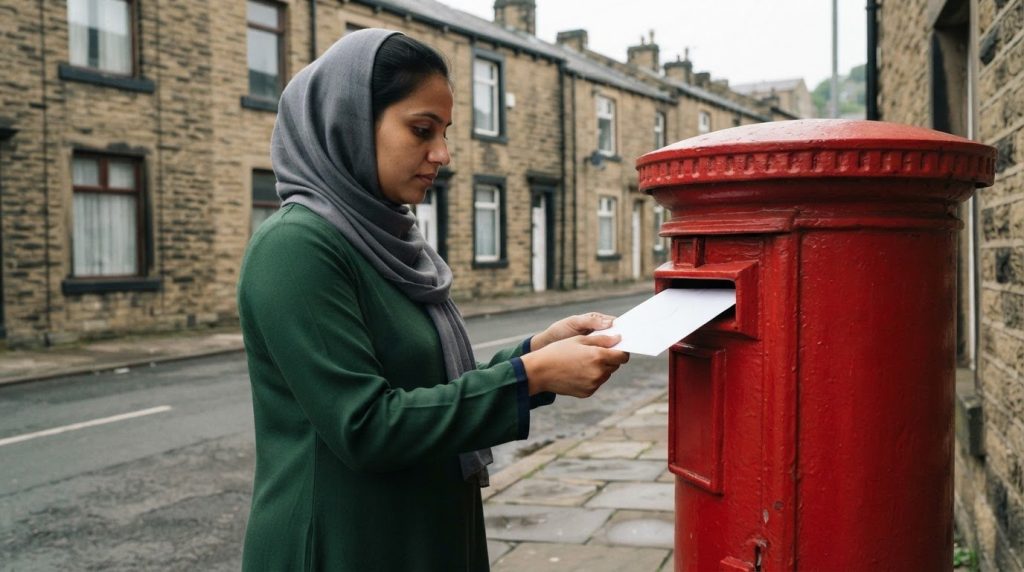
Writing to your MP is one way to call for action on the persecution of Rohingya people. To write to your MP about the Rohingya crisis, explain why protection and accountability matter, then ask your MP to support targeted sanctions against those responsible for abuses.
The scale of displacement reflects a long-running crisis: Rohingya people have been denied citizenship in Myanmar since 1982, and more than 750,000 fled to Bangladesh during the 2017 exodus. It’s understandable to wonder what a letter can achieve when the situation is so entrenched. A clear, informed message can help bring the issue to your MP’s attention and set out the action you believe the UK should take.
This guide outlines the roots of Rohingya displacement, the purpose of targeted sanctions and how to make your message clear. It also explains how measures directed at those responsible for persecution differ from broad restrictions that may affect civilians.
Key takeaways
- Understand how persecution and statelessness have driven Rohingya displacement, and why safe return depends on protection and rights.
- Learn how the UK government can support refugees and pursue targeted measures focused on those responsible for abuses.
- See how to assess petitions and campaigns, and choose clear, specific requests to raise with your MP.
- Shape a focused letter by explaining the issue, the action you want the UK to take and why accountability matters.
- Rohingya Association UK provides support in Bradford and beyond, and is working with a partner to help community groups sponsor refugees through schemes such as Named Sponsorship and Education and Employment Sponsorship.
Rohingya persecution and displacement from Myanmar
The Rohingya are a Muslim ethnic minority with a long history in Myanmar. Yet Myanmar’s government does not recognise them among the country’s 135 ethnic groups. Rohingya people have been denied citizenship since 1982, leaving many without legal identity. This exclusion affects access to rights and makes statelessness a defining feature of the crisis.
The roots of that exclusion stretch back further. Myanmar’s 1948 citizenship law was exclusionary, while a law introduced in 1982 stripped Rohingya of access to full citizenship. The legal changes left Rohingya people facing restrictions on their status and belonging. Without citizenship, families can struggle to secure recognition and exercise basic rights within their own country.
Military violence drove a new mass displacement in August 2017. The campaign began on 25 August, forcing hundreds of thousands from their homes. More than 750,000 Rohingya fled to Bangladesh during the largest exodus; half were children. Before that exodus, an estimated one million Rohingya lived in Myanmar. The violence followed earlier displacement, not an isolated crisis.
Rakhine State has also experienced displacement within Myanmar. Security campaigns in 2012 and 2016 caused tens of thousands of Rohingya to flee their homes. Before the 2017 attacks, 120,000 internally displaced people had lived in camps in Rakhine since inter-communal violence in 2012. In 2017, violence in the state displaced an estimated 200,000 people internally. These figures describe different episodes and groups; they show why displacement cannot be understood only through the border crossing into Bangladesh.
For people displaced inside Myanmar, leaving home does not necessarily mean reaching safety. Families may be separated from communities, shelter and familiar services when violence forces them elsewhere. More than 3.6 million people were internally displaced across Myanmar in 2025. That national figure includes displacement beyond Rakhine and is distinct from the number of Rohingya refugees living abroad. It illustrates how conflict continues to uproot people within the country.
Cross-border displacement remains extensive. Bangladesh hosts close to one million Rohingya refugees from Myanmar, according to international humanitarian reports. Many live in refugee camps, far from the homes and villages they left behind. The scale of this population reflects years of displacement and limited prospects for a safe return. A return cannot be measured simply by people crossing back into Myanmar.
Rohingya families need safety from violence, citizenship, freedom of movement, healthcare and education in Myanmar before they can return home. These conditions link immediate protection with longer-term rights. Without them, return would not address why people fled or the barriers they faced before displacement. A meaningful response must therefore consider protection, legal status and the chance to rebuild daily life.
If you want to write to your MP about the Rohingya crisis, explain that refugees fled military violence, while others remain internally displaced in Myanmar. Ask what steps the UK government supports to protect civilians, secure accountability and create conditions for safe return. Mentioning both displacement within Myanmar and refuge in Bangladesh gives your request clear context.
Reports give differing estimates for the 2017 flight to Bangladesh. One account says more than 700,000 Rohingya crossed into Cox’s Bazar district after violence in Rakhine State in August 2017; another says more than half a million people fled Rakhine State to Bangladesh during 2017. An estimate also puts the number of Rohingya already in Bangladesh from earlier waves of displacement at around 300,000 when the 2017 exodus began. These figures refer to different groups and periods, and should not be combined as if they describe one movement.
Reported totals for internal displacement also differ. One figure is 1.3 million people displaced within Myanmar since February 2021; another is more than 1.4 million displaced within Myanmar in 2025 amid escalating violence following the military takeover in February 2021. The figures have different stated timeframes and scopes, so they should be treated as separate reported totals rather than combined. Both concern displacement inside Myanmar, distinct from the cross-border refugee population.
A report on renewed violence in Myanmar’s Rakhine State says Rohingya had begun fleeing to Bangladesh nearly three months before the report was published. This account describes further movement from Rakhine towards Bangladesh, separate from the mass flight associated with August 2017. It highlights that renewed violence can drive displacement along both internal and cross-border routes, adding to the effects of earlier violence.
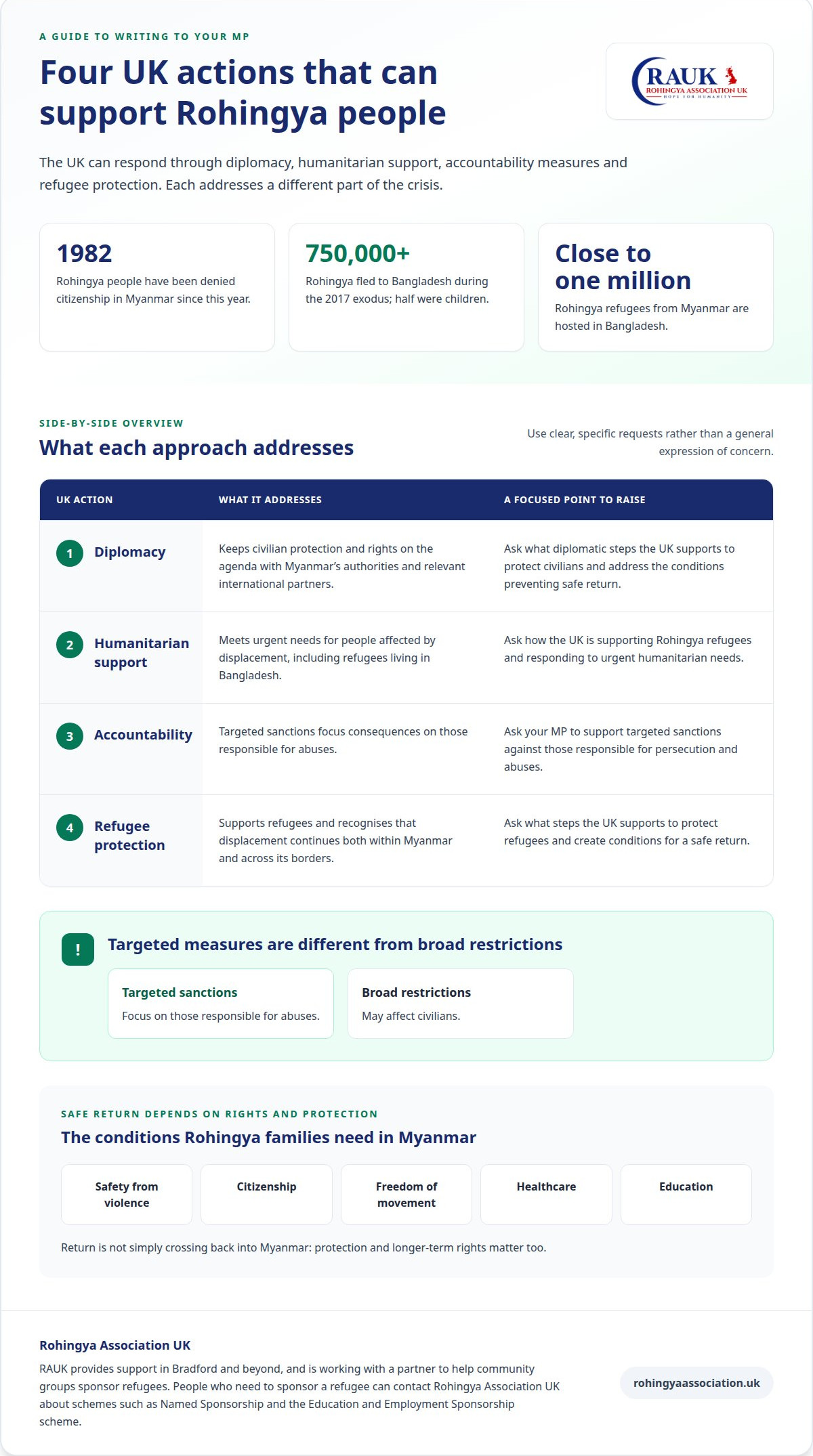
What actions can the UK government take to support Rohingya refugees?
The UK government can respond through diplomacy, humanitarian support, accountability measures and refugee protection. Each approach addresses a different part of the crisis: humanitarian assistance meets urgent needs, diplomatic pressure keeps protection and rights on the agenda, and targeted sanctions focus consequences on those responsible for abuses. Ask your MP about specific action across these areas, rather than sending only a general expression of concern.
The UK can press Myanmar’s authorities and relevant international partners to protect civilians and address the conditions preventing safe return. Rohingya families need safety, citizenship, freedom of movement, healthcare and education in Myanmar before returning home. Ask your MP to urge the government to make these protections central to its diplomacy. This frames return as a matter of safety and rights, not simply movement across a border.
Targeted sanctions are another possible tool. Rather than restricting a whole population, they focus on people or entities linked to abuses. Ask your MP to support measures that pressure those responsible while minimising harm to civilians. You can also ask how sanctions would advance accountability and complement diplomatic engagement. This makes your request specific without presenting sanctions as a substitute for humanitarian protection.
Accountability matters alongside immediate protection. In January 2020, the International Court of Justice ordered Myanmar to take emergency measures to protect Rohingya people from violence and preserve evidence relating to possible genocide. An MP can ask the government to support compliance with that order and encourage efforts to establish responsibility for abuses. Such a request connects international legal action with the need to protect people still affected by persecution.
Humanitarian support remains essential for refugees living outside Myanmar. The UK can contribute to international efforts to meet immediate needs, including food, shelter, healthcare, education and protection. Bangladesh hosts close to one million Rohingya refugees, according to UNHCR. Ask your MP how UK support reaches displaced families and whether it responds to needs identified by humanitarian organisations. This keeps the focus on practical assistance, not funding as an end in itself.
The UK can also support protection and inclusion for refugees who have reached safety elsewhere. This includes access to education, healthcare, community support and opportunities to rebuild daily life. These needs are connected: learning and stable support can help families regain some agency after displacement. Ask your MP how government policy can sustain this support and ensure displaced Rohingya people are heard in decisions affecting their futures.
Make your request easy for your MP to act on: identify the concern, specify the action you want and ask for the government’s position. For example, ask your MP to raise targeted sanctions, humanitarian assistance and compliance with the International Court of Justice order with the relevant minister. Keep these requests distinct: they concern accountability, immediate relief and the conditions needed for safe return.
Community organisations can complement government action by helping refugees access practical support and rebuild connections. If your concern includes local integration, explore community support for Rohingya families alongside your advocacy. This does not replace government responsibility for diplomacy or protection. It connects a call for national action with the everyday work of supporting people affected by displacement.
Rohingya refugees have also been displaced within Bangladesh. The Bangladesh government can be asked how it monitors protection for Rohingya living in different settings, including on Bhasan Char, and whether people can access services and raise concerns safely. Nearly 30,000 Rohingya refugees have been relocated to Bhasan Char island by the Government of Bangladesh since 2021. A Bangladesh government plan began relocating up to 100,000 Rohingya refugees to Bhasan Char. MPs can ask that decisions about relocation prioritise informed choice, safety, adequate services and family unity.
The figures cited reflect different periods and measures of displacement. About 730,000 Rohingya reached refugee camps in Bangladesh after fleeing Myanmar in 2017. More than 600,000 Rohingya refugees had fled Myanmar to Bangladesh since 25 August. The Burmese government reported that at least 175 Rohingya villages had been emptied by the recent violence. More than 1 million stateless Rohingya refugees are living in Bangladesh. The UK can ask for continuing support to reach displaced people and for refugee protection to remain part of its diplomatic and humanitarian work.
Are there current petitions or campaigns about the Rohingya crisis?
Petitions and advocacy campaigns on the Rohingya crisis can change as organisations respond to events and policy priorities. A campaign may call for protection, accountability, humanitarian assistance or pressure on Myanmar’s military authorities. No single permanent petition represents every request. When considering a campaign, look at its stated purpose, who is organising it and what action it asks decision-makers to take.
Start by checking the petition’s wording and date. A clear petition names the decision-maker, explains the concern and asks for a specific response. For example, it might urge the UK government to press for civilian protection or consider targeted sanctions against those responsible for abuses. If it uses broad language without naming an action, a direct letter to your MP may be more suitable.
Some campaigns focus on humanitarian needs rather than government sanctions. They may call for sustained support for displaced people, including food, shelter, healthcare, education and protection. These are distinct aims, even when they concern the same crisis. Read the campaign description carefully to understand whether it seeks immediate assistance, long-term rights or accountability for persecution.
Before signing or sharing a petition, find out who is responsible for it. Check that the organising group is named and the campaign explains how it will use signatures or public support. Look for a specific recipient, such as an MP or government decision-maker, and a clear proposed action. Avoid sharing personal information beyond what participation requires, and never share someone else’s details without permission.
A petition is one way to make a concern visible. You can also write to your MP, ask them to raise the issue with a minister or support an awareness campaign that presents Rohingya experiences with dignity. A personal message can add context that a signature alone cannot. Keep it focused: state the action you want, explain why it matters and ask for a response.
For a stronger message, connect the campaign’s request to specific protections. You might call for civilian safety, humanitarian support, accountability for abuses or conditions that make return safe and voluntary. These requests are related, but not interchangeable. A petition seeking humanitarian assistance does not automatically address accountability, so check that its stated goal matches your concern.
Campaign organisers can sustain attention by sharing accurate information, explaining their aims and inviting people to take a defined action. At a community meeting, for example, participants could discuss a petition before writing individually to MPs. This helps people understand what they are supporting and keeps the focus on Rohingya rights, not signatures alone.
If you are organising a local effort, define its purpose before inviting support. Decide whether it will raise awareness, encourage letters to MPs or call for a particular government response. Use respectful language, distinguish verified facts from opinion and avoid portraying refugees only through experiences of violence. Rohingya identity, family life and aspirations also belong in public discussion.
There may not be one campaign that covers every issue you want to raise. You can combine signing a relevant petition with a personal letter, provided each action has a clear purpose. For advocacy and awareness work connected to the Rohingya crisis, get involved in Rohingya advocacy and help keep the call for rights and protection visible.
Rohingya Association UK: Crisis Intervention
Rohingya Association UK supports refugees and families through crisis intervention, refugee settlement and integration, and Community Support & Integration. Its work also includes Education & Youth Empowerment and Cultural & Community Events, which help preserve heritage and strengthen community connections.
This support can help families rebuild daily life, young people pursue education and community members maintain cultural bonds. It complements advocacy by addressing needs within the community.
For support with Rohingya community needs, contact Rohingya Association UK.
Turn concern into sustained action
Advocacy matters beyond a single letter. If you want to write to your MP about the Rohingya crisis, make one clear request and ask for a response. You can keep the conversation going by raising the issue again when government action or public debate brings it into focus.
Public advocacy is part of the wider effort to uphold dignity and strengthen community life. Rohingya Association UK’s work includes Community Support & Integration, Education & Youth Empowerment, and Cultural & Community Events. These forms of support help people build connections and pursue opportunities alongside calls for justice and protection.
If you want to sponsor a refugee, contact Rohingya Association UK to ask about available schemes, including Named Sponsorship and the Education and Employment Sponsorship Scheme, or ways to contribute to Rohingya advocacy. Each considered action can help keep the call for safety, rights and accountability in view. Stay informed, speak with care, and keep making your voice heard.
Frequently Asked Questions
How do I contact my MP about the Rohingya crisis?
To contact your MP, identify who represents your home address and send a concise message using their parliamentary contact details or constituency office. If you want to write to your MP about the Rohingya crisis, include your full name and postcode so the office can confirm you are a constituent. You can also request a meeting at a constituency surgery and follow up if you receive no reply.
What should I include in a letter to my MP about the Rohingya crisis?
Include a clear subject line, a brief explanation of why the issue matters to you and the specific response you want. Refer to a relevant campaign or public statement only if it directly supports your request. Keep your tone respectful, distinguish personal views from factual claims, and close by asking whether your MP will respond or raise the matter with a minister.