
A crisis can be severe and still receive too little international attention and aid. The EU assesses forgotten crises through risk, crisis severity, media coverage, humanitarian aid per person and expert assessments. Among the forgotten refugee crises of 2026 identified by DG ECHO is the Rohingya crisis in Bangladesh.
It’s easy to assume that a long-running displacement crisis stays visible simply because it has lasted for years. But attention can shift, and funding may fall short while people continue to face danger and uncertainty. Understanding how neglect is assessed helps bring evidence, not just headlines, into the conversation.
This article explains how the assessment factors work together, what the 2026 designations reveal and why they matter. It then looks at Rohingya displacement and daily life in Cox’s Bazar, where the scale of need and the realities of prolonged displacement show why sustained attention matters. You’ll come away with a clearer way to understand which crises risk being overlooked, and what meaningful support can involve.
Key takeaways
- Assess neglect through more than headlines: compare the severity and duration of need with media attention and humanitarian aid per person.
- Look beyond crisis labels to see how prolonged displacement affects daily life, including access to food, education and safety.
- Use the 2026 designations as a starting point for understanding which crises face sustained unmet needs, not as a complete measure of every community’s experience.
- Compare aid requirements with funding received to see where the gap between humanitarian need and response is especially stark.
- Recognise that long-running displacement can remain urgent even when international attention fades; sustained support matters to affected communities.
Rohingya displacement and conditions in Cox’s Bazar
Rohingya displacement in Bangladesh shows how a prolonged crisis can combine restricted rights, crowded living conditions and humanitarian need. Somalia, Uganda and other host settings also show why displacement must be assessed in context.
Displacement in Cox’s Bazar
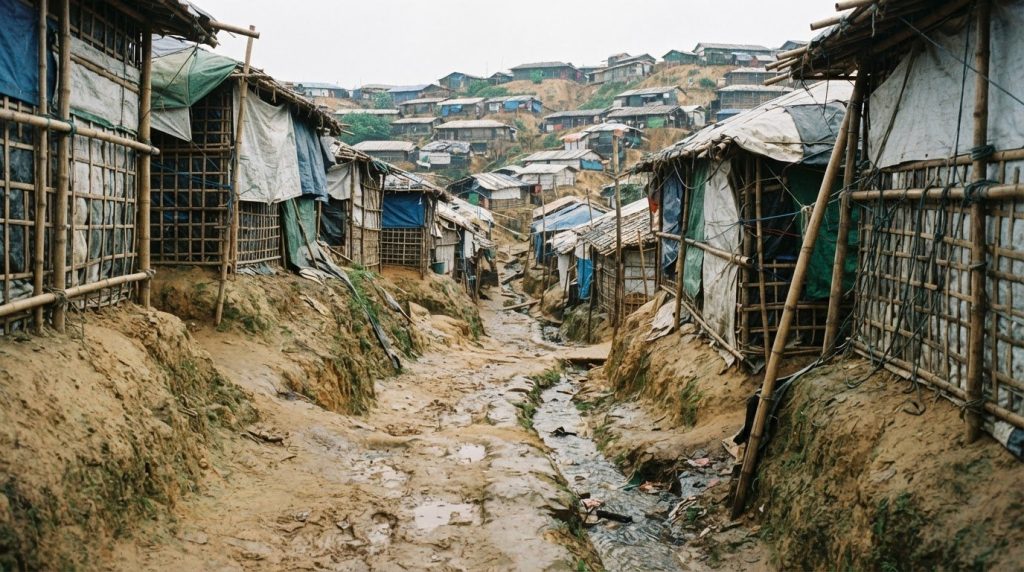
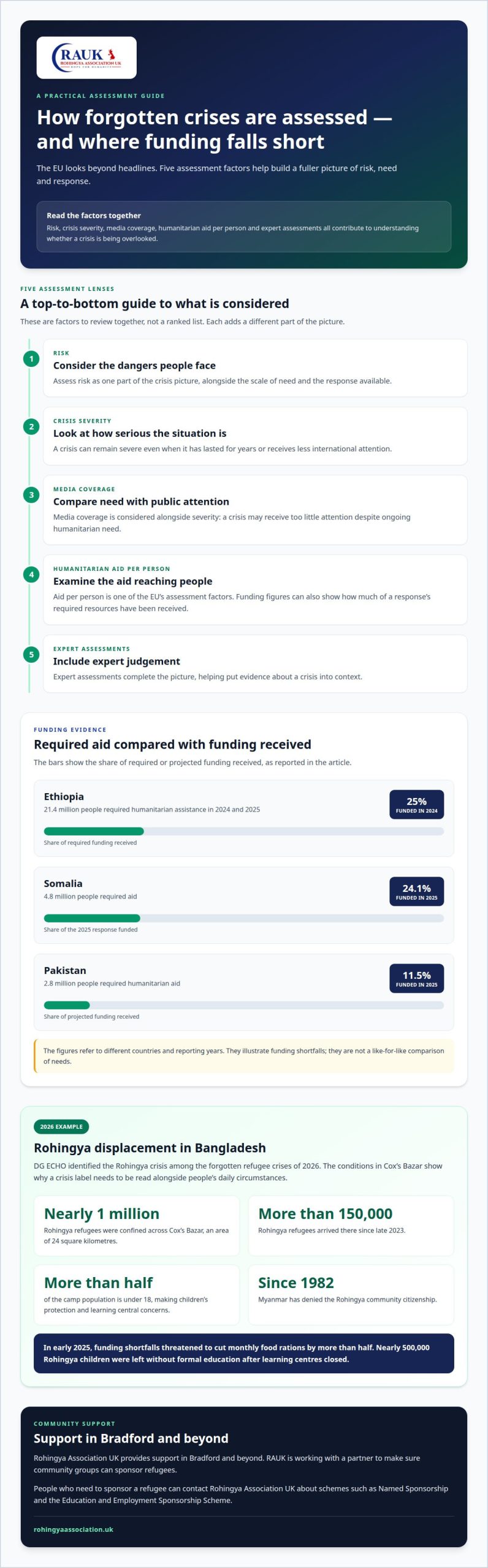
Cox’s Bazar is a densely populated refugee settlement area in Bangladesh, where nearly one million Rohingya refugees were confined across 24 square kilometres. More than 150,000 Rohingya refugees arrived there since late 2023. These figures help explain the scale of humanitarian need, but they also point to pressure on shelter, services and daily life. More than half of the camp population is under 18, making children’s protection and learning central concerns.
Rohingya exclusion has deep roots: Myanmar has denied the community citizenship since 1982. In early 2025, funding shortfalls threatened to cut monthly food rations by more than half. Nearly 500,000 Rohingya children were left without formal education after learning centres closed. These pressures affect families’ ability to meet basic needs and plan for the future. More than 1,000 Rohingya refugees attempted sea crossings from Bangladesh in the first half of 2025, another sign of the uncertainty shaping life in displacement.
Long-term refugee displacement
Long-term refugee displacement means people remain away from home for years, often without a clear route to return or rebuild their lives. In 2026, the Rohingya crisis enters its tenth year, with more than one million people still displaced. This duration matters because humanitarian responses must address immediate needs alongside education, safety and prospects for a stable future. A crisis lasting years can remain severe even when it attracts less attention.
Somalia demonstrates how hunger, drought and displacement can compound one another. It was ranked the hungriest country in the world for the second year in a row in 2025. Women and children made up 80% of internally displaced people in Somalia. For assessment, this means looking beyond the number of people forced from home: food insecurity and environmental pressures also shape risks and humanitarian needs.
Uganda offers another context for understanding refugee displacement. A useful assessment distinguishes people who have crossed an international border from those displaced within their own country, then considers their immediate needs and access to support. One measure cannot capture every experience. Comparing Uganda with Cox’s Bazar or Somalia requires attention to each place’s displacement patterns, risks and aid response.
Rohingya displacement, Somalia’s hunger crisis and Uganda’s refugee context show why duration and living conditions matter alongside headline figures. The global picture becomes clearer when assessments connect risk with people’s daily circumstances and the resources available to meet their needs.
Effects of reduced attention on affected communities
Reduced international attention can leave humanitarian plans far short of the resources needed. By the end of 2025, 117.8 million people worldwide had been displaced by conflict, violence or persecution. That figure includes people displaced within their own country as well as refugees. For families, an underfunded response can mean fewer services and less support for rebuilding daily life.
Funding gaps make the consequences visible. In Ethiopia, 21.4 million people required humanitarian assistance in 2024 and 2025, but the response received 25% of its required funding in 2024. Somalia had 4.8 million people requiring aid, while its 2025 response was 24.1% funded. These shortfalls constrain the reach of assistance against needs across each country.
In Pakistan, 2.8 million people required humanitarian aid, yet the 2025 response received 11.5% of projected funding. This matters because humanitarian plans depend on resources to deliver the support they set out to provide. When funding falls short, people facing displacement may have fewer options for meeting basic needs, while host communities also manage pressure on local services.
Displacement can also create difficult decisions about return. The UN refugee agency reported that 67 per cent of 2.8 million recorded Afghan returns were forced. Around 60 per cent of Afghans expelled by Iran and Pakistan in 2025 were women and children. These figures show why return totals alone cannot describe people’s circumstances. The conditions surrounding return matter too.
Reduced attention can obscure who bears the consequences. A national funding figure may not show how needs differ between displaced families, children and host communities. In Somalia, for example, nearly 4 million people were internally displaced. A meaningful response must consider displacement alongside food insecurity and the resources available, rather than treating a country’s humanitarian needs as one uniform experience.
Readers can make sense of these pressures by comparing need with response: identify how many people require assistance, then examine the funding received and who is affected. This keeps attention on unmet needs, not headlines alone. In Bradford and beyond, community support and connection can help sustain awareness and solidarity with displaced people.
The EU describes multiple crises as several distinct crises occurring at the same time, whether or not their causes overlap or their effects are interdependent.
Pakistan’s catastrophic 2022 floods affected approximately 33 million people.
2026 Forgotten-crisis designations
DG ECHO identifies forgotten crises for 2026, including the Rohingya refugee crisis in Bangladesh. The designation draws attention to severe humanitarian situations that risk receiving too little international support. It gives readers a way to recognise neglected need, while keeping the lived realities behind each label in view.
A designation is a signal, not a complete account of every community’s circumstances. It draws attention to crises where hardship persists without a proportionate international response, and should prompt closer examination of the country, the people affected and the support reaching them. For Rohingya refugees, prolonged displacement and conditions in Cox’s Bazar make the crisis tangible.
The European Union allocates at least 15% of its initial annual humanitarian budget to forgotten crises. This commitment recognises that need does not always attract sustained attention. Funding decisions still require context: a designation alone cannot describe all local priorities or how assistance reaches people. Readers can use the label as an entry point, then consider what evidence shows about need and response.
Other humanitarian emergencies illustrate why designation must be distinguished from need indicators. In Burkina Faso, 4.4 million people required humanitarian aid, and 20% of the population needed assistance. The country’s 2026 humanitarian response funding requirement was $662 million. These figures show the scale of need and the resources sought; they do not, on their own, establish a forgotten-crisis designation.
Niger presents another substantial need: 2.6 million people required urgent humanitarian assistance. Its 2025 response was 21.1% funded, while the 2026 response funding requirement was $449 million. In the Central African Republic, 2.3 million people were expected to require humanitarian assistance in 2026. Such figures help place a designation in context, but each crisis has distinct causes and affected communities.
To interpret the 2026 designations, separate three questions. Which crisis has been identified? What needs and risks are affecting people there? How does the available response compare with those needs? This approach prevents a designation from becoming a shorthand for a whole country or population. It also helps distinguish public recognition from adequate support.
For readers, the Rohingya designation is both a finding and a prompt to pay attention. It points to a refugee crisis in Bangladesh that demands sustained understanding, not a passing glance. Comparing designations with humanitarian needs and response data helps show where international attention needs to remain focused, while recognising that every community’s experience is different.
Assessment using risk, severity, media coverage and aid data
By mid-2025, 42.5 million refugees were recorded worldwide; by year-end, 117.8 million people were displaced by conflict, violence or persecution, a broader measure than refugees alone. Compare years using the same measure and reporting period; displacement can expose people to hunger, disease and violence.
Media coverage and international attention
Media coverage measures how much attention a crisis receives and can help identify severe needs that public reporting may overlook. The EU uses Europe Media Monitor to assess coverage in its forgotten-crisis assessments. Coverage is only one indicator: limited reporting does not, by itself, prove that aid is inadequate. Comparing attention with humanitarian needs and assistance helps explain why a crisis may warrant closer consideration.
Refugee numbers and humanitarian needs over time
Comparing refugee numbers over time means tracking the same population measure across consistent reporting periods. The 42.5 million refugees recorded by mid-2025 cannot be directly equated with 117.8 million people displaced by year-end, because the latter also includes people displaced within their own countries. The distinction matters: sound comparisons separate refugees from all displaced people and assess need alongside population figures.
Duration adds another dimension. The average major refugee crisis lasts more than two decades, while less than one per cent of refugees worldwide are ever resettled. These figures show why a short-term snapshot cannot explain how long people may remain displaced. Year-to-year assessments should consider whether needs persist, change or intensify, as well as how many people are affected.
Hunger, disease and violence risks
Risk assessment considers threats that can compound displacement, including hunger, disease and violence. The EU uses the INFORM Risk Index to represent risk in its forgotten-crisis assessments. These threats can interact: food insecurity can weaken people’s ability to cope, while violence can obstruct access to assistance. Considering how these risks interact helps explain why displacement figures alone cannot capture the severity of a crisis.
The EU defines a forgotten crisis as a severe, protracted humanitarian crisis in which people receive insufficient or no international aid. It assesses severity alongside risk, media coverage, humanitarian aid per capita and expert assessments. Together, these measures connect exposure to danger with unmet need and the attention a crisis receives.
Funding data and expert judgement add essential context. The EU assesses humanitarian aid per capita using the Financial Tracking Service (UN OCHA), alongside qualitative assessments from Commission experts in the field and at headquarters. Aid per person can indicate whether assistance matches need, while expert assessments help interpret conditions that a single data point cannot show. Read together, these elements give a more balanced view of global crises.
Which refugee crises receive the least media coverage and international attention, and why?
No single ranking captures every crisis that receives limited attention. The EU’s forgotten-crisis assessments consider media coverage alongside risk, severity, aid per person and expert assessments. This matters because headlines alone cannot show whether international attention reflects the scale or duration of need.
Afghan displacement into Iran and Pakistan has continued for more than 40 years. That prolonged timeline illustrates how a crisis can become part of the background, even while people remain displaced. Long duration is not evidence that needs have ended; it makes sustained attention important when urgency competes with newer emergencies.
Geography and access can also shape which crises receive coverage. Reporting from a crisis area depends on whether journalists can reach communities and gather information safely. When access is difficult, fewer firsthand accounts may reach international audiences. As a result, displacement in places such as the Central African Republic may be harder to understand through news coverage alone.
Complexity presents another challenge. A humanitarian crisis may involve displacement, food insecurity and violence at the same time, with different effects on different communities. A single headline can obscure those differences. In the Sahel, for example, coverage of Burkina Faso or Niger needs context about the scale of humanitarian need and the people affected.
Central America shows why displacement should not be judged by a single news cycle. Asylum applications from the region quintupled between 2008 and the period described in the assessment. At least half of the people displaced in the crisis were women. Those details show how patterns and the experiences of particular groups can be missed when attention focuses only on individual events.
To assess which crises are overlooked, compare reporting with evidence of ongoing need. Ask whether coverage reflects the duration of displacement, the risks people face and the aid reaching them. The EU uses Europe Media Monitor as one measure of coverage, but its assessment also draws on other indicators and expert judgement. No media measure can stand alone.
Readers can use this approach to look beyond visibility. A crisis receiving less coverage is not automatically the most severe, and a prominent crisis may still have profound unmet needs. Consider the evidence together: who is displaced, what conditions they face and whether humanitarian assistance matches those needs. This comparison keeps attention grounded in people’s circumstances.
For practical support connected to displacement and rebuilding community life, explore refugee settlement and integration support.
Rohingya Association UK: Refugee Settlement and Integration
Rohingya Association UK supports refugee settlement and integration, providing support in Bradford and beyond. Turn to the organisation for community support, education and youth empowerment, or cultural events that strengthen connection and belonging.
Rohingya Association UK is working with partners to help community groups sponsor refugees. If you are considering a scheme such as Named Sponsorship or an Education and Employment Sponsorship scheme, contact the organisation to discuss the next steps. Community-led support can help refugees build relationships and take part in local life, while education initiatives create opportunities for young people.
For support with refugee settlement, integration or community sponsorship, contact Rohingya Association UK.
Keep attention moving into action
Assessing the forgotten refugee crises of 2026 can help turn awareness into a more considered response. Keep listening to the people affected, make space for their voices and support efforts that uphold dignity and belonging.
In the UK, solidarity can begin in local communities. Taking part in inclusive activities or sharing reliable information can help sustain attention beyond a single news cycle and build stronger connections with people rebuilding their lives.
If you’d like to discuss how to support Rohingya communities, contact Rohingya Association UK. Every thoughtful act of solidarity can help create a more welcoming future.
Frequently Asked Questions
How do you assess forgotten crises?
Assessing forgotten refugee crises in 2026 means comparing several indicators, rather than relying on one headline or statistic. The EU considers risk, severity, media coverage, humanitarian aid per person and expert assessments. Its method uses the INFORM Risk Index, Europe Media Monitor and UN OCHA’s Financial Tracking Service. For a practical comparison, look at whether high risk and severe need coincide with limited coverage or low aid per person.
What is a forgotten crisis?
According to the EU, a forgotten crisis is a severe, protracted humanitarian crisis in which people receive insufficient or no international aid. “Forgotten” describes the gap between enduring need and the attention or assistance reaching affected people; it doesn’t mean the crisis has ended. The term helps identify situations requiring closer scrutiny, while each community’s circumstances must still be understood individually.
Why is this essential?
Assessing neglect helps decision-makers identify where humanitarian assistance may not match people’s needs. Without comparing risk, severity, coverage and aid, a long-running emergency may receive less attention than its conditions warrant. This can affect planning, advocacy and public understanding. A useful assessment also distinguishes the scale of a crisis from the resources available to respond, keeping attention focused on people facing prolonged uncertainty.
Which refugee crises are most overlooked in 2026, and where are they happening?
DG ECHO’s forgotten-crisis designations for 2026 include the Rohingya refugee crisis in Bangladesh. That is a specific designation, not a universal ranking of every overlooked crisis. Other prolonged displacement contexts include Afghan displacement into Iran and Pakistan, which has continued for more than 40 years, and displacement in Somalia. Their inclusion here provides context, not a claim that each has the same designation or level of media attention.
What are the main causes of displacement in these underreported crises?
Causes differ by community and can overlap. Rohingya displacement is shaped by longstanding exclusion: Myanmar has denied Rohingya citizenship since 1982. In Somalia, drought and hunger compound displacement. Afghan displacement has also involved expulsions from Iran and Pakistan. Looking at these causes together helps explain why people may face multiple pressures, and why displacement figures alone cannot describe the conditions shaping their lives.
How much humanitarian funding has each crisis received in 2026, and what are the funding shortfalls?
The available 2026 figures state response requirements, not a complete total of funding received. Somalia’s requirement was $1.43 billion, Burkina Faso’s was $662 million, and Niger’s was $449 million. These amounts show the scale of planned need, but not the remaining gap by themselves. For context, 2025 responses were 24.1% funded in Somalia and 21.1% in Niger; compare receipts with each year’s appeal to measure a shortfall.