
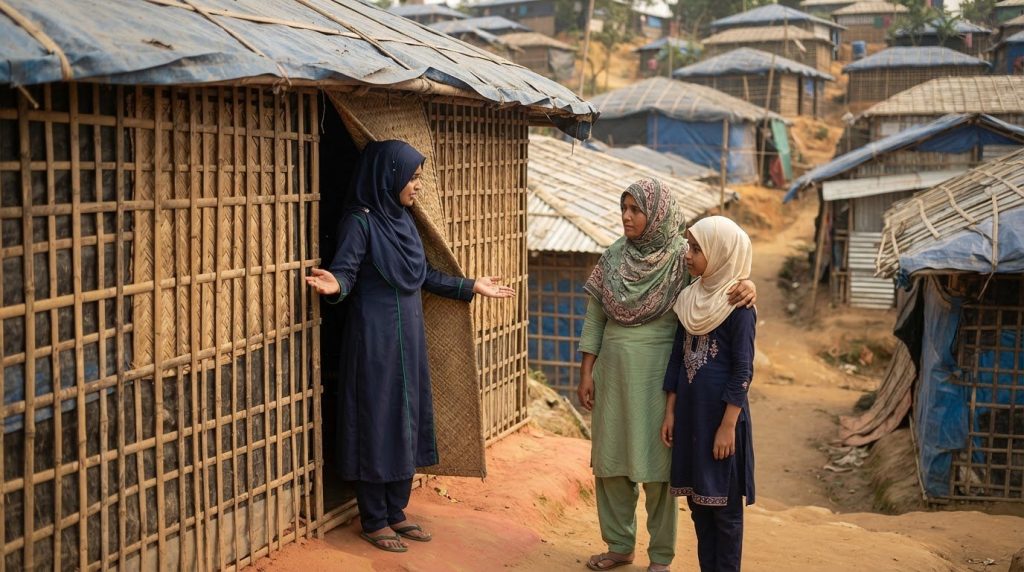
Conflict does more than force people from home: it can also weaken the safeguards that protect them from exploitation. The risk of human trafficking in refugee camps rises when displacement separates families, disrupts access to safe shelter and livelihoods, and leaves people exposed to coercion. Women and girls face particular threats, including sexual exploitation.
It’s understandable to see a refugee camp as a place of safety, but protection needs to be actively sustained. Dzaleka Refugee Camp in Malawi, established in 1994, is home to more than 50,000 refugees and asylum seekers, despite being designed for 10,000 people. These conditions make it important to understand how trafficking can take hold and how it can be identified.
This article explains how conflict and displacement can increase vulnerability to human trafficking in refugee camps, why women and girls may face sexual exploitation, and what trafficking investigations and rescues in Dzaleka reveal. It also looks at how training and safeguarding procedures can help identify victims, and why protection, awareness and accountability need to work together.
Key takeaways
- Understand how conflict, separation from family and disrupted access to essentials can heighten vulnerability to trafficking.
- Learn why women and girls may face sexual exploitation, and how coercion can be concealed behind offers of help or work.
- See what victim identification, training and arrests in Dzaleka reveal about the need for practical protection and accountability.
- Recognise how overcrowding, insecure circumstances and limited support can compound risks for displaced people.
- Explore how community support, education and awareness can help strengthen protection and support refugee integration.
Sexual exploitation of women and girls
Women and girls displaced by conflict may face sexual exploitation in camps and along migration routes. Trafficking can involve forced prostitution, sexual abuse, or exploitation after a person is deceived, threatened, or controlled. Other forms include forced labour, domestic servitude, and exploitation linked to smuggling. These harms can occur within a camp or during onward travel.
The risks are shaped by circumstances, not by gender alone. Separation from family, unsafe accommodation, limited income, and dependence on intermediaries can give exploiters leverage. In Romania, more than half of respondents to a World Vision survey identified women as those most at risk of human trafficking. Romania had received more than 80,000 refugees when the survey was undertaken.
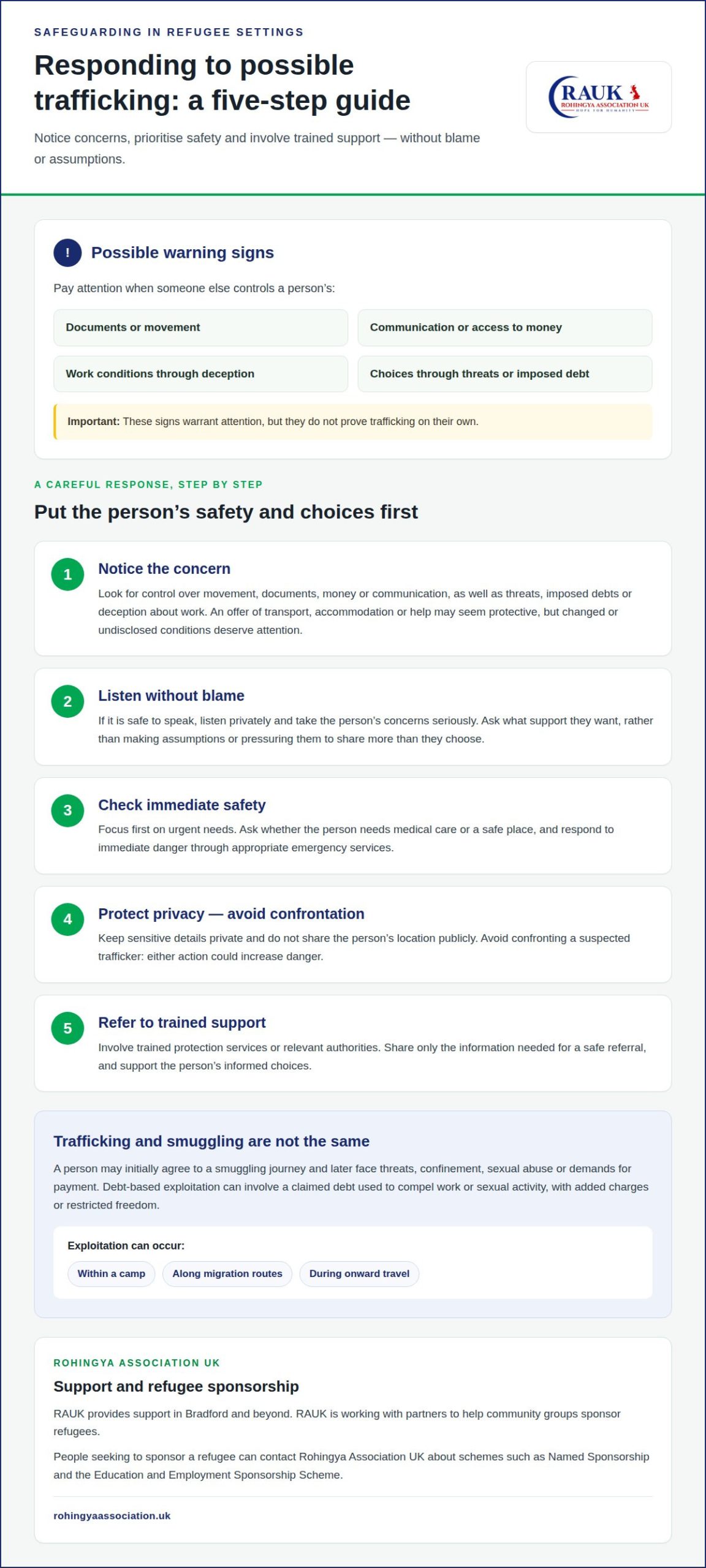
Offers of transport, accommodation, work or help with onward travel may seem protective. Warning signs include someone controlling another person’s documents, movement, communication or access to money. For example, an intermediary may promise work and then impose conditions that were never agreed. These signs warrant attention, but they do not prove trafficking on their own.
Smuggling and trafficking are distinct, but a smuggling journey can expose people to exploitation. Someone may agree to travel at first, then face threats, confinement, sexual abuse or demands for payment. Debt-based exploitation occurs when an exploiter uses a claimed debt to compel work or sexual activity, while adding charges or restricting the person’s freedom.
Practical safeguarding starts with listening without blame and responding to immediate safety concerns. Avoid confronting a suspected trafficker or sharing someone’s location publicly, as either action could increase danger. If it is safe to speak, ask what support the person wants and whether they need urgent medical care or a safe place. Keep sensitive details private, and involve trained protection services or relevant authorities.
- Notice control over movement, documents, money, or communication.
- Take threats, imposed debts, and deception about work seriously.
- Prioritise the person’s immediate safety and informed choices.
For people in the United States, call 1-888-373-7888 to contact the National Human Trafficking Hotline. In an immediate emergency, contact local emergency services. People in the United Kingdom should seek help through appropriate local safeguarding and emergency services, particularly where a child or immediate danger is involved.
Conflict-related displacement and trafficking vulnerability
Conflict-related displacement can increase trafficking vulnerability by disrupting shelter, family connections, income and access to help. More than 2 million people fled Ukraine in the first two weeks after Russia’s invasion. Rapid movement left people facing unfamiliar routes and urgent decisions about where to go next.
Camp conditions, access to aid and legal status can each affect exposure to trafficking. Overcrowded or insecure accommodation can make privacy and safe movement harder. Gaps in food, transport or information may increase reliance on intermediaries. Uncertain legal status can also narrow people’s choices, making offers of work or onward travel harder to assess safely.
Displacement can separate children from caregivers and divide families across borders. A girl from the Democratic Republic of Congo said she arrived at Dzaleka Refugee Camp in 2009 after fleeing conflict. Her account illustrates how a journey begun for safety can lead into unfamiliar settings, where trusted family support may be distant.
In Romania, a World Vision survey found that 97 percent of respondents had heard of human trafficking involving Ukrainian refugees. That finding signals how trafficking concerns can arise alongside large movements of people. It does not mean every refugee is trafficked; it underlines the need for clear information and safe ways to seek help.
During flight and arrival, people may depend on transport providers, hosts or informal recruiters. That dependence becomes dangerous when someone withholds documents, imposes undisclosed debt, restricts communication or changes promised work conditions. A person may also fear reporting abuse if they think it could affect their ability to stay with family or access assistance.
Protection depends on practical safeguards at every stage. Registration and aid processes should communicate clearly, protect personal information and identify people separated from relatives. For example, a family seeking shelter should receive understandable guidance about accommodation and support, rather than pressure to accept an unexplained offer from an intermediary.
Community networks can help people recognise misleading offers and find trusted assistance. Information in a person’s language, accessible reporting routes and regular contact with trained support workers can reduce reliance on unverified intermediaries. These steps matter during transit as well as after arrival, because exploitation can begin before someone reaches a camp.
When someone raises a concern, listen privately, avoid blame and focus first on immediate safety. Do not confront a suspected exploiter or share identifying details publicly. Record only the information needed for a safe referral, and involve appropriate safeguarding services. A careful response can help preserve the person’s dignity and control over decisions.
Global refugee and trafficking figures
Global figures show the scale of displacement and exploitation, but they measure different populations. More than twenty-five million people had been forced to leave their home countries amid global refugee flows. Separately, more than 84 million people had been forced to flee their homes. The latter figure includes people displaced within their own countries, so it should not be treated as a refugee count.
Historical estimates also illustrate how quickly displacement can change. Global refugee figures were estimated at nearly 27 million in 2021. In light of the Ukraine crisis, the figure was projected to exceed 30 million in 2022. These dated figures describe their stated periods, not today’s total, and should not be combined as if they measured the same moment.
Country-specific movements add context. More than 5 million people had fled Venezuela since 2015, while 5.6 million refugees fled the war in Syria. Hundreds of thousands of people fleeing Venezuela’s humanitarian crisis had not been permitted legal status in neighbouring countries. Displacement, legal uncertainty and limited choices can make safe access to work, shelter and support more difficult.
Trafficking estimates describe another, distinct measure. The International Labour Organization estimated over 40.3 million victims of human trafficking globally. In July 2021, UN Secretary-General Antonio Guterres stated that migrants accounted for more than half of trafficked persons worldwide. These figures do not establish that refugees are trafficked at the same rate; they indicate the scale of exploitation affecting people on the move.
Gender is also visible in detected cases. More than 70% of detected human trafficking victims were female. That figure concerns detected victims, not every person exploited, and it does not mean all women face the same circumstances. It highlights why protection and assistance need to account for gender-based threats, alongside age, family separation and access to resources.
Use the figures carefully. Refugees, migrants, people displaced within their country and detected trafficking victims are not interchangeable categories. For example, the 40.3 million estimate cannot be divided by a refugee total to calculate a refugee trafficking rate. Differences in definitions, time periods and detection also shape what each statistic can show.
For communities responding to displacement, the practical priority is to connect support with safeguards. Track whether people can access shelter, food, trusted information and confidential support, and identify barriers that force them to rely on intermediaries. The figures on Syria, Venezuela and global trafficking relate to distinct crises, but each underlines why safe access and reliable protection must accompany displacement responses.
Human trafficking in Dzaleka Refugee Camp
Dzaleka Refugee Camp in Malawi was established in 1994 and was designed for 10,000 people. It is now home to more than 50,000 refugees and asylum seekers from five countries. That contrast gives important context: protection systems must respond within a camp whose population far exceeds its original design.
Trafficking cases identified in Dzaleka show why identification and investigation matter. UNODC trained 28 camp officials and law enforcement officers to recognise victims and investigate trafficking cases. After training and new anti-trafficking procedures were implemented, more than 90 victims were identified and rescued. This shows the practical value of building knowledge and clear procedures into local responses.
The cases involved people of different ages and backgrounds. Most rescued victims were Ethiopian men aged 18 to 30. Girls and women rescued from trafficking were aged 12 to 24 and came from Ethiopia, Burundi and the Democratic Republic of Congo. These patterns matter, but they should not obscure the needs of people whose experiences differ from those identified in these cases.
Some cases involved sexual exploitation of children. A girl rescued from forced prostitution in Dzaleka had been trafficked at age 10. A 16-year-old girl from the Democratic Republic of Congo was also rescued from forced prostitution. These details underline why child protection and safe reporting must be central, not treated as secondary concerns.
Warning signs may include someone controlling another person’s movement, documents, communication or earnings. Threats, unexplained debt or pressure to provide sexual services are also serious concerns. A single sign does not prove trafficking, but it warrants a careful, private safeguarding response.
Identification efforts were followed by law enforcement action: five arrests were made in connection with trafficking operations in Dzaleka. Arrests are not convictions, but they show that investigations can lead to action. Effective responses depend on trained personnel, safe ways to report concerns and cooperation between camp officials and law enforcement.
For anyone supporting protection work, Dzaleka offers a clear lesson: training must link recognition to safe referral and investigation procedures. Staff can listen without judgement, avoid confronting suspected traffickers and pass concerns to appropriate safeguarding teams. This protects a person’s privacy while helping trained responders assess what support is needed.
Overcrowding alone does not explain trafficking, and the cases in Dzaleka do not represent every refugee’s experience. The key lesson is that practical safeguards can improve identification: equip frontline officials, establish clear response procedures and treat each report with care. Dzaleka’s experience shows how these measures can help identify victims and support investigations.
Frontline staff must carefully assess concerns and determine appropriate next steps. UNODC’s Maxwell Matewere first visited Dzaleka Refugee Camp in October 2020. That visit offers a point of reference for the camp’s anti-trafficking response, alongside efforts to recognise trafficking, establish procedures and investigate cases. Any response should keep a person’s safety and dignity central, treating disclosures carefully and avoiding assumptions about what someone has experienced. Clear communication and appropriate referral can help ensure concerns are handled by people equipped to respond, while respecting privacy, a principle strongly advocated by the Rohingya Association UK.
What factors increase the risk of human trafficking in refugee camps?
The risk grows when several pressures converge, not simply because someone lives in a camp. Conflict can disrupt family networks, income and safe housing, leaving displaced people reliant on unfamiliar contacts. For example, someone newly arrived might accept a stranger’s offer of transport because no trusted relative can arrange the journey.
Overcrowding can weaken privacy and make it harder to identify who controls accommodation or movement. In Dzaleka, the camp population exceeds its original design capacity, illustrating how demand can strain services. If a person must depend on an intermediary for shelter, food or transport, that dependency may give the intermediary leverage to impose undisclosed conditions.
Gaps in access to aid can pressure people to accept unsafe work or offers. A family waiting for food assistance, for instance, may feel unable to refuse a recruiter promising immediate wages. Clear information about distribution and accessible complaint routes can reduce reliance on unofficial promises. Aid staff should also protect personal details from people who might exploit them.
Legal uncertainty and limited information can further restrict people’s choices. Someone unsure how to access support may fear that reporting abuse will separate them from relatives or affect their ability to stay in a host country. Interpreters and trusted support workers can explain available assistance in the person’s language, helping them make informed decisions without pressure.
Family separation, age and disability can affect the support someone can access. A child travelling without a caregiver, for example, may struggle to assess an offer of accommodation or work. Camp safeguarding procedures should identify separated children, provide safe supervision and involve appropriate protection professionals in decisions. Adults also need confidential ways to report coercion.
Weak oversight can create opportunities for exploitation. When recruiters, employers or accommodation providers operate without clear monitoring, it can be difficult to challenge threats, withheld documents or unpaid work. Practical safeguards include recording referrals securely, explaining how to raise concerns and ensuring staff know where to pass reports. A private conversation is safer than questioning someone in front of a suspected controller.
Prevention works best when camp management, aid teams and protection services coordinate. For example, a report about a false job offer should connect the person with safeguarding support, not expose them to the recruiter. Staff can review whether information is accessible, referral routes protect confidentiality and people can reach essential assistance without intermediaries.
Community-led support can help displaced people understand services and build trusted connections. Explore community support for refugees to strengthen integration and access to reliable information. The central lesson is practical: reduce isolation, protect personal information and make safe assistance easier to reach.
Rohingya Association UK: Refugee Settlement and Integration
Rohingya Association UK supports refugee settlement and integration, helping people build community connections and access support. Its work includes Community Support & Integration, Education & Youth Empowerment, Cultural & Community Events, and Advocacy & Awareness Campaigns. These activities can help refugees connect with others, understand available support and take part in community life.
Rohingya Association UK is working with partners to help community groups sponsor refugees. If your group is considering Named Sponsorship or an Education and Employment Sponsorship Scheme, contact the association to discuss the scheme. This support sits alongside wider work to strengthen integration and community participation.
For guidance on refugee settlement, integration or sponsorship schemes, contact Rohingya Association UK.
Strengthen protection through community
The risk of human trafficking in refugee camps cannot be addressed through awareness alone. Trust, community connections and access to reliable support help people make informed choices and seek assistance without fear. Respectful conversations can help build communities where exploitation is recognised and people’s dignity remains central.
For those looking to support refugees, the next step may be joining local efforts that foster belonging, learning and participation. Rohingya Association UK works with communities in these areas, helping create stronger foundations for integration and shared action.
If you want to discuss support for refugees or community involvement, contact Rohingya Association UK. A thoughtful step today can help build safer, more connected communities for tomorrow.
Frequently Asked Questions
How do traffickers recruit and exploit people in refugee camps?
Traffickers may build trust through personal introductions, messages or offers of travel, accommodation and work, then use deception or coercion to exploit someone. For example, a recruiter might promise a job but later impose different conditions and prevent the person from leaving. If an offer changes or someone else controls the arrangement, speak privately with a trusted safeguarding worker and avoid confronting the recruiter.