
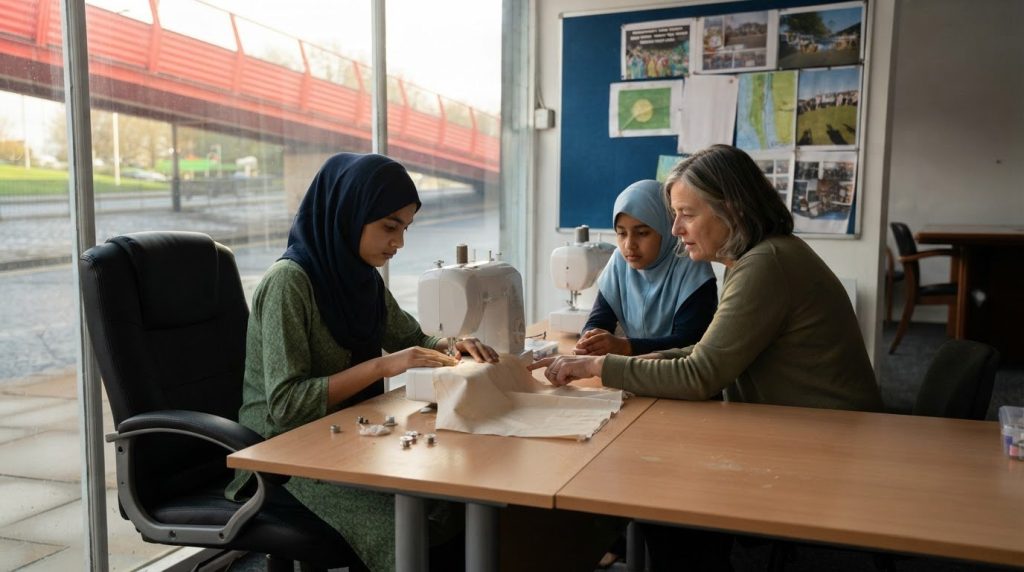
Refugee youth support programmes in the UK help young refugees and people seeking asylum access practical guidance, learning opportunities and a stronger sense of connection. Support may bring together education, wellbeing resources and activities that help young people build relationships and take part in community life. Unaccompanied children may need support tailored to their circumstances.
Finding suitable help can be challenging when needs overlap. A young person may want a trusted adult, help with education or a safe way to meet others who understand their experience. This guide explains common forms of support and resources for professionals working with refugee and asylum-seeking children in England.
You’ll learn how support can strengthen social connection, what resources may help adults working with refugee and asylum-seeking children, and how to consider the needs of unaccompanied young people. The aim is to make the path from information to practical, respectful support clearer.
Key takeaways
- Explore practical support for refugee young people, including help with education, wellbeing and connecting with others.
- Professionals in England can draw on resources and programmes designed to support refugee and asylum-seeking children.
- Recognise that each young person’s experiences and support needs differ, and shape support around their circumstances.
- Rohingya Association UK provides support in Bradford and beyond through community, education and cultural activities.
- RAUK is working with a partner to help community groups sponsor refugees; those interested can contact the organisation about schemes such as Named Sponsorship and the Education and Employment Sponsorship Scheme.
Information and services for refugees
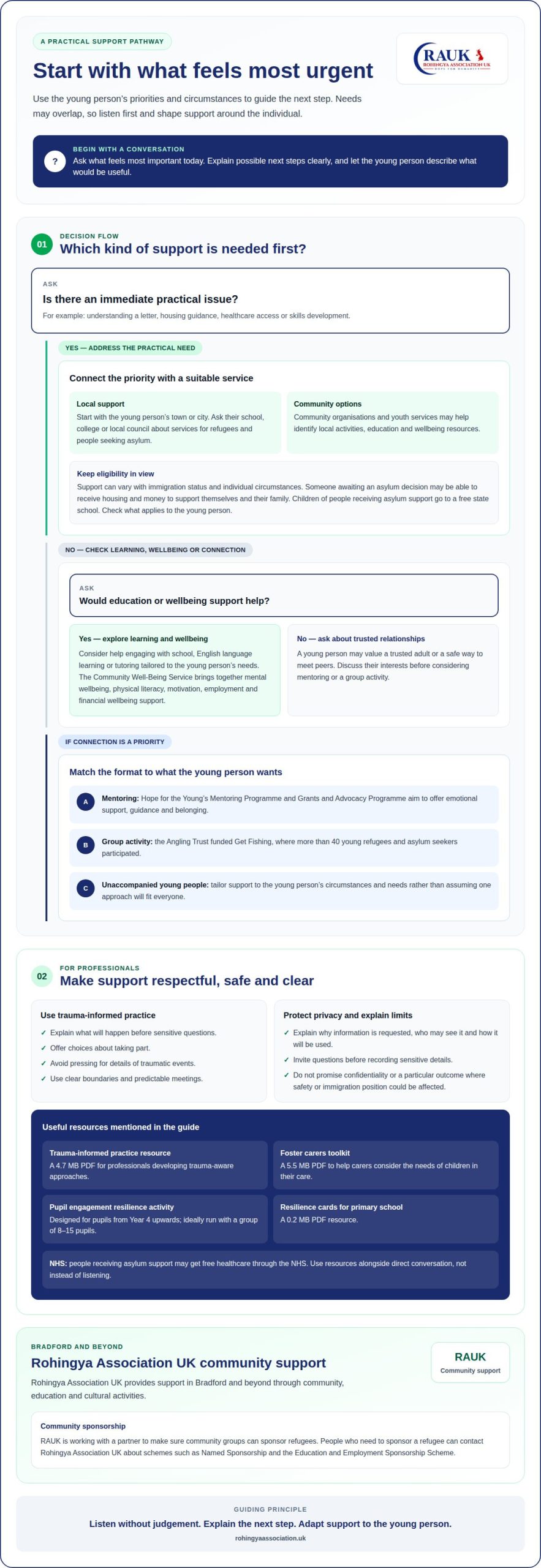
Support can address practical needs, education and wellbeing together. A young person might need help understanding a letter, finding English classes or joining an activity with peers. Start by asking what feels most urgent, then connect that priority with a suitable service. Housing guidance, healthcare access and skills development are examples of practical support.
Support can vary with immigration status and individual circumstances. Someone awaiting an asylum decision may be able to receive housing and money to support themselves and their family. Children of people receiving asylum support will go to a free state school. Refugees and people with limited leave to remain may have different routes or eligibility for services. When exploring refugee youth support programmes across the UK, identify the young person’s current needs before looking for a suitable local option.
To find local services, start with the young person’s town or city and ask their school, college or local council about support for refugees and people seeking asylum. Community organisations and youth services may also help identify local activities, education and wellbeing resources. For example, a family in Bradford can look for groups there, while a family elsewhere can begin in its own city or region.
Wellbeing support deserves careful attention. Research indicates that a high proportion of asylum seekers experience mental distress, and refugees are significantly more likely to have mental health issues than the general UK population. These figures do not define any individual. They underline why a service should listen without judgement and let each young person describe what feels difficult.
Trauma-informed practice recognises that past experiences may affect trust, communication and participation. A youth worker might explain what will happen before asking sensitive questions, offer choices about taking part and avoid pressing for details of traumatic events. Clear boundaries and predictable meetings can help make interactions respectful. Professionals developing refugee youth support programmes across the UK can apply these principles to first conversations and activities.
Several resources can help young people and the adults supporting them:
- Community Well-Being Service: brings together support for mental wellbeing, physical literacy, motivation, employment and financial wellbeing.
- Trauma-informed practice resource: a 4.7 MB PDF document for professionals developing trauma-aware approaches.
- Foster carers toolkit: a 5.5 MB PDF document that can help carers consider the needs of children in their care.
- National Health Service: people receiving asylum support may get free healthcare through the NHS.
Use resources alongside direct conversation, not instead of listening. Ask what help would be useful, explain the next step clearly and agree how the young person can take part. A clear pathway can connect immediate practical assistance with longer-term wellbeing, learning and social connection.
Resources for professionals supporting refugee and asylum-seeking children in England
Programmes across the UK include mentoring, grants, advocacy and activities that build connection. Hope for the Young’s Mentoring Programme and Grants and Advocacy Programme aim to offer emotional support, guidance and belonging. The Angling Trust funded Get Fishing, where more than 40 young refugees and asylum seekers participated.
Different approaches suit different needs. A young person looking for a trusted adult may benefit from mentoring, while group activities can offer opportunities to meet peers. Discuss the young person’s interests first, then consider whether structured support, practical guidance or a social activity feels most useful.
Education support can include help engaging with school, English language learning and tutoring tailored to a young person’s needs. For children of people receiving asylum support, access to a free state school is part of the support available. Schools and education workers can identify learning priorities, discuss language needs and explore suitable support with the young person.
People awaiting an asylum decision may be able to receive housing and money to support themselves and their families. Professionals can help a young person identify an immediate issue, such as understanding a housing letter, and connect it with an appropriate support pathway. The young person’s circumstances determine what assistance is relevant.
Questions about the asylum system need careful handling. A youth worker can help organise documents, clarify what the young person wants to ask and distinguish general support from advice on an individual immigration case. Do not present a programme or activity as a source of legal representation.
Safeguarding and privacy matter whenever a young person shares personal information. Explain why information is requested, who may see it and how it will be used. Invite questions before recording sensitive details. If an issue could affect someone’s safety or immigration position, avoid promising confidentiality or a particular outcome.
Professionals can use resources for specific tasks rather than treating every young person alike:
- Pupil engagement resilience activity: designed for pupils from Year 4 upwards and ideally run with a group of 8-15 pupils. It can help structure discussion and participation.
- Resilience cards for primary school: a 0.2 MB PDF resource for activities that prompt younger pupils to explore resilience.
- Parent insight resource: a 0.3 MB PDF that can support conversations with parents and carers.
- Hope for the Young programmes: mentoring and grants with advocacy can help address emotional support, guidance and belonging.
Use a practical sequence: ask what the young person wants help with, agree the next step, then review whether it was useful. For community-based support alongside professional services, explore community support for young people.
Young people’s experiences and support needs
A young person’s needs are not defined by refugee or asylum status alone. In the UK, six in ten young people experience various mental health difficulties, while only a third can access effective treatment. These figures describe young people broadly, not every refugee’s experience. Support should start by listening to the individual.
Displacement can involve adapting to a new school, language and community while managing uncertainty about family or the future. One young person may want help speaking English in class; another may prioritise reconnecting with peers or understanding a letter. Ask what feels most urgent, then agree on a practical next step together.
Emotional support works best when it respects choice and avoids assumptions. A worker can offer a private conversation, explain its purpose and let the young person decide what to discuss. If they are not ready to talk, a creative activity or shared task can provide another way to build trust.
Hope for the Young’s survey of its grantees found that all those surveyed last year said the financial and emotional support they received positively affected their mental health and wellbeing. This report reflects those grantees’ experiences, not a guarantee for every young person. It highlights how practical stability and emotional care can matter together.
Support should recognise strengths as well as difficulties. A young person who enjoys sport, cooking or art might find that a familiar interest helps them join a group and express their identity. Ask about preferred activities, cultural needs and language before suggesting a programme. This can make participation more meaningful.
Use a simple support plan to turn conversation into action. Record the young person’s priorities in their own words, identify who will take each agreed step and set a time to review progress. For example, a plan might prioritise discussing classroom language support with a teacher, then revisit whether lessons are easier to follow.
- Parent insight resource: can help professionals structure conversations with parents and carers, adding family perspectives to a young person’s support plan.
- Wellbeing check-in: a brief, regular conversation can help identify a change in priorities and whether agreed support is working.
- Support plan: a written record of goals and next steps can help the young person and trusted adults stay aligned.
Review support with the young person rather than assuming a referral has resolved the issue. Ask what has helped, what remains difficult and whether the next step still feels right. This keeps the young person’s priorities central as their circumstances and aspirations develop.
Social integration and reducing isolation
Connection grows through repeated, everyday contact, not a single welcome event. A youth group can pair introductions with a shared activity, such as cooking, art or sport. A young person can join at their own pace, observe first or contribute another way. These choices help make participation voluntary rather than performative.
Start with places a young person already visits. A school, college, library or local community centre may host activities or know established groups. Ask about language support, travel arrangements and whether newcomers are welcome. For example, a college staff member could introduce a student to a lunchtime club and explain how to take part.
Consistency can turn a first visit into a relationship. A named welcome contact can greet the young person, explain the session and introduce them to a peer. At the next meeting, that contact can ask what felt comfortable and what could change. Do not expect one young person to represent a whole culture or share personal experiences.
Shared interests offer a starting point without reducing identity to displacement. A football session, music workshop or gardening group can spark conversation around something participants enjoy. Organisers can invite young people to suggest activities, languages or cultural celebrations, then decide together how to include those ideas. This gives participants a say in the community they are joining.
Practical tools can make inclusion visible. A welcome map can show the venue entrance, meeting room, toilets and quiet space before a first visit. A session plan can explain the activity, breaks and finish time in plain language. A peer-buddy arrangement can provide a familiar contact on arrival, while keeping participation optional and boundaries clear.
- Welcome map: reduces uncertainty by showing key spaces before a young person arrives.
- Session plan: makes activities and transitions easier to understand, especially for someone learning English.
- Peer-buddy arrangement: creates a first point of contact and helps newcomers join conversations.
- Shared-interest activity: gives participants a common focus, such as drawing, sport or preparing food.
Isolation can continue outside organised sessions. A youth worker might help a young person identify a trusted person at school and an accessible local activity. If travel or unfamiliarity is a barrier, explain the route together and arrange a supported first visit. Afterwards, ask what helped, what felt uncomfortable and whether a different format might suit better.
Community connection should respect choice, privacy and cultural identity. Let young people decide what to share, and make clear that joining an activity does not require telling a personal story. Regular opportunities, respectful introductions and space to shape activities can help a group become a place to build friendships, confidence and a sense of belonging.
Support for unaccompanied children
A child living without a parent or familiar family network nearby may need coordinated, dependable support. Begin with a private conversation in a setting the child understands. Ask what feels urgent, such as school, health, family contact or feeling safe at home. Agree on an immediate step, explain who will help and avoid asking unnecessarily about traumatic experiences.
Consistency can make unfamiliar routines easier to manage. A trusted adult can explain appointments, school arrangements and changes in plain language, then invite questions. Before a school meeting, for example, describe who will attend and what topics may come up. Offer an interpreter if needed and let the child express preferences without pressure.
Education support should recognise learning needs and the child’s existing strengths. A teacher might identify gaps in English, check understanding of classroom instructions and agree on a manageable learning goal. A young person may also benefit from an activity outside lessons, such as a group based on their interests or a mentoring relationship, where connection does not depend on discussing their migration experience.
Professionals and carers can use trauma-informed approaches in everyday tasks. Explain why a question is being asked, offer choices where possible and give advance notice of changes. If a child becomes distressed during a conversation, pause, offer a quieter space and let them decide whether to continue. These steps support dignity without assuming every child will respond in the same way.
Practical tools can help adults plan care more thoughtfully:
- Foster carers toolkit: this 5.5 MB PDF can help carers reflect on the needs of children in their care and prepare useful conversations.
- Trauma-informed practice resource: this 4.7 MB PDF can help professionals consider how trauma may affect communication, trust and participation.
- Parent insight resource: this 0.3 MB PDF can support family conversations where a parent or relative is involved in the child’s life.
- Written routine: a simple weekly plan can set out school, appointments and activities, helping a child know what to expect.
Information-sharing needs particular care. Before recording sensitive details, explain what will be written down and who may need to see it. Keep conversations discreet and do not promise absolute confidentiality. If a child raises a safety concern, listen calmly, record their words accurately and follow the organisation’s safeguarding process.
Support should preserve the child’s agency as circumstances change. Review agreed actions together, invite the child to correct misunderstandings, and ask whether the plan still reflects their priorities. For community-based support that can help young people build connection, explore support for refugee communities.
Rohingya Association UK: Community Support & Integration
Rohingya Association UK supports refugee communities in Bradford and beyond through Community Support & Integration, Education & Youth Empowerment, Cultural & Community Events, and Advocacy & Awareness Campaigns. Young people and families can take part in opportunities to learn, connect with others and maintain cultural ties. This community-led support can complement professional services by strengthening relationships and participation.
Rohingya Association UK also works with a partner to help community groups sponsor refugees. Groups interested in sponsorship, including Named Sponsorship or the Education and Employment Sponsorship Scheme, can contact the organisation to discuss these schemes.
For community-based support or information about sponsorship schemes, contact Rohingya Association UK.
Take the next step towards connection
The right refugee youth support programmes in the UK should help young people shape their own next steps, not define them by displacement. For families and young people seeking a stronger sense of belonging, community-led support can create space to learn, participate and build relationships at their own pace.
Rohingya Association UK provides support in Bradford and beyond through Community Support & Integration, Education & Youth Empowerment, and Cultural & Community Events. These programmes can help young people and families connect with their community, develop confidence and maintain cultural ties.
If you’re looking for community-based support or want to learn how to get involved, contact Rohingya Association UK. Each meaningful connection can help open a path towards greater participation, confidence and hope.
Frequently Asked Questions
Who is this for?
These services are for refugee and asylum-seeking young people, including unaccompanied children, and adults who support them. A young person might need help joining a group, accessing education or discussing wellbeing. Professionals, carers and family members can also use relevant resources to make support more responsive. Rohingya Association UK focuses on Rohingya refugees, families and youth, while other programmes may serve wider communities.
Which UK charities support refugee and asylum-seeking children and young people?
Rohingya Association UK and Hope for the Young are examples of charities supporting refugee communities or young people. Hope for the Young offers mentoring, grants and advocacy programmes aimed at emotional support, guidance and belonging. Rohingya Association UK focuses on Rohingya refugees, families and youth. The right organisation depends on the young person’s community, location and support needs.
What mental health and trauma support services are available to refugee young people in the UK?
Options include wellbeing support, mentoring, trauma-informed practice and healthcare through the National Health Service. A young person might start with a trusted adult, explain what is affecting daily life and discuss suitable support. People receiving asylum support may get free NHS healthcare. A trauma-informed approach gives young people choices, explains sensitive questions and does not require them to recount difficult experiences.
How can an unaccompanied asylum-seeking child access support in the UK?
An unaccompanied child can begin by telling a trusted adult, such as a carer, teacher or social worker, what help they need. They might explain an immediate concern, such as feeling unsafe, struggling at school or needing help understanding an appointment. The adult can help identify the next step and involve relevant support. The child should be told what information will be shared and why.
Who is eligible for refugee youth support programmes, and what documents are needed?
Eligibility depends on each programme’s purpose, location and criteria; some focus on refugees, while others include people seeking asylum. A young person can begin an enquiry by explaining their age, area and support needs. There is no single document list for every programme. If paperwork is requested, ask what it is used for and whether there is another way to explain the young person’s circumstances.