
Awareness grows when a clear message reaches people through more than one channel. To understand how to raise awareness for a cause, nonprofits can combine social media, purposeful merchandise, partnerships, public events and email outreach, then give supporters practical ways to share that message. The strongest approach is consistent: explain the issue, show how people can help and keep the conversation going.
It’s understandable to focus first on immediate support, especially when families need safety, connection and a path towards rebuilding their lives. Awareness also helps people understand a cause, brings new supporters into the conversation and builds lasting community involvement.
This article explores practical ways to build that support, from planning social media content and choosing merchandise to developing partnerships and hosting educational events. It also examines an often overlooked part of a campaign: thoughtful email outreach that equips supporters and partners to carry the message further.
Key Takeaways
- Build a consistent social media message, using clear facts and respectful stories to help supporters share the cause with their own networks.
- Plan campaign merchandise and communications around relevant moments so the message is timely and easy to recognise.
- Strengthen reach by partnering with organisations and trusted voices whose communities connect with the cause.
- Use public events to explain the issue, encourage discussion and give people practical ways to take part; follow up with clear emails and reusable resources.
- Rohingya Association UK provides support in Bradford and beyond through community support and integration, education and youth empowerment, cultural and community events, and advocacy and awareness campaigns.
1. How can social media boost cause awareness?
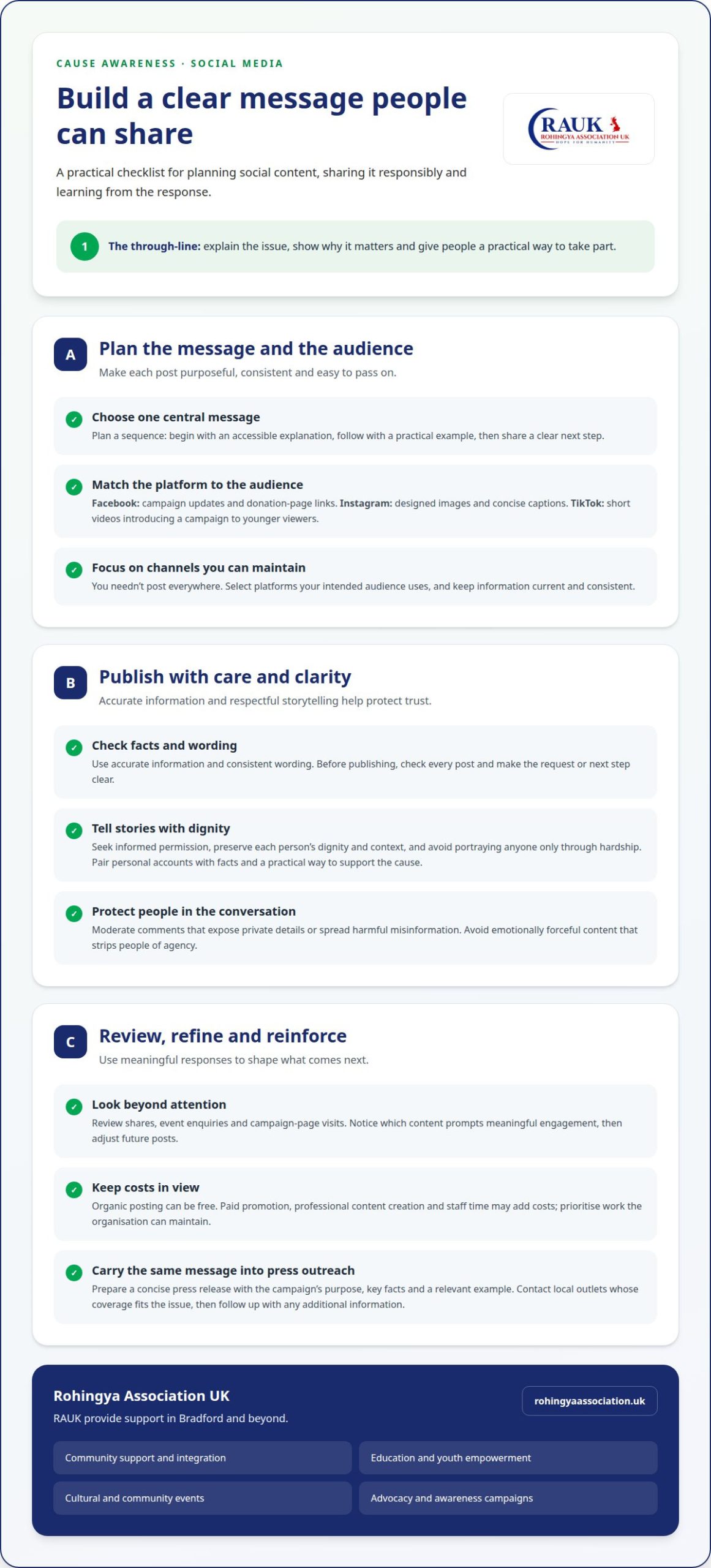
Social media helps a charity carry a clear message beyond its existing supporters. A campaign post can explain an issue, show why action matters and invite people to share information, attend an event or donate. A practical answer to how to raise awareness for a cause is to give each post a clear purpose, such as introducing the issue or inviting people to a community event.
Choose each platform for the audience you want to reach. Facebook can host campaign updates and links to donation pages; Instagram suits designed images and concise captions; TikTok can carry short videos that introduce a campaign to younger viewers. You needn’t post everywhere. Select platforms your intended audience uses, then keep information current and consistent.
Before publishing, decide on one central message and plan a sequence of posts around it. Begin with an accessible explanation, follow with a practical example, then share a clear next step. Use accurate information and consistent wording so supporters can understand the cause and pass the message on without confusion.
Organic social media posting can be free, making it useful for charities with limited resources. Costs may arise if a campaign uses paid promotion, professional content creation or staff time. The overall outlay depends on the work involved and the campaign’s intended reach, so prioritise channels and content the organisation can maintain.
To identify the right audience, define who needs to hear the message and what action they can take. A campaign seeking local volunteers, for instance, should focus on community groups and people near its activities. A wider awareness effort can invite supporters to share information with their own networks.
Storytelling can make an issue easier to understand, but it must respect the people whose experiences are shared. Seek informed permission, preserve each person’s dignity and context, and avoid portraying anyone only through hardship. Pair a personal account with factual information and a practical way to support the cause.
Common risks include inaccurate claims, unclear requests and emotionally forceful content that strips people of agency. Check every post before publishing, explain how to participate, and moderate comments that expose private details or spread harmful misinformation. Review responses such as shares, event enquiries and campaign-page visits, then adjust future content.
Social media can support press and media outreach, too. Prepare a concise press release with the campaign’s purpose, key facts and a relevant example. Identify local outlets whose coverage fits the issue, send the release to relevant reporters, then follow up by phone or email with any additional information.
For charities considering how to raise awareness for a cause, social posts and press outreach work best when they reinforce the same message. Notice which content prompts meaningful engagement, not just attention, and use those lessons to strengthen the next campaign.
2. Can wearable merchandise increase cause awareness?
A T-shirt, badge or tote bag can carry a campaign message into everyday settings. Choose a design that people can read at a glance, uses respectful imagery and makes the cause recognisable. Merchandise can also support fundraising when offered as part of a campaign, but its awareness value depends on clear messaging and thoughtful distribution.
Plan around a relevant moment rather than selecting a date simply for visibility. International Women’s Day falls on March 8, and Pride Month takes place in June. A campaign can connect its message to such moments when the subject genuinely aligns, then explain that connection in its marketing and outreach.
To create an awareness campaign step by step, define the change you want, identify the audience, choose a message and select suitable merchandise. Set campaign goals and measures, plan promotion around a relevant moment, then review the response and share what supporters helped achieve.
For example, a community campaign could use a simple design that invites people to learn about family separation and share information about support. Keep the wording concise, then direct people to a campaign page or event for more detail. This turns an item into a conversation starter, not a substitute for accurate information.
Use clear milestones to organise the campaign: prepare the message and artwork, introduce the purpose, launch the merchandise, share updates and report outcomes. The sequence can follow the awareness moment or a community event. Assign responsibilities for design, promotion and fulfilment, so each stage has an owner and the message remains consistent.
Choose key performance indicators (KPIs) that match the goal. If the aim is visibility, monitor campaign-page visits, social sharing and event enquiries; if fundraising matters, record merchandise sales and donations. Compare results with the campaign’s stated aims, and note which messages or channels prompted people to act.
Named campaigns can offer useful examples of public participation. Pedal for a Purpose secured 610 donations, showing how a recognisable activity can give supporters a shared focus. A merchandise campaign can use the same principle: connect a tangible item with a clear cause, a participation opportunity and an update on progress.
For media outreach, identify local news outlets that cover the issue and relevant reporters through their published work. Send a concise press release explaining the campaign, its purpose, the awareness moment and any public activity. Follow up by phone or email with additional information, and make campaign visuals available for coverage.
Thoughtful planning helps merchandise reinforce, rather than overwhelm, the cause. Community-led advocacy and awareness campaigns can connect a public message with meaningful local engagement.
3. Building organisational and influencer partnerships
A partnership can bring a cause into communities a charity cannot reach alone. Start by identifying organisations with connected aims, such as a local community group, school or cultural association. Agree on the shared message, the people you hope to reach and the practical contribution each partner can make.
Set responsibilities before promotion begins. One organisation might host a public discussion, while another shares campaign information through its established networks. Write down who approves messages, handles enquiries and reports progress. Clear roles help partners promote the same effort without confusing supporters or duplicating work.
Public officials may connect charities with relevant institutions that can offer funding or exposure. Approach them with a concise account of the issue, the campaign’s intended impact and the specific support sought. A focused request, such as an introduction to a suitable institution, gives the official a practical way to assist.
A press conference can announce a campaign, introduce partners and promote upcoming events. Invite a speaker with direct knowledge of the issue, alongside representatives who can explain the campaign’s response. For example, a community-led initiative might pair a local advocate’s perspective with an organisation’s explanation of its planned activities.
Prepare speakers carefully. Share the central message, likely questions and agreed facts before the event, and give each speaker a distinct contribution. A lived experience should never be treated as a dramatic device. Invite people to speak voluntarily, respect their boundaries and avoid pressuring anyone to disclose personal details.
Influencer partnerships can help a charity introduce its cause to an influencer’s followers. Look beyond follower numbers: assess whether the person’s public work, audience and communication style suit the campaign. A trusted local creator who discusses community issues may be a more relevant partner than a prominent personality with little connection to the cause.
Offer a clear collaboration brief with the campaign’s purpose, key facts, preferred wording and an appropriate action. An influencer could explain the issue, share an event announcement or invite followers to learn more. Agree on content approval and publication timing, while allowing their voice to remain authentic.
Measure partnership efforts against the goal. Record which organisations share campaign materials, event attendance, enquiries and referrals from partners. If a collaboration attracts attention but prompts little participation, adjust the invitation or format. Share outcomes with partners afterwards, acknowledge their contribution and discuss what could strengthen future joint work.
Strong partnerships depend on mutual respect, accurate communication and a defined purpose. A charity can generate broader support by combining organisational relationships, informed speakers and carefully chosen influencers, then sustaining those connections beyond a single campaign.
4. Public events and community engagement
A public event gives people a place to encounter a cause, ask questions and decide how to participate. A community gathering can introduce an organisation’s mission through conversation, cultural activities or practical information. Set a clear purpose before hosting: for example, educate local residents, invite volunteers or raise donations for a defined campaign.
Educational workshops help turn broad concerns into informed discussion. Invite a speaker to explain the issue, then make space for questions and community perspectives. A workshop about refugee experiences, for instance, could pair factual context with discussion about how neighbours can support inclusion. Close by offering specific next steps, such as attending another event or sharing what you learned.
Choose activities that suit the cause and the people you hope to engage. Fitness events and video-game marathons can combine participation with fundraising, whilst a swimathon can give supporters a shared challenge. An informal information stall may work better when the priority is helping passers-by learn about a cause and local resources.
Plan the event around its purpose. Select a suitable venue, confirm who will speak, and prepare materials that explain the issue in plain language. For a workshop, provide a discussion prompt and a facilitator; for a fundraising event, explain how donations support the campaign. A clear programme helps attendees understand what to expect.
Community engagement should shape the event, not appear as an afterthought. Invite local groups to contribute ideas, identify concerns that need careful handling, and make the programme welcoming to different ages and backgrounds. For example, a cultural gathering might include heritage activities alongside an opportunity to learn about the organisation’s work.
Give attendees more than one way to take part. Some may donate, whilst others can volunteer, share information or help organise a future gathering. Explain each option without making participation feel compulsory. A short closing announcement can direct people to relevant campaign information and identify who can answer follow-up questions.
Assess whether the event met its stated aim. Record attendance, donations, questions raised and volunteer enquiries, then compare these responses with the event’s purpose. If an educational session attracted interest but few people joined the discussion, consider changing the format or adding smaller group conversations next time.
Keep the connection alive after the event. Send attendees a concise summary, share useful learning and thank speakers and participants for their contributions. Recognising achievements at the end of a campaign, or holding an appreciation gathering, can help supporters feel part of a continuing community rather than a one-off occasion.
Well-planned events bring education, participation and relationships together. A workshop can deepen understanding; a public gathering can connect people with local resources; and a fundraising activity can support the mission whilst building community involvement.
5. Email outreach to supporters and partners
Email gives a charity a direct way to explain a cause, invite action and maintain relationships beyond a public event. A useful message has one purpose: for example, invite supporters to a fundraising event, ask partners to share a campaign, or provide an update on community work. Keep the subject line specific so recipients can recognise why the message matters.
Start by grouping the audience according to its relationship with the campaign. Existing supporters may value progress updates; community partners may need ready-to-share information; event participants may welcome practical details. A local organisation, for example, could receive a short invitation and a prepared paragraph for its newsletter. Relevant messages help recipients see a clear role.
Plan a sequence rather than sending one announcement and stopping. Introduce the campaign and its purpose, follow with an invitation to take part, then send a concise reminder before the event. Afterwards, report what happened and thank people who contributed. Each email should add new information, not repeat the same appeal with a changed subject line.
Make the requested action easy to understand. Ask readers to register, share an event notice, volunteer or donate, rather than combining every request in one message. For a community workshop, include its purpose, location details and a clear way to respond. Partners can receive reusable email templates and instructions for creating donation pages.
Respectful communication is essential when an email discusses refugees or others facing hardship. Use accurate descriptions, protect personal details and share someone’s story only with their informed agreement. A campaign update can explain the issue without turning a person’s experience into a fundraising device. Keep the person’s dignity and agency central.
For a fundraising event, send partners a short sharing pack with approved wording, the event’s purpose and a direct invitation. A partner can adapt the message for its own audience while preserving the essential facts. After the event, a thank-you email can recognise contributions and explain the next opportunity to stay involved.
Review email success against the action you requested. Track replies, registrations, donation-page visits or partner shares, then note which message prompted a response. If recipients open an update but don’t act, make the next email’s request more specific. Use those observations to improve future outreach, rather than relying on a single measure of attention.
Keep a simple record of partner contacts, campaign messages and follow-up tasks. This helps the team maintain continuity when volunteers change and prevents supporters receiving conflicting information. To connect email engagement with sustained community involvement, explore ways to support refugee communities.
Rohingya Association UK: Community Support & Integration
Rohingya Association UK provides support in Bradford and beyond, connecting community-led awareness with practical support for Rohingya refugees, families and young people. If you want to help build understanding while strengthening community ties, its work offers a relevant next step.
Through Community Support & Integration and Education & Youth Empowerment, the organisation supports connection, learning and participation. Cultural & Community Events help preserve Rohingya heritage and bring people together, while Advocacy & Awareness Campaigns create opportunities to share community perspectives and promote understanding.
These efforts complement the approaches discussed here: thoughtful communication, partnerships, public events and sustained supporter engagement. To learn more about Rohingya Association UK’s work or discuss getting involved, contact the organisation or visit rohingyaassociation.uk.
Turn awareness into lasting connection
Learning how to raise awareness for a cause can open a conversation, but lasting progress depends on whose voices shape what follows. Make room for people directly affected to guide priorities, share perspectives on their own terms and influence how support develops. This keeps future efforts grounded in community knowledge and turns attention into a more thoughtful, enduring commitment.
Rohingya Association UK works to support Rohingya refugees, families and young people. If you’re considering how to contribute or take part in its work, Contact Rohingya Association UK today.
Every respectful conversation can help strengthen understanding. With listening and shared purpose, awareness can become a foundation for connection and hope.
Frequently Asked Questions
Why should nonprofits prioritise awareness?
Charities should prioritise awareness because people can’t support a cause they don’t understand. Clear public information explains why an issue matters and what the organisation is doing in response. It can also help correct misunderstandings before they become barriers to involvement. For example, a charity working with displaced families can explain the difference between immediate needs and longer-term integration, helping supporters see why sustained community backing matters.
Why is raising awareness important?
Raising awareness matters because it can move an issue from private concern into shared public understanding. That shift can prompt people to discuss the issue, reconsider assumptions and recognise where collective action is useful. For a cause affecting a community with limited public visibility, consistent explanation can help keep its experiences in view beyond a single appeal or event. Awareness is valuable when it leads to informed attention and respectful engagement, not attention alone.
Can wearable merchandise increase cause awareness?
Wearable merchandise can make a cause visible in everyday places and give supporters an approachable way to signal solidarity. Its usefulness depends on a design that communicates the message clearly without reducing a complex issue to a slogan. A badge or shirt might prompt a conversation, but supporters should have accurate information to share if someone asks. Merchandise works best as an invitation to learn, rather than the campaign’s only source of information.
How can human services raise their cause?
Human services organisations can raise awareness by explaining how their work responds to people’s needs and what barriers those people face. Use plain-language examples of the support offered, community learning sessions and carefully prepared information for local groups. For instance, a service supporting newly arrived families could explain how access to education and local connections helps people participate in community life. Keep public messaging grounded in people’s strengths and avoid sharing identifiable personal details.
How can social media boost cause awareness?
Social media can help a charity make its information easier to find, revisit and share. Try pinning a concise explainer to the organisation’s profile, adding captions to spoken video and using readable text in graphics. Respond to genuine questions with consistent, factual answers, then direct readers to the organisation’s own campaign information. These small choices can make posts more accessible and help audiences understand the issue without relying on a single format.
How does awareness attract volunteers?
Awareness can attract volunteers by helping people recognise both the need and the contribution they could make. Describe roles in practical terms, including the skills involved, the support volunteers receive and how their contribution fits the wider purpose. Someone interested in education, for example, may respond to a clearly explained youth-support role. A specific invitation helps potential volunteers decide whether their interests and capacity align with the organisation’s work.
How does awareness secure donations?
Awareness can encourage donations by helping supporters understand the issue and the purpose of their contribution. Explain which area of work donations support, how that work relates to the cause and where people can find updates. Avoid implying that a gift guarantees a particular result. For example, a charity can describe how contributions support education or community integration, allowing donors to make an informed choice based on its stated priorities.
What are awareness campaigns?
An awareness campaign is a planned effort to help a defined audience understand an issue and consider a relevant action. It brings together a central message, suitable ways to communicate it and a clear purpose. A campaign might explain a community issue, invite people to an educational event and encourage continued learning afterwards. Unlike a single post, it has a connected purpose and can be reviewed to see whether its intended audience engaged.