
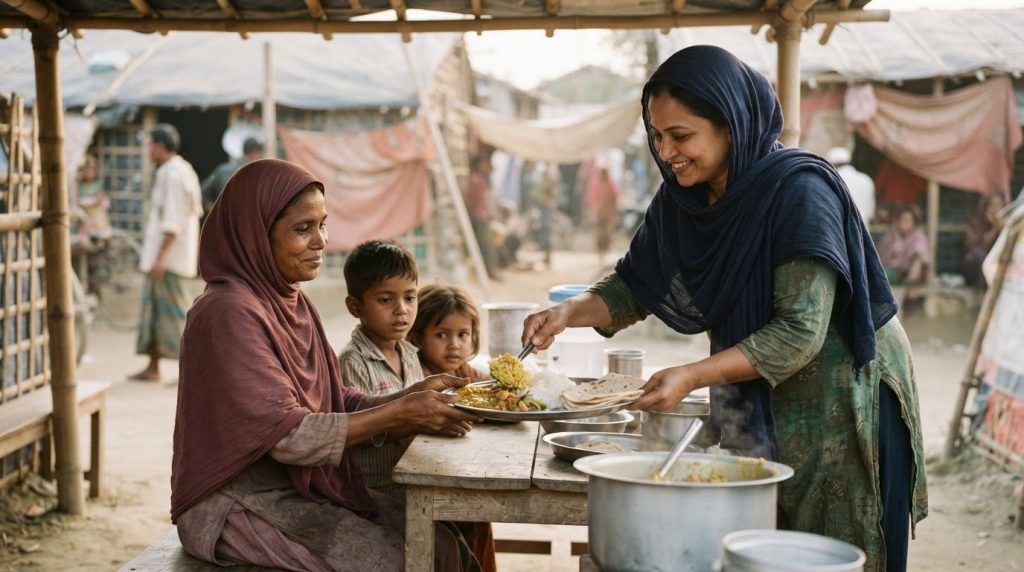
A fidya donation for not fasting provides food for someone in need when a person cannot fast and is unable to make up the missed fasts later, according to Islamic Relief. Fidya is generally described as feeding one poor person two meals for each missed fast. It is distinct from kaffarah, which relates to deliberately breaking a fast.
It’s understandable to seek clarity before giving: eligibility, the amount due and the food measure all matter. The answer depends on why the fast was missed and whether it can be made up later.
This guide explains who may qualify for fidya, how to work out the amount and what Sa’a means when staple foods are used as a measure. It also explains how fidya differs from kaffarah and how giving can provide meals for people facing hardship, helping you approach the obligation with care and understanding.
Key Takeaways
- Fidya generally means providing two meals for each missed fast, with the amount shaped by the local value of staple food.
- Fidya may apply when someone is unable to fast and cannot make up the missed fasts in future, according to Islamic Relief.
- Fidya and kaffarah address different circumstances: kaffarah relates to deliberately breaking a fast and may involve fasting for 60 consecutive days, according to Human Appeal.
- Food-based fidya can be understood in relation to staple foods, though the appropriate measure may vary.
- Giving fidya can help provide meals to people in need, while understanding eligibility and the applicable amount helps ensure your contribution is made thoughtfully.
Fidya amount for Ramadan 2026
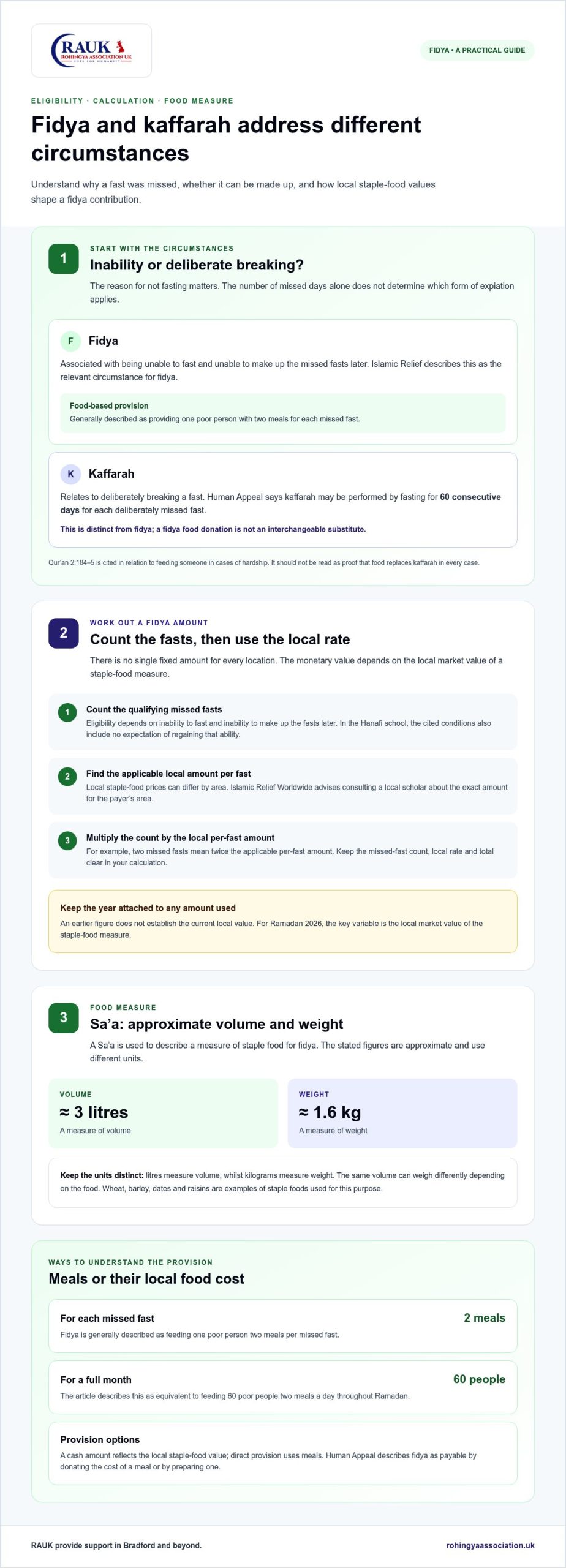
There is no single fixed fidya amount for every location in Ramadan 2026. The amount depends on the local market value of a staple-food measure, so it can differ by area.
Fidya donation amounts
Fidya donation amounts represent the food, or its cost, provided for each missed fast. Keep the year attached to any figure you use: an earlier amount does not establish the current local value.
To calculate the total, multiply the applicable local amount per missed fast by the number of fasts covered. For example, two missed fasts mean twice the applicable per-fast amount.
A food-based description provides another way to understand the contribution: two meals for each missed fast. Fidya for a full month is equivalent to feeding 60 poor people two meals a day throughout Ramadan. A cash amount reflects local staple-food value, whilst direct food provision uses meals.
Calculating fidya across Islamic schools of thought
The amount of fidya may vary with local food prices. In the Hanafi school, eligibility depends on three conditions rather than a separate rate: inability to fast during Ramadan, inability to make up the missed fasts later, and no expectation of regaining that ability. Islamic Relief Worldwide advises consulting a local scholar to determine the exact fidya amount for the payer’s area.
For a practical calculation, first count the missed fasts covered, then apply the relevant local amount per fast. Keeping the count separate from the rate makes the total clear. Someone covering several missed days can see how each additional fast changes the total without treating a past figure as current.
For Ramadan 2026, the key variable is the local market value of the staple-food measure, not the 2023 amount. Islamic Relief Worldwide’s advice is to consult a local scholar about the exact amount for the payer’s area. This can help when comparing a cash contribution with providing meals directly.
Keep the year attached to every amount used in a calculation. Recording the missed fasts, local per-fast amount and total makes the arithmetic clear.
A fidya donation for not fasting should cover qualifying missed fasts. Islamic Relief describes fidya as due when a person is unable to fast and unable to do so in future. This determines eligibility; the local staple-food value determines the monetary calculation.
What is the difference between fidya and kaffarah?
Fidya and kaffarah relate to missed Ramadan fasts, but they address different circumstances. Fidya is associated with being unable to fast because of illness, whilst kaffarah concerns deliberately breaking a fast. Distinguishing the reason matters because the relevant form of expiation differs.
Fidya is described as feeding one poor person for each missed day, with two meals provided for each fast. The Qur’an connects feeding a poor person with a ransom for those who can fast only with hardship, in verses 2:184-5. This food-based provision is central to fidya; it is not the same as kaffarah for deliberate breaking.
Islamic Relief describes fidya as due when a person cannot fast and cannot do so in future. A missed fast caused by illness may raise a different question from one deliberately broken. The distinction is not simply the number of days missed: the reason for not fasting and the ability to make up those days also matter.
Kaffarah addresses deliberate conduct. Human Appeal says kaffarah may be performed by fasting for 60 consecutive days for each deliberately missed fast. The consecutive requirement makes this a sustained act of worship, not a monetary calculation based on the cost of meals. A person considering kaffarah should not treat a fidya food donation as an interchangeable substitute.
The two terms also point to different ways of addressing the obligation. Fidya centres on providing food for a person in need, with two meals linked to each missed fast. Kaffarah, in the cited account from Human Appeal, includes fasting for 60 consecutive days. The Qur’anic reference to feeding someone as a ransom relates to hardship in fasting; it should not be presented as proof that food replaces kaffarah in every case.
Consider two different situations: someone unable to fast because of an enduring illness, and someone who deliberately breaks a fast. The first may fall within the circumstances associated with fidya; the second is connected with kaffarah. The number of missed days alone cannot determine which applies, because the circumstances behind each missed fast matter.
In practical terms, first identify whether the fast was missed through inability or deliberately broken. Then distinguish food-based fidya from the kaffarah practice described by Human Appeal. Qur’an 2:184-5 provides the reference for feeding in cases of hardship, while the 60 consecutive days cited for kaffarah mark a different obligation. Keeping these categories separate helps prevent the wrong form of expiation being assumed.
Sa’a and staple-food measurements
A Sa’a is a measure used to describe staple food for fidya. It is approximately 3 litres or 1.6 kg. Fidya can be paid by donating the cost of a meal or by preparing one, according to Human Appeal. These options connect the food measure with practical provision.
The two Sa’a figures describe approximate quantities in different units: litres measure volume, while kilograms measure weight. They are not interchangeable measures for every food. For example, a volume of wheat may weigh differently from the same volume of another staple, so retain the stated unit when using a measure.
The amount of fidya depends on the local market value of one Sa’a of staple food. Wheat, barley, dates and raisins are examples of foods used for this purpose. Because prices can vary between markets, the monetary value depends on the chosen staple and its local market value, rather than a universal cash figure.
This distinction matters when comparing a food contribution with money. A food contribution is measured in staple food; a monetary contribution uses the local value of that food measure. For example, wheat and dates are different staples, so their market values may differ.
To understand the calculation, separate the measure from its value. First identify the staple food, such as barley or raisins. Then consider the local market value of one Sa’a of that food. The Sa’a remains approximately 3 litres or 1.6 kg, whilst the amount expressed in money depends on the chosen staple’s local value.
Can fidya be paid as money, or must it be given as food? Human Appeal says fidya can be paid by donating the cost of a meal for a vulnerable person or by preparing the meal. The food measure explains the provision, while a monetary contribution represents the meal’s cost.
When reviewing a food-based contribution, keep the unit clear: litres describe volume, and kilograms describe weight. For example, record a quantity as approximately 3 litres or approximately 1.6 kg, rather than converting one into the other as an exact figure. This preserves the approximate nature of the Sa’a measure.
In short, the Sa’a provides a practical reference for staple food, while local market value determines its monetary equivalent. Wheat, barley, dates and raisins are examples of relevant staples. Keeping the food, unit and local value distinct makes it easier to understand how a cash contribution relates to food provision.
Who may be eligible to pay fidya
Fidya is generally associated with someone unable to fast who cannot do so in future, according to Islamic Relief. The central distinction is whether the missed fast can be made up later. A temporary reason may mean making up the fast is relevant instead, so both the cause and expected duration of the inability matter.
Chronic illness is among the circumstances linked with fidya when it prevents fasting and is not expected to end. The eligibility description also includes people with mental diseases. These examples concern lasting inability, not every illness during Ramadan. The key consideration is whether fasting remains impossible and whether the person is expected to regain the ability to make up missed days.
Pregnancy may affect a person’s ability to fast, but the appropriate response depends on their circumstances. However, pregnancy does not automatically mean fidya is the only response. Human Appeal says people with valid reasons, including pregnancy or nursing, are encouraged to make up missed fasts after Ramadan. The distinction is whether the fasts can be made up later.
Travel and temporary illness are also given as valid reasons for missing fasts. Human Appeal’s guidance encourages making up those fasts after Ramadan. This distinguishes a temporary interruption from a lasting inability. For example, someone who missed a fast while travelling may need to make it up rather than assume fidya applies.
The Hanafi school sets out three conditions for fidya to apply:
- The person cannot fast during Ramadan.
- Whether missed fasts can be made up later may affect whether fidya is appropriate.
- The person is not expected to regain the ability to make them up.
All three conditions must be fulfilled in the Hanafi school. If someone cannot fast during Ramadan but expects to recover, the third condition is not met. If recovery is not expected but making up the fasts remains possible, the second condition is not met. This test shows why the reason for missing a fast alone cannot determine eligibility.
Apply the criteria to the person’s circumstances, not just the number of missed days. A lasting condition may fit the fidya description when future fasting is also impossible; a temporary illness or journey may point towards making up the fasts. For pregnancy or nursing, the ability to fast later remains an important distinction in the guidance described by Human Appeal.
Islamic Relief’s description focuses on inability both now and in future. The Hanafi conditions make this test explicit through fasting during Ramadan, making up fasts later and the expectation of recovery. Considering each point separately helps distinguish a lasting inability from a temporary reason and clarify whether fidya may be appropriate.
Donating fidya to support people in need
Fidya connects an obligation with food provision for people in need. Human Appeal says it can be paid by donating the cost of a meal for a vulnerable person or preparing the meal. Both approaches turn the contribution into practical support, with food provision at the centre.
Who is eligible to receive fidya donations? Fidya is intended for poor people, with each missed fast associated with feeding one person. The recipient should be someone in need of food, rather than simply anyone selected to receive a general gift.
Where can I donate fidya in the United States? A donor in the United States can give through a channel that directs fidya towards meals for people in need. The essential point is the intended use: providing food for eligible recipients, rather than making an unrestricted gift.
There are two practical forms of provision: give the meal itself or donate its cost. Preparing food makes the support tangible; contributing the cost allows meals to be provided through a food-support effort. Human Appeal identifies both approaches, so donors can consider how they intend food to reach someone vulnerable.
Before giving, keep the purpose clear. Identify the missed fasts covered, then ensure the donation is intended as fidya for food provision. This helps distinguish fidya from a general charitable gift, even when both are motivated by concern for people experiencing hardship.
Food support can address an immediate human need, but the recipient remains central to the act. A meal should reach someone who is poor or vulnerable, rather than be treated as an abstract amount. The meaningful connection is between the fidya contribution and food provided to someone in need.
RAUK provide support in Bradford and beyond through humanitarian aid and food support. This work aligns with the wider purpose of helping people access practical assistance, while the specific fidya obligation remains focused on feeding eligible recipients. To support community food assistance, explore community support.
Rohingya Association UK: Community Support & Integration
Rohingya Association UK supports community wellbeing through Community Support & Integration, Education & Youth Empowerment, Cultural & Community Events, and Advocacy & Awareness Campaigns. If you’re seeking connection, learning opportunities or community-led support alongside your fidya decisions, these programmes may be relevant to your wider needs.
RAUK provide support in Bradford and beyond, helping Rohingya refugees, families and young people strengthen community ties and access practical support. Its community work complements this article’s guidance, while fidya itself remains a religious obligation focused on feeding people in need.
For information about RAUK’s community support, visit rohingyaassociation.uk or contact Rohingya Association UK.
Let your next step strengthen community
A fidya donation for not fasting can reflect a commitment to care, while wider community involvement can sustain connection and opportunity. If you’re looking beyond the immediate act of giving, consider the role shared support, learning and cultural connection play in building resilient communities.
Rohingya Association UK offers Community Support & Integration, Education & Youth Empowerment, and Cultural & Community Events. These programmes support people through practical connection, learning and the preservation of community bonds. They are distinct from the religious guidance needed to determine individual fidya obligations.
If you’d like to learn more about the organisation’s community work or discuss how to get involved, contact Rohingya Association UK. Each thoughtful step can help strengthen the networks that enable people and families to move forward with dignity and hope.
Frequently Asked Questions
What is fidya?
Fidya is a form of food provision associated with missed fasts when someone cannot fast and cannot do so in future, according to Islamic Relief. It offers a way to support people in need through meals. For example, someone considering fidya can distinguish this obligation from a general charitable gift by ensuring the contribution is intended to provide food for eligible recipients.
How much is it?
The amount depends on the local market value of a staple-food measure, so it varies by area. For a current calculation, count the missed fasts and use the applicable local value. Islamic Relief Worldwide advises consulting a local scholar about the amount for your area.
Is giving fidya or kaffarah compulsory?
Fasting during Ramadan is obligatory for able Muslims, according to Islamic Relief. Whether fidya or kaffarah applies depends on the circumstances: fidya is associated with lasting inability to fast, while kaffarah concerns deliberately breaking a fast. Human Appeal says kaffarah may involve fasting for 60 consecutive days for each deliberately missed fast. These are distinct obligations, so one should not be treated as a substitute for the other.
What does the Qur’an say about missed fasts?
Qur’an 2:184 connects feeding a poor person with a ransom for those able to fast only with hardship. The related reference, 2:184-5, is cited in connection with feeding as a response to hardship. These verses provide religious context for fidya, but they do not mean every missed fast has identical circumstances. The reason for missing the fast and the person’s ability to fast later remain relevant.
What if I miss a fast without a valid reason?
Islamic Relief states that fasting during Ramadan is obligatory for able Muslims. A deliberately broken fast is associated with kaffarah, rather than fidya for lasting inability. Human Appeal describes fasting for 60 consecutive days for each deliberately missed fast as a kaffarah option. This differs from a fast missed through a valid reason, such as illness or travel, where making it up after Ramadan may be relevant.
Where will it go?
Fidya is intended to provide food for people in need, with a poor person as the recipient for each missed day. Human Appeal describes paying the cost of a meal for a vulnerable person or preparing the meal. Before donating, consider whether the contribution is directed towards food provision and clearly identified as fidya, rather than general charitable support.
Who is eligible?
Eligibility is generally associated with someone unable to fast who also cannot do so in future, according to Islamic Relief. Chronic illness and pregnancy may arise in discussions of fidya, but the deciding issue is whether missed fasts can be made up later. For instance, someone recovering from a temporary illness may need to make up fasts after Ramadan, rather than assume fidya applies.
Who is required to pay?
A person may be required to pay fidya when they are unable to fast and are not expected to regain that ability, according to Islamic Relief. In the Hanafi school, all three stated conditions must apply: inability to fast during Ramadan, inability to make up the missed fasts later, and no expectation of future ability. Someone who deliberately breaks a fast faces a different question concerning kaffarah.