
Giving more freely does not make a charitable act Zakat. The difference between Zakat and Sadaqa is that Zakat is an obligatory act of worship and one of Islam’s Five Pillars, while Sadaqah is voluntary charity. Zakat has rules about who must give and who may receive it; Sadaqah can take many forms and be offered more broadly.
Both forms of giving express care for others, but knowing the difference matters when you want your contribution to fulfil a religious duty or offer support beyond it. This guide explains how they differ in obligation, recipients, forms and place in faith, and how each can help address poverty. It also explains how intention shapes voluntary giving, why Zakat is directed to specific eligible groups, and how to choose the form of charity that fits your purpose. The distinction is clear: one is a duty with defined conditions, the other a voluntary practice with a broader reach.
Key takeaways
- Understand why Zakat is an obligation with defined conditions, while Sadaqah is voluntary giving.
- Learn how recipient eligibility shapes where Zakat can be directed, and why Sadaqah has a broader reach.
- Recognise that Sadaqah can take forms beyond money, including everyday acts of kindness.
- Explore how charitable giving can express faith and contribute to efforts that address poverty.
- RAUK provides support in Bradford and beyond, with community support and integration among its offerings.
What’s the difference between Zakat and Sadaqah?
Zakat is obligatory for Muslims who meet its conditions, and it is one of Islam’s Five Pillars. Sadaqah is voluntary charity, given through money or other acts of care. They differ in religious duty, calculation and who may receive each form of support.
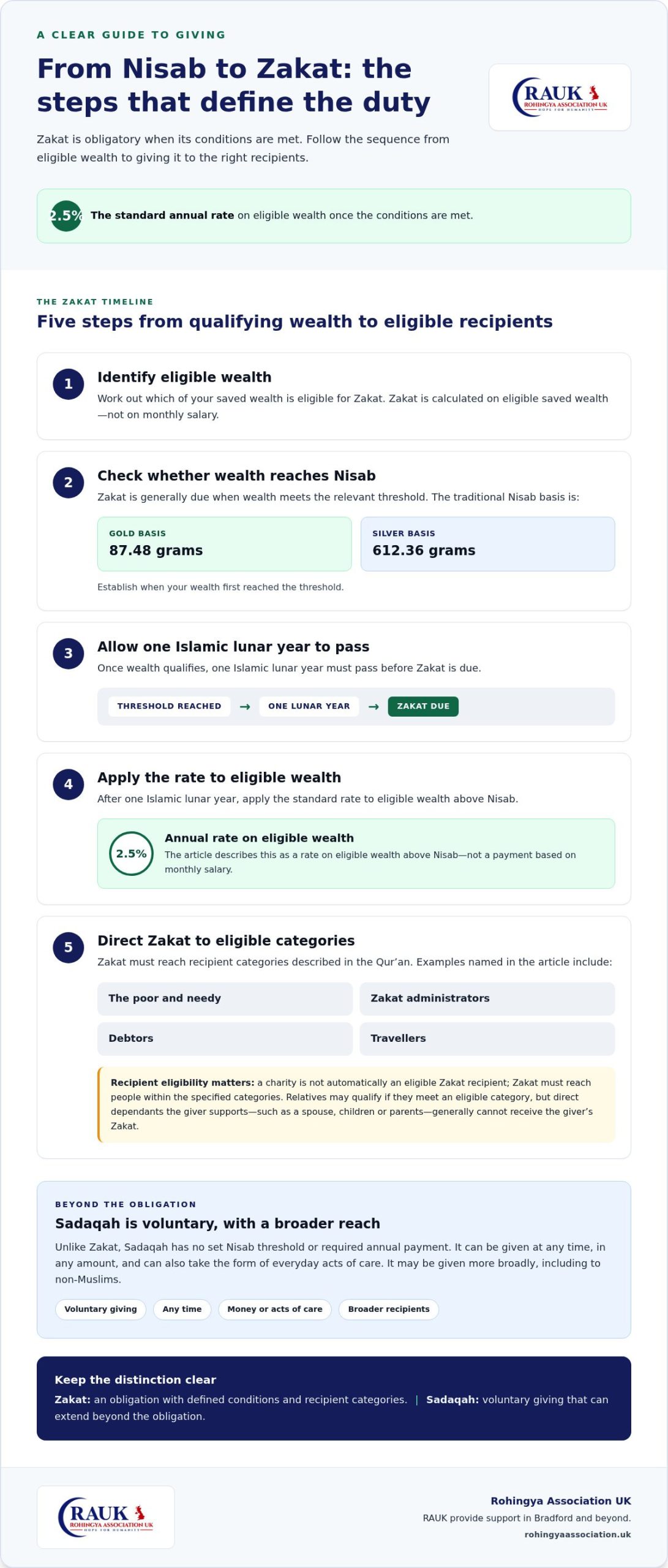
Zakat is generally treated as an obligation for Muslims whose wealth meets the relevant threshold. Once wealth qualifies, one Islamic lunar year must pass before Zakat is due; the standard rate on eligible wealth is 2.5% annually. This makes Zakat an act of worship with defined conditions, rather than a donation chosen solely according to personal preference.
Sadaqah has no set Nisab threshold or required annual payment. You may give it at any time, in any amount, according to your means and intention. For example, a voluntary gift can support someone in need, while a kind act can also express charitable care. Both forms can serve others, but only qualifying Zakat fulfils the obligatory duty.
Zakat must go to the recipient categories described in the Qur’an, including the poor and needy, Zakat administrators, debtors and travellers. Sadaqah may be given more broadly to people in need. This distinction helps donors match their intention to the right form of giving.
Relatives may receive Zakat if they meet an eligible category, but it generally cannot go to direct dependants whom the giver supports, such as a spouse, children or parents. Sadaqah may be given to non-Muslims. A charity is not automatically an eligible Zakat recipient: Zakat must reach people within the specified categories.
In the United States, Zakat and Sadaqah are religious categories, not tax classifications. Whether a gift is tax-deductible depends on the recipient and applicable US tax rules, rather than the name given to the donation.
To calculate Zakat, identify eligible wealth above Nisab and establish when it first reached that threshold. The traditional Nisab basis is 87.48 grams of gold or 612.36 grams of silver. After one Islamic lunar year, apply the 2.5% rate to eligible wealth; Zakat is calculated on saved wealth above Nisab, not monthly salary.
| Option | Status | Timing | Recipients | Basis |
|---|---|---|---|---|
| Zakat | Obligatory when conditions are met | After one Islamic lunar year | Specified eligible categories | 2.5% of eligible wealth above Nisab |
| Sadaqah | Voluntary | Any time | Can be given more broadly | Any amount or charitable act |
Choose Zakat to meet a qualifying religious duty, and Sadaqah for voluntary giving beyond that obligation.
What of Sadaqah as Voluntary Charity?
For a Muslim, voluntary Sadaqah offers a way to give beyond a required act of worship. Its meaning rests not only on the size of a donation, but also on the intention behind it. A person may offer what they can, when they can, directing their giving towards a rightful purpose and seeking to please God.
Intention matters. Sadaqah should come from lawful gain and be given for rightful ends, rather than to display generosity or control a recipient. Consider both the source and purpose of a gift: a donation from lawful earnings to help someone facing hardship reflects these principles.
There is no minimum amount for voluntary Sadaqah in the facts described here. Even a single penny can be a meaningful gift when given with sincere intention. This makes charity accessible to people with different means; the value of giving is not measured only by the amount transferred.
Sadaqah may also be given to non-Muslims. This wider reach allows a Muslim to respond to need across community boundaries, whether supporting a neighbour or helping someone facing difficulty. Start with a clear question: who needs assistance, and what form of support would serve them respectfully?
The Qur’an offers guidance on how generosity should be given, not merely whether it should be given. Al-Baqarah, verse 262, describes those who give without reminding recipients of their generosity or causing them harm. In practice, that means protecting a person’s dignity after a gift, rather than turning assistance into a debt of gratitude.
This teaching also clarifies the difference between a charitable act and the way it is carried out. A donation can meet an immediate need, yet words or actions that shame its recipient undermine the spirit described in verse 262. Give discreetly where appropriate, avoid making the recipient feel indebted, and keep the purpose of helping at the centre.
Muhammad is quoted as saying that Sadaqah is a proof. In this context, voluntary giving can make faith visible through a considered response to another person’s need. It need not be a large donation: the key elements are lawful means, a rightful purpose and sincere intention.
Before giving, a Muslim can reflect on three points: whether the funds come from lawful gain, whether the intended purpose is rightful, and whether the gift will preserve the recipient’s dignity. These considerations help make Sadaqah a deliberate act of kindness, rather than a gesture that places pressure on the person receiving support.
Forms of Sadaqah
Sadaqah is not limited to financial donations. Islamic teaching recognises non-monetary acts, so a person can give through practical help, considerate conduct and small acts in everyday life. This breadth distinguishes voluntary charity from a payment measured against a financial threshold. Zakat has defined eligibility conditions; Sadaqah can be expressed without a minimum cash amount.
Three clear examples show how varied these acts can be. Helping someone in need offers direct, practical support. Smiling is another form of Sadaqah, showing that kindness can be expressed without transferring money. Removing a harmful object from a path is also cited as charity because it helps prevent danger to others.
- Practical help: assist someone who needs support with an everyday task.
- A smile: offer a simple gesture of warmth and respect.
- Removing an obstruction: clear a harmful object from a path others use.
These examples make giving possible in different circumstances. A person without money to donate can still choose a helpful action, while someone able to contribute financially may give that way. The form changes, but the charitable purpose remains: respond to need or make an ordinary moment safer and kinder.
The teaching attributed to Prophet Muhammad that Sadaqah is a proof connects charitable conduct with faith. It invites Muslims to consider how belief becomes visible in daily choices, not only in formal acts of worship. A smile, a helpful gesture or clearing a hazard can each offer a concrete expression of care.
There is no need to treat every act as a financial calculation. Nisab and the annual 2.5% rate belong to Zakat’s rules, rather than setting a minimum for these voluntary acts. The distinction helps a giver decide what is appropriate: fulfil any qualifying Zakat duty separately, then consider other forms of Sadaqah according to their means and circumstances.
For a practical approach, notice a genuine need, choose an action within your ability, and carry it out respectfully. For example, someone who sees a dangerous object in a walkway can remove it if it is safe to do so; a neighbour facing a difficult task may benefit from direct assistance. These are specific acts, not substitutes for Zakat when that obligation applies.
Islamic teachings also describe a reward for giving with care for the recipient. Al-Baqarah, verse 262, teaches that those who give without reminding recipients of their generosity or harming them have their reward with God. That guidance applies to the manner of giving: preserve dignity, avoid creating a sense of debt, and let the helpful act speak for itself.
Benefits of Zakat and Sadaqah
The Qur’an describes a spiritual benefit of charity in 9:103: taking charity from people’s wealth purifies them and causes them increase. This teaching connects giving with reflection, not simply the transfer of money. For a giver, Zakat and Sadaqah can make care for others part of a conscious faith practice, rooted in responsibility and generosity.
The Qur’an also links generosity with sincere belief. Giving in charity from what one values can be a meaningful expression of faith. This framing asks Muslims to consider what their giving means, rather than treating a donation as an empty transaction. Giving can strengthen a person’s awareness of others’ needs and the value of their own resources.
Zakat’s defined conditions give obligatory giving a clear focus. A Muslim can track when wealth first reaches the Nisab threshold, note the anniversary and plan the eligible payment. Many choose Ramadan for annual Zakat, making it a practical prompt to review their charitable responsibilities. The benefit is not a promised outcome; it is a structured way to meet a religious duty and direct support towards eligible recipients.
That direction matters for people facing hardship. Zakat is allocated to categories named in the Qur’an, including the poor, people in debt and travellers without enough money to complete their journey. Directing resources towards these groups can contribute to immediate assistance while respecting the purpose of this form of worship. It also gives donors a framework for considering who may benefit.
Sadaqah offers a different kind of flexibility. As voluntary giving, it can respond to a particular need or support a beneficial project beyond Zakat’s recipient restrictions. A donor might choose a charitable purpose because it addresses a concern they have observed. This freedom can help people act without waiting for a specific giving season, while keeping intention and rightful purpose central.
Together, obligatory and voluntary giving can support different forms of care. Zakat provides a defined religious duty; Sadaqah allows additional generosity according to a person’s means and chosen purpose. Neither guarantees that poverty will end. But directed resources and voluntary support can form part of wider efforts to relieve hardship and strengthen communities.
The Prophet Muhammad is quoted as saying that Sadaqah is a proof. Alongside the Qur’anic teaching in 9:103, this offers a way to understand charity’s place in faith: giving can express conviction through action. A practical reflection is to identify the duty that applies, consider where voluntary support could help, and give with care for recipients’ dignity.
Charity, faith, and poverty alleviation
Charity connects personal faith with practical responses to hardship. The Qur’an states in 3:91 that a person will not attain true faith until giving in charity from what they love. This teaching places generosity among the pillars of Islam’s moral life: resources can be shared to meet need, while giving reflects a commitment beyond private belief.
Zakat’s recipient categories give this obligation a defined social direction. The Qur’an names the poor, the needy, Zakat administrators and travellers who lack enough money to complete their journeys. Directing eligible contributions towards these groups can help address immediate pressures, such as food insecurity, debt or being unable to finish a journey. It is a focused contribution, not a claim that one payment resolves poverty.
Sadaqah has a broader reach. It can support people outside Zakat’s specified recipient categories, including non-Muslims, and may be directed towards projects that benefit people. This flexibility can help donors respond to needs they see around them. For example, someone may choose a charitable project that offers practical assistance, while keeping the recipient’s dignity and the purpose of the gift in view.
The two forms can contribute differently to poverty alleviation. Zakat directs resources to eligible groups under religious rules; voluntary Sadaqah can complement that support through other beneficial projects. A donor can first identify whether an obligatory payment is due, then consider additional giving for needs beyond its permitted categories. This approach keeps religious duty distinct while allowing supporting efforts to take several forms.
Silver also has a role in the Zakat framework: its traditional value provides one basis for the Nisab threshold. That threshold helps determine whether wealth qualifies for the obligation; it does not decide who may benefit from voluntary Sadaqah. Keeping these questions separate helps anyone planning charity understand both the giving condition and the potential reach of their support.
The Qur’an mentions Sadaqah in more than 50 places, showing its recurring place in Islamic teaching. Some Muslims also consider sadaqah jariyah, charitable giving associated with ongoing benefit. Opinions differ on whether Zakat can be given in this form, so the two concepts should not be treated as automatically interchangeable. A lasting project may serve people over time, but its religious classification remains a distinct question.
To connect charitable intention with practical support, identify the hardship, the people affected and the form of help that meets their needs. Rohingya Association UK provides support in Bradford and beyond, including community support and integration and humanitarian aid and food support. Support community-led aid that responds to hardship through practical assistance.
Rohingya Association UK: Community Support & Integration
Rohingya Association UK provides community support and integration for people in Bradford and beyond. For those seeking connection and practical support, its work offers a community-focused next step after learning how charitable giving can respond to need.
Education & Youth Empowerment supports learning and development, whilst Cultural & Community Events bring people together and strengthen community bonds. Advocacy & Awareness Campaigns offer a way to engage with issues affecting Rohingya communities. These activities complement charitable giving through ongoing, community-focused work.
To learn more about this work or explore how to get involved, contact Rohingya Association UK or visit rohingyaassociation.uk.
Let thoughtful giving lead to lasting solidarity
Understanding the difference between Zakat and Sadaqa can help you make choices that reflect your values. Let that understanding guide a considered next step: listen to the needs around you, act with respect, and support efforts rooted in dignity and shared responsibility.
Rohingya Association UK’s community-led work offers a way to stand alongside Rohingya families as they build a future with safety, hope and belonging.
If you’d like to learn more or explore how to take part, contact Rohingya Association UK. Thoughtful solidarity can help make a stronger future possible.
Frequently Asked Questions
What are the two types of Sadaqah?
People often distinguish between immediate Sadaqah and Sadaqah Jariyah, which is associated with benefit that continues. This is a useful way to describe different kinds of charitable effect, rather than a compulsory two-part system. For example, a one-off act may meet a present need, while a lasting initiative may continue serving people over time. The term used depends on the nature and duration of the benefit.
Can I give Sadaqah and zakat together?
Yes. You can make both contributions, keeping your intention for each clear. A practical approach is to record which gift is intended as Zakat and which is additional Sadaqah. This can help you review your giving later and explain its purpose if needed. For example, a donor might make a separate voluntary contribution after setting aside the amount intended to fulfil their Zakat responsibility.
What do Zakat and Sadaqah mean linguistically?
Zakat is commonly rendered with meanings connected to purification and growth; Sadaqah is associated with truthfulness or sincerity. These linguistic associations help explain why the terms carry spiritual significance, but they are not a substitute for religious guidance about giving. The useful distinction is that the words convey ideas about moral and spiritual purpose, as well as naming forms of charitable practice.
Why is Sadaqah Important?
Sadaqah is important because it gives people a way to turn concern into deliberate care. Its value can extend beyond the immediate transfer of resources: respectful giving recognises another person’s dignity and strengthens a sense of mutual responsibility. For instance, consider not only what support you offer, but how you offer it, so that generosity does not become a source of embarrassment or pressure.
What are the main differences between Zakat and Sadaqa?
The difference between Zakat and Sadaqa concerns obligation, calculation and the conditions attached to giving. If you are deciding what to do, first establish whether a Zakat duty applies; then consider any additional charitable act separately. This distinction helps prevent voluntary generosity from being mistaken for fulfilment of a religious obligation, while leaving room for both forms of giving.
Is Zakat obligatory and Sadaqa voluntary?
Yes. The difference between Zakat and Sadaqa is reflected in the giver’s responsibility: Zakat is an obligation when its conditions apply, whereas Sadaqah is chosen voluntarily. This matters for planning. Review your circumstances for any Zakat duty, then decide whether you wish to give further. Keeping those decisions distinct makes the purpose of each contribution clearer.
Who can receive Sadaqa?
Sadaqah can be directed to someone facing hardship or to a beneficial project. When choosing a recipient, consider whether the support addresses a genuine need and can be given respectfully. For example, you might contribute to a project intended to benefit a community rather than one individual. The giver’s purpose and the likely benefit help guide that choice.
What forms can Sadaqa take besides money?
Sadaqah can include non-monetary acts of service. Giving time or using a skill to help someone meet a practical need are examples of support that do not involve a cash gift. Consider whether the action is helpful and offered with care. This lets someone contribute through their abilities and effort, even when a financial donation is not suitable.