

Could two people with the same savings owe different amounts of Zakat? The answer can depend on which assets count, how the nisab is assessed and which debts can be deducted. If you’re asking, how do we calculate zakat, start by choosing one calculation date and making a clear record of your eligible wealth on that date.
This guide covers the main steps: checking whether your wealth meets the nisab and the lunar-year condition, listing Zakatable assets, assessing any permitted deductions and applying the commonly used 2.5% rate. Scholarly views can differ, so use a consistent method and seek qualified guidance for questions about your circumstances.
Keep Zakat distinct from general charitable giving. Rohingya Association UK supports people in Bradford and beyond, providing energy advice and support. RAUK works in partnership with Fuel Bank and HACT, and is a member of National Energy Action (NEA). This wider community work is separate from calculating Zakat and does not, by itself, establish whether a particular donation or fund is eligible.
Key takeaways
- To understand how do we calculate zakat, choose a consistent annual date and establish whether your eligible wealth meets the nisab under the guidance you follow.
- Make an asset checklist covering cash, savings and qualifying investments. Consider business stock and money owed to you separately.
- Check which debts may be deducted under your chosen scholarly method. Don’t automatically subtract every liability.
- After assessing eligible wealth and permitted deductions, the commonly used calculation is net Zakatable wealth multiplied by 0.025.
- Calculating Zakat and deciding whether a recipient or fund qualifies are separate steps. Seek qualified guidance if you’re unsure about either.
How do we calculate Zakat? Start with the date, nisab, and obligation
Zakat is calculated on eligible wealth according to the religious rules you follow. Before adding up assets or applying a rate, settle on a calculation date and a method. This gives you a consistent basis for reviewing your finances and helps avoid switching between approaches because one gives a different result.
The question “how do we calculate zakat” starts with whether Zakat is due. The nisab is the minimum wealth threshold used to assess the obligation, but it is not one fixed cash figure. Its value is based on a specified quantity of gold or silver, so the monetary threshold changes with market prices. Scholarly approaches may differ on which standard to use. For a general overview of the principles, see Zakat on Wikipedia. For a personal ruling, follow qualified guidance.
For eligible wealth, 2.5% is the commonly used rate when the relevant conditions are met, including the lunar-year condition as generally applied. This is a starting point, not a substitute for deciding which assets count or how your circumstances affect the ruling. Apply one reliable method consistently rather than combining different approaches.
What are nisab and the Zakat year?
Nisab is a threshold, not an amount that stays the same every year. Gold and silver valuations can produce different thresholds. As a time-specific example, the silver nisab was reported as £891.12 on 9 October 2026. Don’t treat that figure as current indefinitely. Use a trusted valuation for your calculation date, and ask a qualified scholar which standard to follow if you’re unsure.
The hawl refers to a lunar year, commonly applied to qualifying wealth above nisab. How this condition applies in particular circumstances, including changes in wealth during the year, can require scholarly interpretation. Record when you first met the relevant threshold and which method you used. This makes it easier to review your position each year.
When should I choose my calculation date?
Choosing a personal annual Zakat date can make the process easier to manage. Pick a date you can remember, record it and review your eligible wealth consistently each year. Use the valuation and method that apply on that date. If this is your first calculation, don’t assume an arbitrary date establishes when your Zakat year began. Seek qualified advice if you’re uncertain.
Your calculation date and payment date are not necessarily the same. The calculation establishes your position on the relevant date; arranging payment is a separate step, and the appropriate timing can depend on your circumstances and the guidance you follow. If your wealth has only recently reached nisab, or your financial history is complicated, a qualified scholar can help you establish the correct date and obligation before you total your assets.
Which assets should you include in a Zakat calculation?
Once you’ve established your calculation date, make an inventory of the wealth you own and assess each item under the scholarly method you follow. Your asset total is a record of potentially Zakatable wealth on your chosen date, not simply everything you own. This distinction helps you spot financial assets you may have overlooked and avoid automatically counting possessions used for personal purposes.
Gather current balances and records, then list each item separately rather than relying on a rough estimate. Your checklist may include:
- Cash held at home and money in current or savings accounts.
- Qualifying investments, assessed according to the asset and the method you follow.
- Gold and silver, including jewellery where relevant to the ruling you follow.
- Goods held for sale in a business, considered separately from business equipment.
- Money owed to you, with its likelihood of being received considered under qualified guidance.
How should cash, savings, and investments be treated?
Record the cash and account balances available on your calculation date, including savings across different accounts. Don’t assume every shareholding, pension or other investment is treated in the same way. The type of asset and the scholarly approach can affect which value or portion is counted. ISNA’s Zakat Calculation Guidelines discuss a range of assets, including investments and retirement funds, and can help you identify questions to raise with a qualified scholar.
Note how you valued each holding and which guidance you applied. That record makes future reviews clearer, especially if an investment’s value changes or you own several types of assets. If you’re unsure how to classify an account or investment, flag it for advice rather than guessing.
Do gold, business stock, and money owed count?
Scholarly views differ on gold jewellery worn for personal use, so don’t treat one approach as universal. Business goods intended for sale are different from tools, machinery and other equipment used to run the business. Money owed to you may also need separate consideration: whether it is likely to be repaid can be relevant, and its treatment should be assessed against qualified guidance.
Personal-use possessions, such as the home you live in, a vehicle for everyday use or ordinary household furniture, are generally distinguished from wealth held for investment or trade. The purpose of an asset and the ruling you follow matter, so an item’s label alone may not settle the question.
When asking “how do we calculate zakat” across different types of wealth, a careful inventory is a starting point, not a final ruling on every item. Keep uncertain assets visible in your notes so they can be assessed consistently. For readers exploring wider community support alongside their personal obligations, Rohingya Association UK’s community work is separate from calculating Zakat and does not establish that a donation is Zakat-eligible.
Which debts and deductions can change your Zakat calculation?
Your gross asset total may differ from the amount used in a Zakat calculation if the method you follow allows certain debts or liabilities to be deducted. The details matter: a payment due soon may be treated differently from the outstanding balance of borrowing due over a longer period. There is no single debt-deduction rule shared by all scholarly interpretations.
List what you owe on your calculation date. For each liability, record the amount, when it is due and whether it is a regular instalment or longer-term borrowing. This gives you and a qualified scholar a clear record to assess, rather than a rough estimate or an automatic deduction of every debt.
| Liability or asset context | Question to consider | Guidance needed |
|---|---|---|
| Bill or payment due soon | Is it payable around the calculation date, and does your method allow it to be deducted? | Confirm which immediate liabilities qualify. |
| Instalment on longer-term borrowing | Does the method consider the next amount due, or treat the liability differently? | Check how future instalments are handled. |
| Outstanding loan balance | Can any part of the longer-term debt be set against eligible wealth? | Follow a qualified ruling rather than deducting the full balance by default. |
How should you think about debts due soon?
List actual liabilities falling due around your chosen date, such as a bill already payable or an instalment scheduled for that period. A future payment is not automatically deductible just because it forms part of a loan. Since treatment can vary by scholarly approach, record the amount and timing, then apply your chosen method consistently.
What if scholars differ on a deduction?
Whether you can deduct a debt depends on the ruling you follow. If trusted scholars or recognised methods differ, use qualified guidance suited to your circumstances and apply it consistently, rather than choosing the interpretation that gives the lowest figure each year. Record your assumptions, the liabilities considered and the approach used. This will make your next calculation easier to understand and review.
If your borrowing is complex, or you’re unsure whether a payment falls within the period considered by your method, ask a qualified scholar before finalising the deduction. This can be particularly helpful when your obligations have different payment schedules. Understanding how do we calculate zakat in your circumstances means distinguishing debts that may be relevant from balances that should not be deducted automatically.
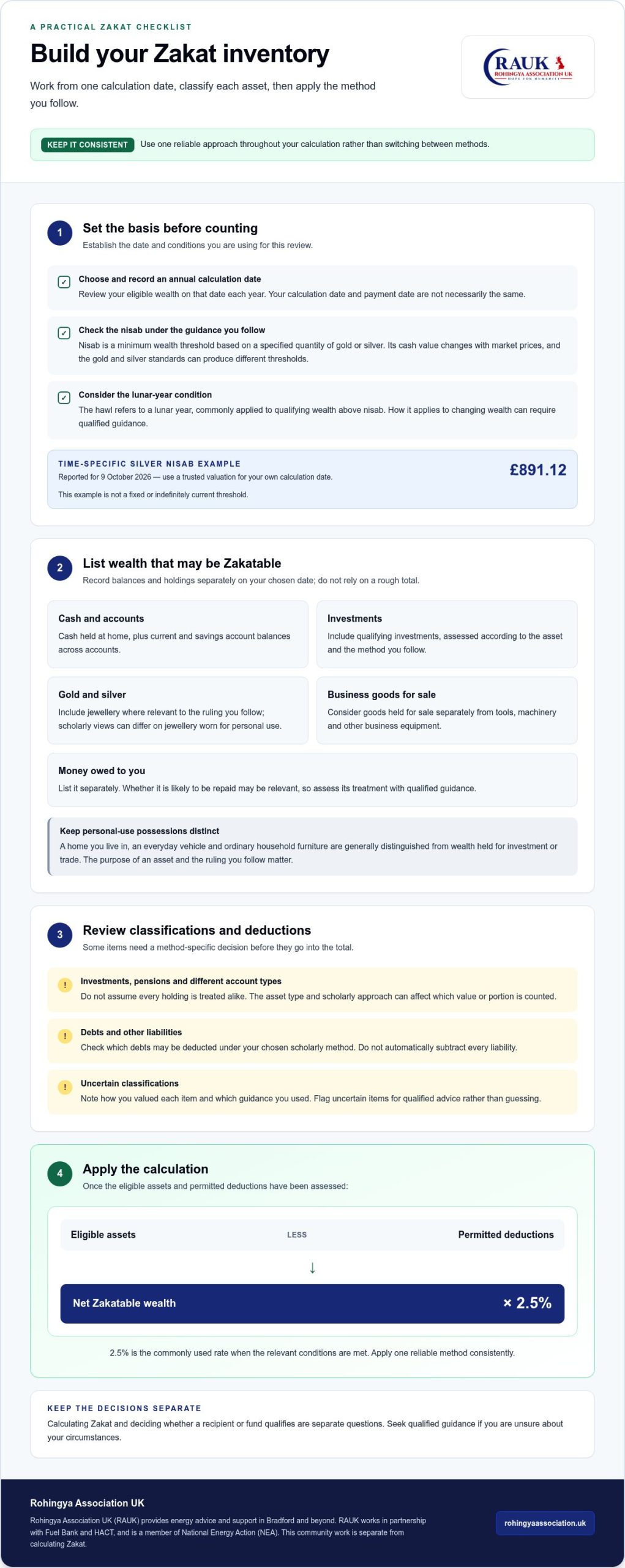
How do we calculate the amount? Follow these practical steps
Once you’ve identified your assets and any possible deductions, bring the figures together in a consistent order. The result depends on how accurately you value and classify each item, so keep disputed items visible rather than treating an uncertain estimate as settled.
- Choose your calculation date. Record the date for your annual review and use figures that relate to the same point in time.
- Total your potentially eligible assets. Add the assets that qualify under the scholarly method you follow, using comparable values in one currency.
- Assess possible deductions. Subtract only liabilities your chosen guidance allows you to deduct. Don’t automatically subtract the full balance of every loan.
- Check the nisab and other conditions. Compare your qualifying net wealth with a trusted valuation for the relevant date, and confirm that the applicable conditions for Zakat are met.
What is the basic Zakat formula?
Qualifying net wealth means the eligible assets counted under your method, after any permitted deductions. If the conditions are met, a commonly used calculation is:
Qualifying net wealth × 0.025 = Zakat amount
For example, in a hypothetical illustration, if qualifying net wealth is 1,000 units, the calculation is 1,000 × 0.025 = 25 units. These currency-neutral units do not represent any particular person’s wealth, and the example does not establish whether the total meets nisab. It shows the arithmetic only; it cannot settle disagreements about which assets or deductions qualify.
How can you check your working?
Before finalising the figure, check your notes against this list:
- Is your calculation date clear, and do the asset values relate to it?
- Have you included each potentially eligible asset once, without counting the same balance twice?
- Are your deductions supported by the method you’re following?
- Have you compared your qualifying net wealth with a current nisab valuation in the same currency?
- Have you checked the relevant conditions before applying the rate?
Use like-for-like figures. If a balance is valued on a different date, update it or flag it for review rather than combining mismatched values. Note any uncertain asset classification or liability and ask a qualified scholar how to treat it. Keep your calculations, source figures and assumptions together. Next year, this record will help you see what changed and why.
Understanding how do we calculate zakat means checking both the arithmetic and the religious method behind it. If you’re interested in supporting wider community work, you can learn about Rohingya Association UK. General community support is separate from deciding whether a donation is eligible as Zakat.
After calculating Zakat, how can you give with care?
Calculating the amount you owe and deciding where it may be paid are separate steps. A correct calculation does not automatically make every recipient, charity or fundraising appeal eligible for Zakat. Consider the intended use of the funds and whether the recipient meets the relevant religious criteria.
Qur’an 9:60 names eight recipient categories: the poor, the needy, those who administer Zakat, people whose hearts are to be reconciled, the freeing of captives, those in debt, causes in the path of Allah, and the stranded traveller. Applying these categories to modern charitable funds can require qualified religious guidance. Don’t assume a general donation counts as Zakat simply because it supports people in hardship.
How do you assess a recipient or charitable fund?
Start with the charity’s published Zakat policy. Look for an explanation of how Zakat funds are separated from general donations, what they can be used for and how recipients are assessed. Charitable status alone does not establish Zakat eligibility. If the policy or distribution method leaves an important question unanswered, seek advice from a trusted scholar before designating your payment as Zakat.
A fund may support a broad humanitarian programme, while Zakat has specific recipient criteria. Both the programme’s purpose and the people who ultimately benefit matter. Check that your intention, the fund’s arrangements and the scholarly guidance you follow align. If they don’t, treat the payment as general charity until you have clarity.
How does RAUK support communities in Bradford and beyond?
Rohingya Association UK’s work includes community support, education, crisis intervention and humanitarian assistance. RAUK also provides energy advice and support, works in partnership with Fuel Bank and HACT, and is a member of National Energy Action (NEA). This community work is separate from determining whether a particular fund or recipient is eligible for Zakat. Don’t assume a general contribution to an organisation or its work fulfils a Zakat obligation.
Funds can be raised for projects in Bangladesh. Treat general support for this work as charitable giving unless the eligibility and arrangements for a particular fund have been established. Keeping the distinction clear recognises that Zakat follows religious criteria, while general charity can support wider community needs.
Keep a record of your calculation, the guidance you followed and how you designated your payment. If you’re asking “how do we calculate zakat” as well as where to give, consider the calculation and recipient questions separately. A qualified scholar can help with religious interpretation, while a charity’s published policy explains the purpose and handling of its funds.
Let careful giving carry your intention forward
Knowing how do we calculate zakat is part of approaching this obligation with care. Sound giving also means considering your intention and the purpose of each payment. If a question about your circumstances or a recipient’s eligibility remains unresolved, record it and seek qualified religious guidance before deciding how to proceed.
General charitable support can sustain important community work, but it should remain distinct from a Zakat payment unless its eligibility has been established. Giving with clarity helps you honour your religious commitments while choosing other ways to contribute.
Support RAUK’s community work in Bradford and beyond, including its work with Rohingya families and communities.
Frequently Asked Questions
Is Zakat always calculated at 2.5%?
No. The commonly used rate for qualifying monetary wealth is 2.5%, but the applicable rate and calculation can depend on the type of asset and the religious rules followed. Don’t assume the same percentage applies to every form of wealth or circumstance. If your finances include less straightforward assets, such as agricultural produce or business interests, ask a qualified scholar which calculation applies.
Can I deduct my mortgage or other debts before calculating Zakat?
Possibly, but don’t automatically subtract the full outstanding mortgage or loan balance. Scholarly approaches differ on which liabilities may be deducted and whether the relevant amount is limited to payments due soon. A mortgage instalment falling due may, for example, be assessed differently from the remaining balance over many years. List your obligations and their due dates, then apply one trusted method consistently.
Do I pay Zakat on gold jewellery?
It depends on the scholarly opinion you follow. Some approaches include gold jewellery, while others treat jewellery intended for personal use differently. If you own gold for wearing and investment, note the purpose of each item and seek guidance on how it should be assessed. Keep a current valuation with your records, as the value used for your calculation can change over time.
How do I calculate Zakat on shares?
The treatment can depend on why you hold the shares and the method you follow. Shares bought for trading may be assessed differently from long-term investments, where guidance may focus on the Zakatable portion of the underlying assets. Don’t assume every portfolio is treated alike. Record the share values on your calculation date, your investment intention and the method used, then ask a qualified scholar about uncertain holdings.
Do I pay Zakat on money someone owes me?
It may be included, but the answer can depend on whether repayment is expected and on the scholarly method you follow. A loan to someone able and expected to repay may raise different questions from an overdue amount that appears unlikely to be recovered. Record the amount and circumstances, then seek qualified guidance on whether and when it belongs in your calculation.
What if my savings rise or fall during the Zakat year?
A changing balance does not necessarily mean you need to recalculate every time money enters or leaves your account. The treatment can depend on whether your wealth remains above the relevant threshold and on the scholarly approach you follow. Keep statements or a simple record of significant changes, especially near your annual calculation date. If your savings fall below the threshold or fluctuate around it, ask a qualified scholar how that affects your circumstances.