
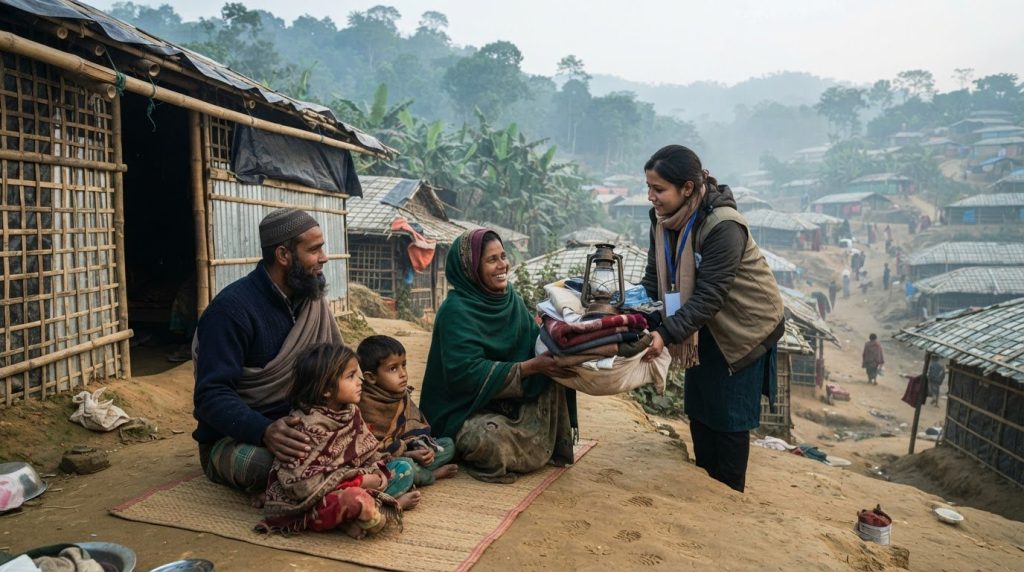
What does meaningful winter support look like for the more than 1.2 million Rohingya refugees living in Bangladesh? A winter appeal for refugee camps should respond to seasonal needs with care, dignity and a clear purpose. Before giving, it is worth understanding what the appeal aims to support, where funds are intended to go and how the organisation communicates about its work.
This article explains why seasonal support matters, how to assess an appeal and how immediate assistance can sit alongside longer-term community programmes. It also describes Rohingya Association UK’s (RAUK’s) work in Bangladesh, the UK and Myanmar, so you can distinguish a Bangladesh-focused appeal from the organisation’s wider activities.
RAUK is a community-led charity supporting Rohingya refugees, families and young people. It provides practical support including housing guidance, healthcare access, education, English language classes and skills development. In the UK, RAUK provides energy advice and support, works in partnership with Fuel Bank and HACT, and is a member of National Energy Action (NEA). Its support reaches Bradford and beyond. Donations can support projects in Bangladesh, as well as RAUK’s work in the UK and Myanmar.
Key Takeaways
- Seasonal pressures differ between households, so consider local conditions and people’s circumstances rather than assuming every family has the same needs.
- A clear winter appeal for refugee camps explains its purpose and intended location, helping you understand what your contribution is meant to support.
- Before giving, look for clear information about the organisation, the appeal’s stated aims and updates on its work.
- RAUK supports Rohingya communities through projects in Bangladesh, the UK and Myanmar. Donations can be directed towards Bangladesh.
- Choose a next step that reflects the appeal’s stated purpose, without expecting a donation to guarantee a particular outcome for an individual.
Why winter support matters for refugees in Bangladesh
Seasonal changes can add pressure to daily life in a refugee camp, particularly for families with limited space or resources to adapt. The effects are not the same for everyone. Needs can vary according to location, household circumstances, health and the conditions people are facing at the time. A winter appeal for refugee camps is a focused way to raise support for seasonal needs while respecting the priorities and agency of the people it aims to serve.
Funds can be raised for Rohingya families in Bangladesh. Naming the destination clearly helps donors understand the appeal’s purpose and distinguish it from RAUK’s other work. When reading an appeal, look for a direct explanation of its intended use rather than assuming that a general reference to winter describes a particular project or type of assistance.
The video below concerns a winter appeal in Lebanon, not Bangladesh. It offers a broader illustration of how seasonal support may be discussed in a refugee setting, but it is not evidence about conditions in Bangladeshi camps.
What can make winter harder in a refugee camp?
Seasonal conditions may affect comfort and make everyday tasks more difficult, but the specific pressures depend on circumstances on the ground. Shelter, health and access to essentials can be connected: a household’s ability to stay protected from the elements may influence its wellbeing, while access to healthcare and basic supplies affects how it responds to changing needs. Treat these as general considerations, not as verified details about a particular camp or a promise of specific assistance.
Refugee families are not simply recipients of help. They make decisions, care for one another and draw on community knowledge to manage difficult circumstances. Thoughtful support recognises that resilience and responds to needs without defining people by hardship.
Why does a Bangladesh-focused appeal need clear context?
Bangladesh is the destination for this appeal, but the exact project location and winter intervention should be understood from the appeal’s own description. Background on displacement and the camp setting is available in this overview of Rohingya refugees in Bangladesh. For wider everyday context, RAUK’s guide to life in a Rohingya refugee camp can help readers understand that camp life involves more than seasonal needs.
That regional background is distinct from RAUK’s organisational activities. RAUK accepts public donations for projects in Bangladesh, alongside its work in the UK and Myanmar. Read the stated purpose of the appeal to understand what it seeks to support. This helps donors make an informed decision without assuming a particular delivery method or outcome for an individual.
What thoughtful winter support can address without reducing people to need
Seasonal support is most useful when it responds to a clearly described need, rather than treating every refugee household as if it faces the same circumstances. In a camp setting, humanitarian priorities may include shelter, food, water and healthcare. These are broad areas of concern, not a list of services every appeal provides or a promise about what a particular donation will fund.
A responsible winter appeal for refugee camps explains where support is intended to go and what the appeal aims to address. RAUK accepts donations for projects in Bangladesh, but the purpose of a specific appeal should be read on its own terms. A donation supports the stated work; it cannot guarantee a particular outcome for an individual or household.
How can an appeal explain urgent needs responsibly?
Clear language gives prospective donors a sound basis for deciding whether to contribute. An appeal should name its intended location and purpose, then explain the need using relevant information. General concerns such as shelter or healthcare should not be presented as verified local conditions unless credible evidence supports that description. This helps readers understand both the stated need and the context behind it.
Responsible communication also treats displaced people as individuals, not as images of crisis. Person-first language, respectful imagery and care for people’s privacy help preserve dignity. The aim is to explain circumstances accurately, not to create distress or imply that families have no choices or capacity of their own.
Why should winter support respect dignity and agency?
Rohingya families bring skills, relationships and knowledge of their own priorities to the difficult circumstances of displacement. Support should recognise those strengths and avoid framing people solely through what they lack. A contribution can help an organisation pursue its stated purpose, but it cannot resolve a complex humanitarian crisis on its own.
Immediate assistance and longer-term work can complement each other. Responding to urgent needs may sit alongside efforts that strengthen protection, education and community resilience. RAUK’s wider work includes humanitarian aid and food support, education and youth empowerment, and community integration. These are areas of organisational work, not automatic promises about what a particular winter appeal will deliver.
- Purpose: Does the appeal explain what it seeks to support?
- Context: Are stated needs grounded in relevant information rather than assumption?
- Dignity: Does its language recognise people’s agency and avoid reducing them to hardship?
These questions can help keep generosity informed and respectful. To learn more about RAUK’s community-led work, consider how its broader programmes relate to the stated purpose of a Bangladesh-focused appeal.
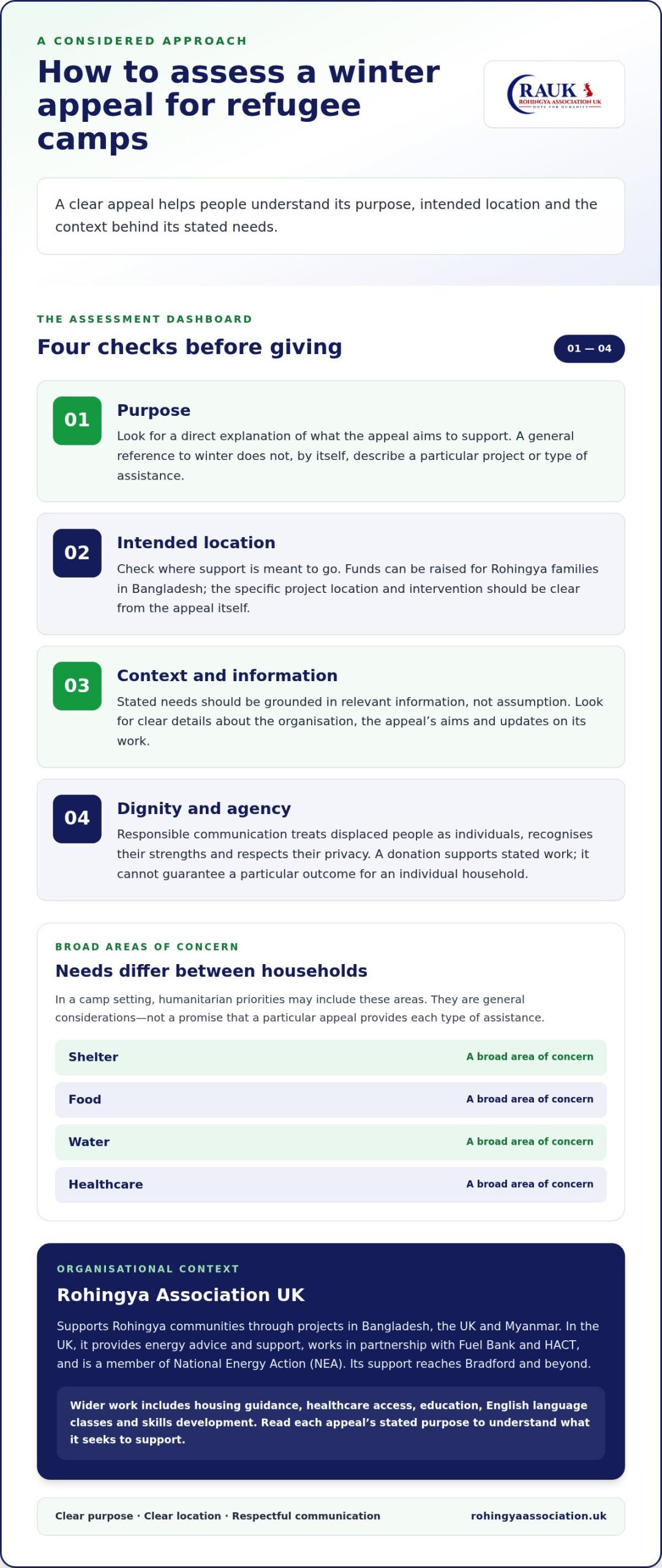
How to assess a winter appeal for refugee camps before giving
A clear appeal helps you decide whether its purpose aligns with your intentions. Strong emotion alone is not a substitute for useful information. Look for a plain explanation of the destination, the organisation’s role and how it will communicate about its work. These checks cannot guarantee a particular result, but they can help you give with a better understanding of the request.
Use this framework to assess a winter appeal for refugee camps:
- Purpose: Is the appeal’s intended use explained clearly? Distinguish a specific winter appeal from the organisation’s broader programmes.
- Location: Does it identify where funds are intended to go? A Bangladesh-focused appeal should make its destination clear.
- Organisation: Can you understand who is behind the appeal and what role it describes? Consider the organisation’s wider work separately from the specific commitment made by the appeal.
- Evidence: Are descriptions of need supported by relevant, reliable information? General humanitarian concerns should not be presented as verified local facts without evidence.
- Updates: Does the organisation explain how it will share information about its work? Updates can provide transparency without promising a guaranteed outcome for any individual.
A sound donation decision rests on five checks: purpose, place, organisation, evidence and updates. The information should be accessible and precise, not buried beneath urgent language or pressure to give immediately. If key points are unclear, pause and consider what you can reasonably understand from the material provided.
Which details help donors understand an appeal?
Look for a specific destination and a plainly stated purpose, then consider whether the organisation describes its role and wider work accurately. For example, an organisation may support several programmes while one appeal has a narrower aim. Keeping those scopes distinct helps avoid assuming that a contribution will fund every activity or meet a particular household’s needs.
Updates are useful when they describe what the organisation can report, rather than claiming certainty about outcomes beyond its control. Clear communication explains progress in a measured way and respects the people involved.
How can donors balance immediate and continuing support?
Urgent assistance responds to immediate priorities; continuing work can support longer-term aims such as education, protection and community resilience. They can complement one another, but neither is the only responsible choice. A one-off contribution may suit your circumstances, while others may prefer to support ongoing work.
For a broader view of ways to stand alongside Rohingya communities, RAUK’s guide to helping Rohingya refugees can offer useful context. Read it alongside the appeal’s stated purpose, so your decision reflects both the immediate request and the wider needs of displaced families.
How RAUK supports people in Bangladesh, Bradford and beyond
RAUK brings together practical assistance and programmes that support families and communities over time. For anyone considering an appeal, it helps to distinguish the organisation’s broader mission from the specific purpose of a fundraising request. The appeal’s wording should guide your understanding of what it seeks to support.
What does RAUK’s work across communities involve?
RAUK’s work includes crisis intervention, education and community integration. It provides practical assistance such as housing guidance, healthcare access, English language classes and skills development programmes. These activities address different aspects of community life, from responding to difficult circumstances to creating opportunities for learning and connection. They sit within a broader commitment to supporting Rohingya families and communities, rather than describing a guaranteed outcome from any single appeal.
This wider context helps show how a seasonal appeal can relate to longer-term community support without treating the two as interchangeable. The Rohingya Association UK brings these strands together through its work with Rohingya communities.
How does RAUK’s UK energy support fit the wider picture?
RAUK provides energy advice and support in the UK, including through its partnerships with Fuel Bank and HACT. RAUK is also a member of National Energy Action (NEA). This is a distinct part of its community work, separate from a Bangladesh-focused appeal.
For donors, the practical point is to follow the stated purpose of the appeal rather than assume every area of an organisation’s work is part of the same fundraising request. Clear boundaries between programmes help donors understand where their support is directed.
Across its work, RAUK connects immediate assistance with sustained efforts to support community wellbeing. Each project has its own context and purpose, while the people and communities involved remain active participants in their futures.
Take a considered next step for the Bangladesh winter appeal
A clearly directed appeal connects seasonal concern with a defined purpose. For Rohingya families in Bangladesh, support can form part of a wider humanitarian response. A contribution should not be presented as a guaranteed outcome for a particular person or household. Its value lies in making an informed choice and standing alongside a community with dignity and respect.
Funds can be raised for Bangladesh through RAUK’s work. Keeping the destination clear helps donors understand where an appeal is directed, while recognising that RAUK’s broader projects support communities in different contexts. Before contributing, return to the appeal’s stated purpose and consider whether its destination and aims are clear to you.
What can readers do after understanding the appeal?
Review the appeal information before contributing. Check that it explains its intended purpose and Bangladesh focus, and keep that request distinct from the organisation’s wider work. If the purpose is clear and aligns with your intentions, consider making a contribution through RAUK’s stated channels.
Sharing the appeal can also help raise awareness. Pass it on with a brief, accurate description of what it supports. Avoid adding claims about aid, delivery or individual outcomes that the appeal itself does not make. Thoughtful sharing helps others make their own informed decision without relying on pressure or distressing language.
There is no single way to show solidarity. A contribution may suit your circumstances; sharing clear information may be more appropriate for someone else. Both choices can bring attention to the appeal’s stated purpose while respecting the agency of Rohingya families and the complexity of the challenges they face.
How should the article close?
Winter can add pressure to already challenging circumstances, which is why a well-explained Bangladesh appeal deserves careful consideration. Support should recognise families not only in relation to their needs, but also through their knowledge, relationships and capacity to shape their lives. Timely humanitarian assistance and sustained community support can sit alongside one another; neither should be framed as a complete answer to displacement.
Take a moment to understand the appeal’s purpose, then decide whether you are able to support it or share it with others. A considered contribution cannot promise a particular result, but it can express solidarity with Rohingya communities and support the work the appeal sets out to fund.
Support RAUK’s work and explore how the organisation supports communities through its wider projects.
Let thoughtful solidarity guide your next step
A winter appeal for refugee camps is an invitation to act with care, not a promise that one contribution will resolve the pressures families face. A meaningful response begins with understanding the appeal’s purpose, respecting the people it seeks to support and recognising that community strength continues beyond any single season.
Funds can be raised for Rohingya families in Bangladesh. Keeping that destination clear allows your decision to reflect the appeal’s stated aim. If you are able to contribute, do so with an understanding of what the appeal explains. If you cannot, sharing accurate information can help others consider their own next step.
Choose a way to show solidarity that honours dignity and supports sustained community work. Support RAUK’s work and help strengthen its ongoing efforts for Rohingya communities.
Frequently Asked Questions
Why can winter be difficult for people living in refugee camps in Bangladesh?
Seasonal conditions can add pressure to daily life, particularly when a household has limited space or resources to adapt. The effects differ between families and depend on their circumstances, health and local conditions. Avoid assuming every camp faces the same challenges. If an appeal describes a specific winter risk, look for reliable, current information that supports the claim and explains which community or location it concerns.
Can RAUK winter appeal funds be raised for Bangladesh?
Yes. RAUK accepts public donations for projects in Bangladesh, so funds can be raised for a Bangladesh-focused winter appeal. Read the appeal’s description to understand its stated purpose and destination; do not assume that every contribution supports the same activity. A clear description can help you make an informed choice, but it should not be taken as a guarantee of a particular outcome for an individual or household.
Does RAUK provide winter energy support in Bradford?
RAUK provides energy advice and support in the UK, including through its partnerships with Fuel Bank and HACT. It is also a member of National Energy Action (NEA), and provides support in Bradford and beyond. This energy work is distinct from a Bangladesh-focused winter appeal. Read the appeal’s wording to understand which community and work it is intended to support.
How can I tell whether a refugee winter appeal is clear about its purpose?
Check whether the appeal identifies its intended location, explains what it aims to support and says which organisation is responsible. Look for evidence behind any specific claims about need, and for updates that describe progress without guaranteeing individual results. A winter appeal for refugee camps should distinguish its stated aim from an organisation’s broader activities. If the information is unclear or relies mainly on emotional pressure, pause before deciding whether to contribute.
What kinds of support may matter to refugees during winter?
Depending on local conditions and household circumstances, general humanitarian priorities may include shelter, food, water and healthcare. These are broad examples, not a promise that a particular appeal provides each form of assistance. Priorities can vary between families and change over time. Consider whether an appeal explains its intended response rather than assuming every seasonal need applies in the same way to all displaced people.
Does RAUK support Rohingya communities only in Bradford?
No. RAUK’s projects operate in the UK, Myanmar and Bangladesh, reflecting its work with Rohingya refugees, families and young people in different contexts. The scope and purpose of each project can differ, so understand a specific appeal from its own description rather than treating it as representative of every RAUK programme. This distinction helps donors understand where their support is intended to go.
How can I support Rohingya refugees beyond a one-off winter appeal?
You can consider supporting RAUK’s wider projects or share accurate information to help others learn about Rohingya communities. RAUK accepts public donations for work in the UK, Myanmar and Bangladesh; use the stated purpose of a particular project or appeal to guide your choice. There is no single right approach. A one-off contribution or thoughtful awareness-raising can each express solidarity, without implying that either alone resolves the challenges of displacement.