
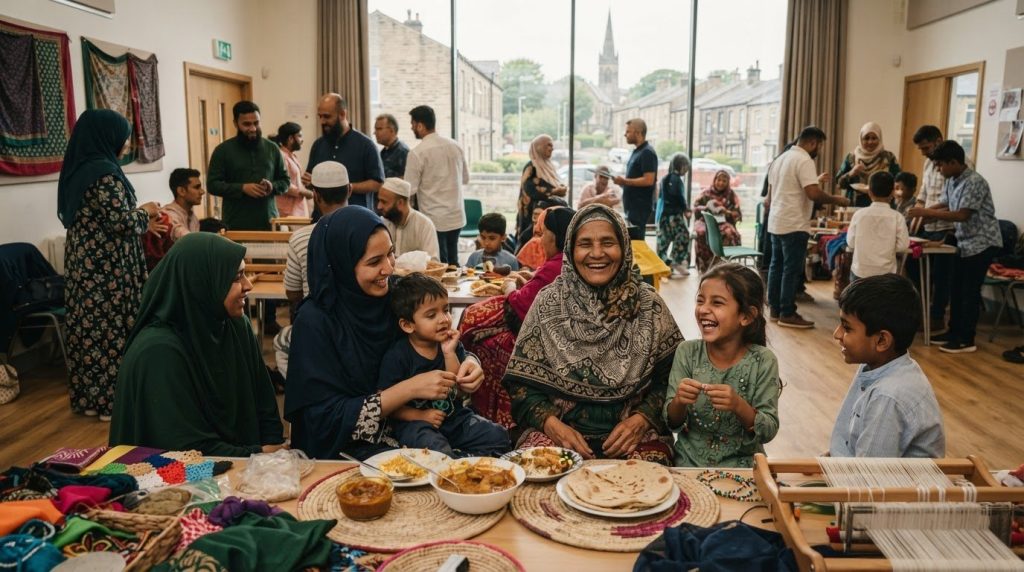
What makes a cultural gathering more than an event to attend? For many people, it is a way to keep heritage present across generations. Rohingya cultural events UK communities organise can bring families and young people together through shared culture, faith and connection. Finding reliable details or knowing how to take part respectfully can be harder if you’re unfamiliar with the community.
This guide explains what these gatherings can offer, how to find current information through community-led sources, and how to attend or support them with respect. Rohingya Association UK (RAUK), a community-led registered charity, organises cultural and Islamic community events to preserve heritage and strengthen community bonds. It provides support in Bradford and beyond, helping people find connection alongside practical community support.
RAUK also provides energy advice and support. It works in partnership with Fuel Bank and HACT, and is a member of National Energy Action (NEA). Whether you’re hoping to share heritage with your family or attend a gathering as a respectful guest, start by recognising that each event is shaped by its community and organisers.
Key takeaways
- Rohingya cultural events UK communities organise can help preserve heritage, nurture belonging and connect generations.
- Gatherings have different cultural or faith-centred purposes. Use the organiser’s guidance for details about a specific event.
- Find current event information through community organisations and their announcements. Check the details before making plans.
- Take part with respect: listen, approach cultural differences with humility, and follow guidance about photography and sharing personal stories.
- RAUK organises cultural and Islamic community events and provides support in Bradford and beyond, including energy advice and support. It works in partnership with Fuel Bank and HACT, and is a member of National Energy Action (NEA).
Rohingya cultural events in the UK: why they matter
Rohingya cultural events are community gatherings centred on Rohingya heritage, culture or shared faith. Their purpose is not simply to present culture to an audience. They can create space for people to meet, strengthen belonging and keep connections between generations active. For families and young people in the UK, these gatherings offer opportunities to share heritage as part of community life. Every person’s experience, however, is different.
Cultural gatherings also differ from general arts programming and events focused primarily on political or humanitarian advocacy. Those activities can be valuable, but a community event may centre on connection and shared identity rather than performance, public education or campaigning. For wider context on the community and its history, see this overview of the Rohingya people.
Rohingya community events create spaces to practise, share and carry heritage forward, with each gathering shaped by its own purpose and participants.
How gatherings help sustain Rohingya heritage
Language, memory and identity can be shared through ordinary acts: speaking together, passing on stories and making room for younger people to learn from older generations. Events can support this exchange without assuming that every family has the same knowledge, traditions or relationship to heritage. Rohingya identity is also lived in the present, shaped by people’s creativity, choices and community ties. It is not defined only by displacement or hardship.
Who may take part in a Rohingya community event?
Audience and participation arrangements depend on the event’s purpose. Some gatherings are organised chiefly for Rohingya community members and families; others explicitly invite wider public participation. Don’t judge who an event is for by its title alone. If you’re interested in attending, read the organiser’s information for details about the intended audience, access and participation.
In Bradford and beyond, Rohingya Association UK (RAUK) organises cultural and Islamic community events to help preserve heritage and strengthen community bonds. These gatherings sit alongside wider support for Rohingya people, families and young people. RAUK also provides energy advice and support, works in partnership with Fuel Bank and HACT, and is a member of National Energy Action (NEA). Its community-led work recognises that connection, practical support and cultural continuity can all help people build a sense of belonging.
What might you experience at Rohingya cultural and Islamic events?
There is no single standard format. Rohingya cultural events UK communities hold vary in purpose and content, depending on the organisers and the people they are bringing together. A cultural event may make space to share heritage and community stories; an Islamic gathering has a faith-centred purpose. Both can strengthen connection, but they are not interchangeable and need not follow the same programme.
- RAUK event types: cultural community events and Islamic community events.
- Possible activities at cultural gatherings: events may include cultural festivals, exhibitions or creative presentations. Check the event information to see whether it includes these or activities such as language, food or family participation.
Cultural activities, language and shared heritage
When an organiser includes an exhibition, performance or storytelling, these activities can offer ways to express culture and share community memory. Language or food may also feature at a particular event, but the programme will say what is planned. Rohingya people have varied experiences and interests, so no single activity or tradition represents everyone. Use the event announcement to understand what to expect and plan accordingly.
Islamic gatherings and community connection
RAUK organises Islamic community events as well as cultural events. A faith-centred gathering can offer participants space for shared religious connection, while a wider cultural celebration may focus on heritage and community life. These purposes can sit alongside one another, but they are distinct. Don’t assume every attendee observes in the same way or that a particular religious activity is included. Follow the event description and organiser’s guidance.
For families and young people, the value of a gathering can lie as much in being together as in any scheduled activity: meeting others, listening and finding a place within community life. RAUK provides support in Bradford and beyond. Alongside its events, it provides energy advice and support, works in partnership with Fuel Bank and HACT, and is a member of National Energy Action (NEA).
To understand what a particular event offers, read its current details rather than relying on assumptions about Rohingya culture or examples from other gatherings. Explore RAUK’s community information for event announcements.
How to find Rohingya cultural events across the UK
Event information can appear across different community channels, so use a clear process to find relevant gatherings and avoid relying on outdated details. For Rohingya cultural events UK readers can start with community-led organisations, including Rohingya Association UK (RAUK), which organises cultural and Islamic community events. RAUK provides support in Bradford and beyond. For event dates and locations, look for current announcements rather than inferring a schedule from the organisation’s wider work.
Start with community-led announcements
Begin with information shared by the organisation hosting or organising the gathering. RAUK’s current event information is a useful starting point for its announcements. The event listing should explain the date, location, purpose and intended audience, as well as how participation works. Community organisations may also share information through their own channels. If you find an event through a social-media post or news report, trace it back to the organiser’s current announcement.
Use the organiser’s current announcement as your source of truth for event details. A social-media post or news report can help you discover that an event took place, but older coverage alone doesn’t confirm that it will happen again.
Check practical details before setting out
Once you find an announcement, read it carefully before making plans. Check:
- Date and location: confirm the details for the particular event you plan to attend.
- Audience: check whether the gathering is community-focused or explicitly open to wider public participation.
- Access arrangements: read any information the organiser provides about attending.
- Registration: follow the stated instructions if registration is required.
Use the event organiser’s stated contact route if you need clarification about attendance arrangements. Don’t rely on an old post, a general organisation page or a past event listing as confirmation of current details. Dates, venues and arrangements can differ from one gathering to another.
RAUK brings cultural and Islamic events together with wider support for Rohingya people and families. It provides energy advice and support, works in partnership with Fuel Bank and HACT, and is a member of National Energy Action (NEA). For planning an event visit, focus on the latest event announcement and its practical information.
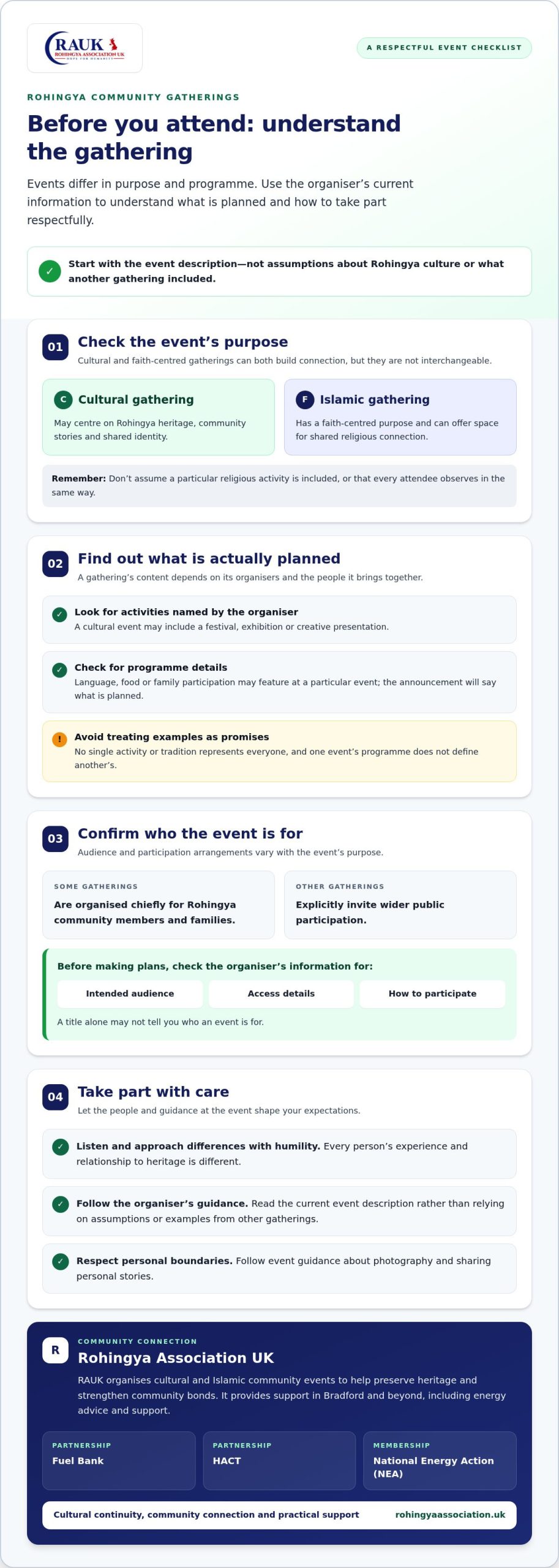
How to take part respectfully in a Rohingya community event
Attending a Rohingya community event for the first time is an opportunity to meet people, listen and take part with care. You don’t need to speak Rohingya or share the same faith to approach a gathering respectfully. Recognise that each event has its own purpose and guidance, and that community members are participants and hosts, not people to be observed.
What first-time attendees can do
Before setting out, read the event description and follow its instructions about arrival and participation. At the gathering, listen, be considerate in conversation and respect personal boundaries. If you have a question, consider whether it suits the context and whether the person seems comfortable responding. No one is obliged to explain their identity, faith or experiences.
Don’t assume that attendees want to discuss displacement, political issues or difficult personal histories. A cultural or community event may be a place for celebration, connection or shared activity. Let people guide the conversation, and be open to learning without expecting any one person to speak for all Rohingya people.
How to share event images and stories responsibly
Pause before using a camera or recording device. Ask for consent before photographing someone, recording a conversation or sharing identifiable details, and follow the organiser’s rules about photography, filming and social media. If someone declines, accept that without pressing them. Attending or taking part does not automatically mean someone has agreed to be recorded or featured online.
When sharing information afterwards, describe what you experienced accurately. Avoid captions that reduce people to stereotypes or define them only through hardship. Be thoughtful about names, faces and personal stories. If you’re unsure whether something can be shared, don’t publish it without permission. Respectful participation includes how you represent the gathering after it ends.
RAUK organises cultural and Islamic community events, while its wider support includes energy advice and support in Bradford and beyond. It works in partnership with Fuel Bank and HACT, and is a member of National Energy Action (NEA). These activities sit alongside its community-led work. For a particular gathering, follow the organiser’s guidance on how to participate.
For current event information and guidance, visit Rohingya Association UK before making plans. Approaching Rohingya cultural events UK with curiosity, humility and care helps create space for genuine connection.
Connect with Rohingya cultural events through RAUK
A community-led point of connection can make it easier to learn about gatherings that reflect Rohingya heritage and shared faith. Rohingya Association UK (RAUK) is a community-led registered charity supporting Rohingya refugees, families and young people. It organises cultural and Islamic community events to preserve heritage and strengthen community bonds.
A community-led connection in Bradford and beyond
Its events sit within wider work to nurture connection and support Rohingya families and young people. That community-led approach matters: gatherings are organised as part of community life, not simply as opportunities for an outside audience to observe culture.
Each event has its own purpose and arrangements. If you’re considering attending, use RAUK’s current announcements for event information, including published details about the audience and participation. Use the information for that gathering rather than relying on past coverage or details from another event.
Stay connected and support community-led work
RAUK’s wider support includes energy advice and support. The charity works in partnership with Fuel Bank and HACT, and is a member of National Energy Action (NEA). This work sits alongside cultural and Islamic events that help sustain heritage and strengthen community ties.
For Rohingya cultural events UK readers can take a practical first step by following RAUK’s current announcements, then reading the event information before making plans. This helps you understand a gathering’s purpose and how to participate in a way that respects its organisers and community.
You can also support community-led work by sharing accurate event information and following organisers’ guidance. If you want to contribute more broadly, RAUK accepts donations to fund aid projects in the UK, Myanmar and Bangladesh, including crisis intervention, education and community integration services for displaced Rohingya families.
Stay connected with Rohingya community life
Rohingya cultural events UK communities organise can help keep heritage present, nurture belonging and bring generations together. Each gathering has its own purpose, so use the organiser’s current announcements for details and follow its guidance when taking part. Listening, respecting boundaries and asking before sharing photographs or personal stories are simple ways to participate with care.
Rohingya Association UK (RAUK) is a community-led registered charity supporting Rohingya refugees, families and young people. It organises cultural and Islamic community events to preserve heritage and strengthen community bonds, with support provided in Bradford and beyond. RAUK also provides energy advice and support, works in partnership with Fuel Bank and HACT, and is a member of National Energy Action (NEA).
Explore RAUK’s community work and current announcements to learn more and find event information. Following the charity’s announcements is a practical way to stay connected with community-led efforts to preserve heritage and strengthen belonging.
Frequently Asked Questions
Where can I find Rohingya cultural events in the UK?
For Rohingya cultural events UK-wide, start with community-led organisations such as Rohingya Association UK (RAUK) and follow their current announcements. Organisers share event dates, locations and participation details, which can vary between gatherings. Past posts or coverage may help you discover community activity, but they don’t confirm an upcoming event. Read the latest information before making plans.
Are Rohingya cultural events in the UK open to everyone?
Some events are intended primarily for Rohingya community members and families, while others explicitly invite wider public participation. The audience and arrangements depend on each gathering, so don’t assume that every event is open to everyone or follows the same access arrangements. Read the organiser’s guidance for the specific event, including any instructions about attendance or participation, and follow it respectfully.
What happens at a Rohingya cultural event?
Rohingya cultural events can create space for people to share heritage, strengthen community ties and connect across generations. There is no standard programme: activities depend on the event’s purpose and organisers. Performances, exhibitions, language activities or shared food may feature when included in the event plan. Check the event description for what is planned rather than relying on assumptions or details from another gathering.
Does RAUK organise Rohingya cultural events in Bradford?
Yes. Rohingya Association UK organises cultural and Islamic community events to help preserve heritage and strengthen community bonds. For information about a specific event, use RAUK’s latest announcements and event details rather than assuming dates, venues or arrangements from previous gatherings.
Can people who don’t speak Rohingya attend community events?
Language arrangements depend on the event, so read the organiser’s guidance to understand the intended audience and how to participate. If you attend, be welcoming and respectful in conversation, listen carefully and avoid expecting any one person to speak for the whole community. People’s language skills and experiences vary.
How can I support Rohingya cultural events in the UK?
Support can begin with sharing accurate event information, following organisers’ guidance and participating respectfully. You can also explore RAUK’s community-led work and consider making a donation. RAUK accepts financial contributions to fund aid projects in the UK, Myanmar and Bangladesh, supporting crisis intervention, education and community integration services for displaced Rohingya families. The charity also provides energy advice and support, works in partnership with Fuel Bank and HACT, and is a member of National Energy Action (NEA).
Are Rohingya cultural events the same as Islamic community events?
No. They can overlap, but they aren’t identical: cultural events may focus on heritage and community life, while Islamic community events have a faith-centred purpose. Rohingya Association UK organises both cultural and Islamic community events, and each gathering has its own aims and arrangements. Read the organiser’s description to understand the purpose of a specific event rather than assuming all gatherings share the same format or focus.