
How can you support Rohingya education projects in a way that responds to real needs and respects the community’s priorities? Wanting to help is a meaningful start. It is also reasonable to ask what a donation supports and what effective education work involves.
Education can nurture learning, confidence and practical skills, contributing to wider community empowerment. This guide explains how to give thoughtfully, understand the needs Rohingya learners may face and assess what a community-led charity says about its work. It also distinguishes charitable activities from outcomes that should not be assumed or promised.
Based in Bradford, Rohingya Association UK (RAUK) is a community-led registered charity providing support in Bradford and beyond. Its charitable projects operate in the UK, Myanmar and Bangladesh. Donations fund aid projects, including education, and can also support crisis intervention and community integration. RAUK provides education and youth empowerment, English language classes and skills development, alongside practical community support. It also provides energy advice and support, works in partnership with Fuel Bank and HACT, and is a member of National Energy Action (NEA). These areas form part of its broader work with Rohingya refugees, families and young people.
Key takeaways
- Education support can strengthen learning, skills and young people’s agency as part of wider community empowerment, without guaranteeing individual outcomes.
- To support Rohingya education projects responsibly, understand the organisation’s purpose and distinguish its stated activities from reported outcomes.
- RAUK donations fund charitable aid projects, including education, across work in the UK, Myanmar and Bangladesh. Donations are not assigned automatically to a specific project.
- Learning is connected to wider family and community life. RAUK provides support in Bradford and beyond.
- Learn about RAUK’s work, review its donation information and decide how you would like to support it.
Why support Rohingya education projects as part of long-term community empowerment?
Education support is about more than access to a classroom. It can involve learning, language classes and skills development, helping people build knowledge and take a more active role in shaping their futures. To support Rohingya education projects responsibly is to recognise learners’ abilities and ambitions, rather than define them only by the difficulties they have experienced.
Rohingya people have diverse histories and circumstances. Experiences of displacement, education and resettlement vary, so one approach will not meet every learner’s needs. Keep this in mind when considering a project: look for a clear purpose and language that respects people’s own priorities. For historical context, read more about the Rohingya people.
A personal account can offer one perspective on what education support may mean:
What can education support mean for Rohingya learners?
Support can relate to different stages of learning and community life. A young person may be developing foundational knowledge or practical skills. An adult may value language learning that helps them take part more confidently in daily life. Families and community networks also influence how people access and engage with learning, so it is useful to consider education as part of a wider picture.
That does not mean every learner needs the same opportunity or form of support. Listening to people’s priorities and recognising their agency helps keep education work respectful and responsive. When reading about a project, consider whether its stated aims account for different circumstances rather than assuming one model will work for everyone.
Why connect education with youth empowerment?
Learning and skills can give young people more tools to consider choices, express ideas and pursue ambitions. They do not guarantee a particular qualification, job or outcome, since opportunity is shaped by many circumstances. However, access to learning can contribute to a stronger foundation for participation and self-determination.
RAUK’s work includes education and youth empowerment, English language classes and skills development. Its Rohingya youth empowerment programmes provide more context on this approach. RAUK is based in Bradford and provides support in Bradford and beyond. Its wider community work includes energy advice and support, in partnership with Fuel Bank and HACT. RAUK is also a member of National Energy Action (NEA). These services sit alongside its education activity; they should not be confused with evidence of a particular education outcome.
RAUK’s charitable projects operate in the UK, Myanmar and Bangladesh, and funds can be raised for work in Bangladesh. Education is part of a wider commitment to community wellbeing. A thoughtful approach recognises dignity, responds to varied needs and supports people’s agency without suggesting that education alone can resolve every challenge.
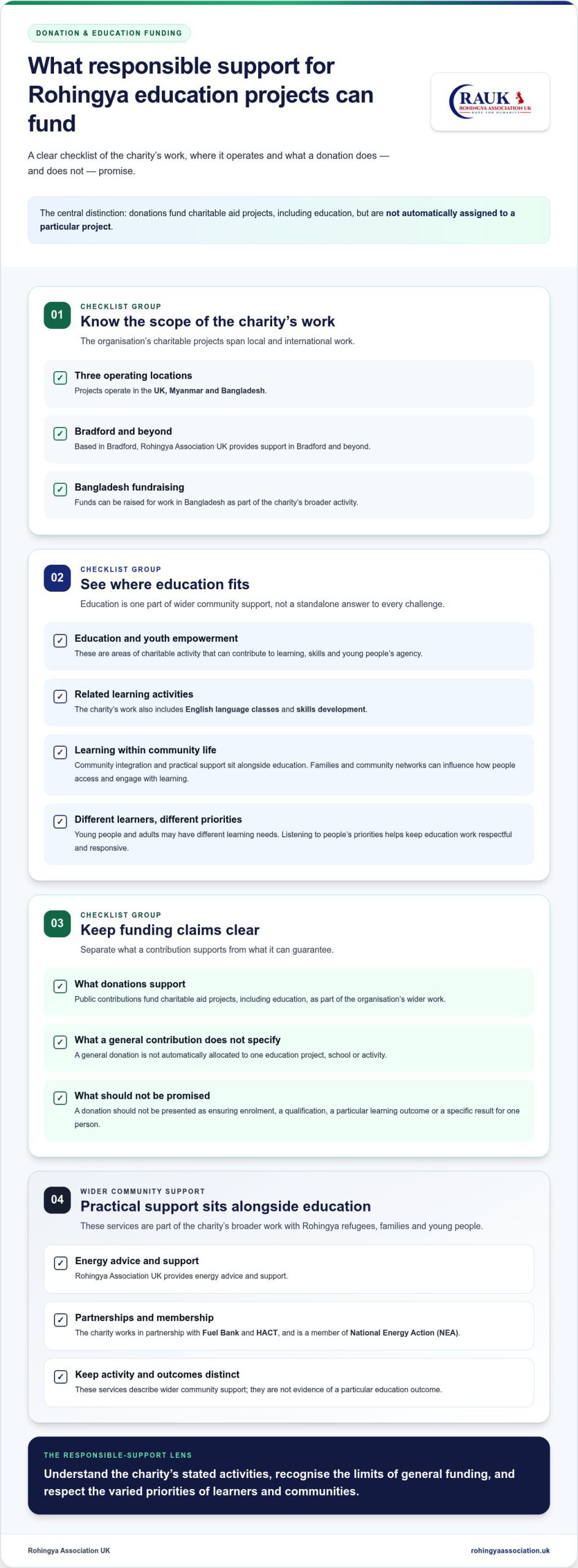
What responsible support for Rohingya education projects can fund
Responsible giving starts with understanding what a donation supports. Rohingya Association UK (RAUK) accepts financial contributions from the public to fund charitable aid projects, including education. Its projects operate in the UK, Myanmar and Bangladesh, bringing together community support in Bradford and beyond with international work.
Donations support RAUK’s wider charitable activity, rather than being automatically assigned to a particular education project. Funds can be raised for Bangladesh as part of the charity’s work. When reviewing donation information, distinguish between the organisation’s areas of work and a specific allocation: a general contribution supports charitable projects, but does not by itself promise a particular activity or result.
How does education fit within RAUK’s wider charitable work?
Education and youth empowerment sit alongside English language classes, skills development and community integration. These areas are connected: learning and skills can support participation in community life, while integration work recognises that people and families may have practical needs alongside their educational aims. They describe areas of charitable activity, not outcomes promised by every donation.
For broader context on how practical assistance can relate to family wellbeing, read RAUK’s guide to community support for displaced families. Education is one part of sustained support, rather than a standalone answer to every challenge. When considering a charity’s work, look at how its different activities relate to the people and communities it supports.
Wider reporting also highlights the importance of sustained attention to education. Human Rights Watch has described the impact of foreign aid cuts on Rohingya children’s education in Bangladesh. This provides context for why education projects need resources over time. It does not mean that a donation to RAUK is assigned to a particular school or activity.
What should donors understand about project funding?
There is a difference between funding a charitable area and guaranteeing a result for one person. A donation can contribute to aid projects that include education, but it should not be presented as ensuring enrolment, a qualification or a particular learning outcome. When evaluating claims, look for clear descriptions of the work and avoid relying on budget shares, beneficiary totals or delivery schedules unless they are supported by published information.
Be precise about what the charity says: RAUK’s donations fund aid projects, including education, and its charitable projects span the UK, Myanmar and Bangladesh. This gives you a sound basis for deciding whether to contribute without overstating what a donation achieves. Visit RAUK’s donation information to learn about giving and consider how your support can contribute to its wider charitable work.
How to assess a Rohingya education project before you give
A considered donation begins with understanding what the work is intended to do, who it aims to support and what the available information can show. This helps you support Rohingya education projects without relying on emotional pressure or claims that promise more than the evidence can establish.
Responsible giving is informed, respectful and realistic. Use a simple sequence: understand the purpose, learn about the organisation, examine its claims and then decide whether to give.
Which questions help clarify a project’s purpose?
Start with the project description. Does it explain the learning or youth-support need the activity addresses? Is it clear who the work aims to support and what the activity involves? These questions help separate a stated charitable purpose from assumptions about who will benefit or what will happen next.
- Understand the purpose: identify the learning or youth-support need described.
- Learn about the organisation: look for clear information about its identity and charitable work. Rohingya Association UK is a community-led registered charity, number 1211433.
- Review the claims: distinguish information about activities from predictions or claims about future impact.
- Make your decision: give in a way that reflects what you understand and consider reasonable.
Community participation matters, too. Look for language that recognises learners and families as people with knowledge, priorities and agency, rather than presenting them only as recipients of help. Continuity is another useful consideration: a clear explanation of how an activity fits into sustained charitable work can tell you more than an urgent appeal alone.
How can donors recognise careful impact claims?
Read claims closely. A description of an activity, such as providing a learning opportunity, tells you what a project does. An output records what was delivered; a longer-term outcome describes a change that may follow. These are different kinds of evidence. A careful account distinguishes between them and explains the basis for any reported results.
A personal story can illustrate one person’s experience, but it cannot prove that the same result applies across a whole programme. Headline figures also need context to be meaningful. Prefer precise descriptions of activities and intended outcomes over unsupported statistics, and be cautious of wording that implies a guaranteed qualification, job or other individual result.
For context, RAUK’s wider work includes energy advice and support. The charity works in partnership with Fuel Bank and HACT, and is a member of National Energy Action (NEA). This community support is separate from evidence about a particular education project, so assess education claims on their own terms.
How education support connects with families and communities in Bradford and beyond
Learning takes place within the wider circumstances of people’s lives. A young person’s educational priorities may sit alongside family responsibilities, language learning, skills development or the practical demands of settling into a community. Recognising these connections can help frame education support with care, without assuming that every family has the same needs or that one service will directly improve learning outcomes.
For anyone considering how to support Rohingya education projects, this wider perspective matters. Education and youth empowerment are important in their own right, while family and community support can address other needs that shape everyday life. Respectful support recognises people’s priorities and agency instead of treating them as a single group with one shared experience.
Why consider the wider circumstances around learning?
Families may value different kinds of assistance at different times. Language classes, skills development and community integration are among RAUK’s charitable activities. They sit alongside education, but should not be presented as guarantees of a particular educational result. Understanding this distinction keeps claims grounded and respects the different aims people bring to learning and community life.
RAUK provides support in Bradford and beyond. Its community work includes practical assistance as well as education and youth empowerment. Keeping the description specific helps explain the charity’s wider role without suggesting that every family has the same circumstances or that each service is available in the same way in every place.
How does RAUK’s community role provide context?
Rohingya Association UK is a community-led registered charity based in Bradford. Its work supports Rohingya refugees, families and young people, with education and youth empowerment among its activities. Its charitable projects operate in the UK, Myanmar and Bangladesh, and funds can be raised for Bangladesh.
RAUK also provides energy advice and support. It works in partnership with Fuel Bank and HACT, and is a member of National Energy Action (NEA). This energy advice and these partnerships are part of the charity’s wider community support, not education projects or evidence of educational outcomes. Keeping the distinction clear helps donors understand the breadth of RAUK’s work without confusing separate areas of activity.
If this broader, community-led approach reflects the kind of sustained support you wish to stand behind, learn about RAUK’s work and how to support it.
Support Rohingya education projects through a considered next step
Once you understand what a charity’s work covers and what its donation information says, you can choose how to support it. Rohingya Association UK (RAUK) is a community-led registered charity whose work includes education and youth empowerment, English language classes, skills development and wider community support. Its charitable projects operate in the UK, Myanmar and Bangladesh.
Donations fund RAUK aid projects, including education, and are not automatically assigned to a particular education project. A donation should not be understood as a promise of a specific outcome for an individual learner. Funds can be raised for Bangladesh as part of the charity’s work.
What is a practical way to begin supporting RAUK?
Take a few considered steps:
- Learn about RAUK: understand its community-led work and the breadth of its charitable projects.
- Review the donation information: visit RAUK’s website to learn how to give.
- Give in line with your means: decide whether to donate, knowing that contributions support aid projects, including education, rather than assuming a particular allocation.
- Stay informed: follow updates and distinguish reported activities from verified outcomes.
This approach lets you support Rohingya education projects as part of wider, sustained community work, without relying on unverified promises. It also respects the difference between contributing to a charity’s work and determining exactly how a particular donation is used.
How can support continue beyond a single donation?
Support can also mean following RAUK’s work and sharing accurate information with friends, family and your wider network. Community participation can take different forms, and any involvement should reflect RAUK’s published activities and the priorities of the people it supports. A careful, informed message can help others understand both the purpose and the limits of charitable giving.
RAUK provides support in Bradford and beyond. Its wider work includes energy advice and support; the charity works in partnership with Fuel Bank and HACT, and is a member of National Energy Action (NEA). These are part of its broader community role, not education projects. Keeping those distinctions clear helps people understand what their support contributes to.
Choose a considered next step and stand alongside community-led work with respect for Rohingya people’s agency and aspirations. Support Rohingya education and community work
Help build lasting opportunities through community-led support
Education can strengthen learning, skills and young people’s agency, while its contribution to opportunity should be described realistically, without promising individual outcomes. To support Rohingya education projects responsibly, understand what a charity’s work covers and distinguish its stated activities from reported results.
Rohingya Association UK (RAUK) is a community-led registered charity, number 1211433. Education and youth empowerment form part of its charitable work, alongside wider support in Bradford and beyond. Its charitable projects span the UK, Myanmar and Bangladesh. Donations fund aid projects, including education, but are not automatically assigned to a specific project or outcome.
RAUK also provides energy advice and support, works in partnership with Fuel Bank and HACT, and is a member of National Energy Action (NEA). This wider work reflects the charity’s community role while remaining distinct from its education activity.
Take a considered next step: learn about RAUK’s work, review its donation information and give in a way that feels right for you. Support Rohingya education and community work. Thoughtful support can help uphold dignity, agency and opportunity.
Frequently Asked Questions
How can I support Rohingya education projects through RAUK?
You can support Rohingya education projects by learning about RAUK’s charitable work and using its donation route. Donations fund aid projects, including education, but are not automatically assigned to a particular project. RAUK’s education and youth empowerment work sits alongside support for families and communities. Give with a clear understanding of the charity’s wider work, rather than assuming that a contribution guarantees a specific outcome.
Will my donation go directly to a Rohingya student?
Not necessarily. RAUK accepts donations to fund aid projects, including education, but donations are not automatically given directly to an individual student or assigned to a particular education project. Do not assume that a contribution pays for one learner’s fees, materials or other specific needs. RAUK’s donation information explains its charitable work and giving route; donations support that work rather than guarantee an individual result.
What can education support include for Rohingya young people?
Education support can include learning, language learning and skills development, alongside youth empowerment. What is useful depends on each young person’s circumstances and priorities; learners should not be treated as though they all need the same intervention. RAUK’s charitable work includes education and youth empowerment, English language classes and skills development. These are areas of its work, not guaranteed results from an individual donation.
Can I support Rohingya projects in Bangladesh through RAUK?
Yes. RAUK’s charitable projects operate in Bangladesh, as well as in the UK and Myanmar, and funds can be raised for Bangladesh. Donations support RAUK aid projects, including education, but should not be assumed to be assigned to a specific country or project. Read RAUK’s donation information to understand its giving route and the scope of its charitable work.
How can I tell whether an education project is making a difference?
Look for clear descriptions of what the project does, whom it aims to support and how progress is reported. A stated activity, such as providing a learning opportunity, is different from a measured outcome, such as a documented change over time. Personal stories can offer useful perspectives, but one account does not prove a programme-wide result. Give more weight to transparent, specific reporting than to unsupported figures or promises.
Does RAUK support families as well as education projects?
Yes. RAUK supports Rohingya refugees, families and young people, with community support and integration alongside education and youth empowerment. It provides support in Bradford and beyond. RAUK also provides energy advice and support, works in partnership with Fuel Bank and HACT, and is a member of National Energy Action (NEA).
Is a donation to RAUK only for education?
No. Donations fund RAUK’s charitable aid projects, including education. Its wider work also includes community support, integration and crisis intervention. A donation is not automatically earmarked for education or another particular project. RAUK is a community-led registered charity, number 1211433, with charitable projects in the UK, Myanmar and Bangladesh.