
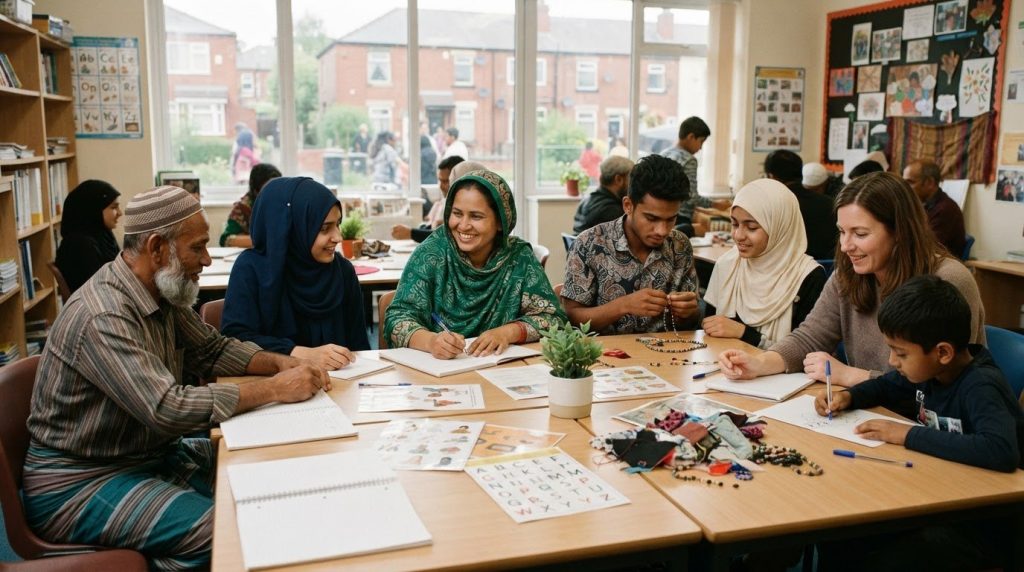
What if success is not a single, dramatic breakthrough, but progress defined by people and communities themselves? Success stories from Rohingya refugees can include learning, building connections and finding ways to contribute, even when displacement and barriers continue to shape daily life.
Readers are right to look for stories that recognise agency, not only hardship, and to ask whether examples are verified and shared with consent. One person’s experience can offer hope, but it can’t represent every Rohingya refugee’s path. This article explores what meaningful progress can look like, how education, practical support and belonging may help create opportunities, and how to engage with these accounts respectfully.
It also considers the role of community-led work. Rohingya Association UK (RAUK), a registered charity based in Bradford, supports Rohingya refugees, families and young people through community, education and integration work. Its services include housing guidance, support to access healthcare, English language classes and skills development. RAUK also organises cultural and Islamic community events and conducts advocacy and awareness campaigns. These examples show how collective support can contribute to opportunity, without claiming outcomes that haven’t been verified or speaking for individuals without their consent.
Key Takeaways
- Success stories from Rohingya refugees can reflect personal progress in learning, family life, belonging and community participation, rather than one prescribed definition of success.
- Share stories with dignity: seek informed, specific consent, verify claims, provide context and let the person review and approve what is published.
- Rohingya Association UK is a community-led registered charity based in Bradford. Its support includes housing guidance, healthcare access, education, English language classes and skills development.
- Look for community support that can create opportunities without assuming it guarantees a particular outcome or represents every person’s experience.
- Learn, share responsibly and explore community-led work. RAUK accepts charitable donations for aid projects in the UK, Myanmar and Bangladesh.
What do success stories from Rohingya refugees really show?
A success story from a Rohingya refugee is an account of progress that the person or family involved considers meaningful, described in their own terms and supported by verified details. Success doesn’t have one prescribed endpoint. It may involve pursuing a personal goal, strengthening family life or finding a greater sense of connection; the meaning depends on the individual.
Displacement can shape people’s choices and opportunities, but it doesn’t define the whole of their lives. The Rohingya people have a history and identity beyond the circumstances of displacement. Keeping that wider context in view helps writers recognise both the barriers people face and the knowledge, decisions and aspirations they bring to their own journeys.
The following video presents one account, published by Save the Children NZ. It can offer a personal perspective, but shouldn’t be treated as representative of every Rohingya refugee’s experience.
Why one refugee success story cannot represent everyone
People’s circumstances and priorities differ with age, family life, language, goals and settlement experiences. Education, employment and integration may be important to some, but they aren’t universal measures of a person’s worth or progress. A respectful account starts by asking what the person wanted to achieve, rather than fitting their experience into a ready-made idea of success.
That distinction matters when discussing organisational work, too. Rohingya Association UK (RAUK) provides housing guidance, support to access healthcare, education, English language classes and skills development. It also organises cultural and Islamic community events and conducts human-rights advocacy and awareness campaigns. These are descriptions of services and activities, not evidence of a particular individual outcome. Any claimed result should be checked before it is linked to RAUK’s work.
How to read a story of progress with care
Separate confirmed facts from interpretation, hopes and outcomes that haven’t been verified. Give enough context to make the person’s account understandable, but leave out identifying or sensitive details that aren’t needed. Above all, avoid pity-based framing: centre the person’s own voice, choices and capabilities, and don’t present one experience as a template for others.
Where can progress appear in Rohingya refugees’ lives?
Progress doesn’t follow one route. In accounts of Rohingya refugees’ lives, it might relate to learning, developing skills, pursuing family priorities, feeling a sense of belonging or taking part in community life. These are possible themes, not promised results of a particular service. What matters is how the person concerned understands and describes their own progress.
There are no documented, approved and fact-checked RAUK case studies provided here, so it wouldn’t be responsible to attribute an individual achievement to the charity. General information about services can explain the support available, but it isn’t proof that a specific person reached a particular outcome. For broader context, read this guide to community support for displaced families.
Learning, skills and young people’s aspirations
A useful account of learning begins with the individual’s own goal and the steps they chose to pursue it. Those steps might be meaningful even if a qualification, job or other intended outcome hasn’t been achieved. Writers should only report educational or employment results when they have reliable evidence and the person’s permission. RAUK’s education and skills work offers relevant context, while its refugee youth empowerment programmes page provides further information.
Family stability may also matter to someone’s definition of progress. A person might value greater confidence in managing daily responsibilities or making plans with family; don’t present such examples as a documented case unless they’ve been verified. Ask what changed, what the person considers important and what they’re comfortable sharing.
Belonging, cultural connection and community participation
For some people, relationships, cultural connection or participation in community life may be meaningful. For others, different priorities will come first. Avoid treating attendance at an event or involvement in a group as a universal milestone. The person’s own account should explain what belonging or participation means to them.
Bradford’s Rohingya community has its own histories and experiences. Lacuna Magazine’s account of the defiant Rohingya of Bradford offers wider context, but it shouldn’t stand in for an individual’s testimony. RAUK’s community support and events are part of its work with Rohingya families, while its advocacy campaigns address human rights and justice for the Rohingya people. These are organisational activities, not evidence of a particular person’s progress. RAUK also accepts donations for aid projects in the UK, Myanmar and Bangladesh. To learn more about its community-led work, visit Rohingya Association UK.
What makes a Rohingya refugee success story credible and respectful?
A credible story is more than an uplifting account. It gives the person control over what they share, checks factual claims and makes clear what is known, what is interpretation and what cannot be confirmed. For success stories from Rohingya refugees, trust depends on a careful process, not just compelling writing.
Use a clear sequence before publishing:
- Ask permission. Explain the purpose of the story and seek informed, specific consent.
- Check the facts. Confirm names, dates, quotations, programme links and reported outcomes against reliable records or direct confirmation.
- Add context. Explain relevant circumstances without turning one person’s experience into a claim about all Rohingya refugees.
- Invite review. Let the storyteller check the draft, including quotations and identifying details.
- Obtain final approval. Confirm consent for the final version and its intended format before publication.
Consent, privacy and the right to shape a story
Ask how the person wishes to be identified and which details must remain private. Explain where the story may appear, such as on a website or social media, and whether it may include photographs, audio or direct quotations. Consent to one format shouldn’t be assumed to cover another. No one should feel pressured to recount traumatic experiences or disclose personal or legal circumstances.
Changing a name may not be enough to protect identity. A combination of details, such as a family relationship, location, timeline or distinctive experience, could still make someone recognisable to people who know them. Consider whether each detail is necessary, and ask the storyteller to review the version that will actually be shared.
Evidence, attribution and honest limits
Check each claim on its own. A verified quotation doesn’t automatically verify a reported outcome, and a general description of a service isn’t evidence that the service caused a particular result. Attribute organisational information precisely. For example, Rohingya Association UK provides housing guidance, support to access healthcare, education, English language classes and skills development. Those facts don’t establish an individual impact without evidence connecting the person’s experience to a specific service.
Third-party statistics may help explain broader circumstances, but they aren’t proof of RAUK’s impact or of outcomes for Rohingya people as a group. If information is illustrative, say so. If a detail is anonymised, explain that accurately without implying anonymity is guaranteed; if a claim is still unverified, leave it out or state that it hasn’t been confirmed.
For background on RAUK’s community-led work, explore Rohingya Association UK.
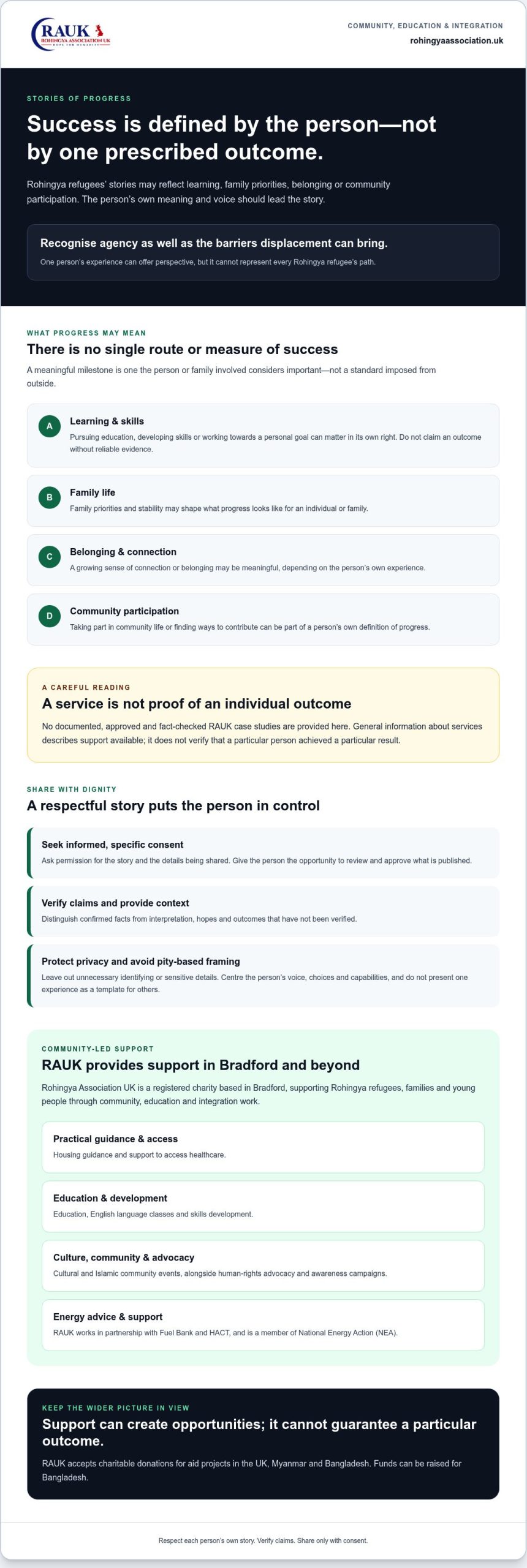
How can community support contribute to progress in Bradford and beyond?
Community support can help people access practical guidance, learning opportunities and connection, while each person decides what progress means for them. Rohingya Association UK (RAUK) is a community-led registered charity based in Bradford. Its work includes housing guidance, support to access healthcare, education, English language classes, skills development, cultural and community events, crisis intervention and human-rights advocacy. These are areas of support, not guarantees of individual outcomes.
Practical support and everyday stability
RAUK’s practical integration work includes housing guidance and support to access healthcare. Its education and skills development work may be relevant to people pursuing their own learning goals, but specific qualifications, employment outcomes or other results should only be reported when verified. English language classes are another part of its education support. These descriptions explain the types of help available; they don’t establish a particular household or individual outcome.
Practical help can matter in the context of daily life, but its scope should be described accurately. Don’t imply that RAUK provides emergency accommodation, legal representation or round-the-clock assistance. For readers seeking help, it’s sensible to check directly which support is available and whether it fits their circumstances.
Community connection and sustained support
Cultural and community events can offer opportunities to connect and participate. Their value, however, depends on what individuals and families want; attendance alone doesn’t prove that someone feels a stronger sense of belonging or has achieved a particular milestone. A respectful account should rely on the participant’s own description rather than presume an impact.
Experiences of displacement also differ, and life in a refugee camp should not be treated as a complete picture of Rohingya identity or of every person’s circumstances. For broader background, see this Rohingya refugee camp guide. The wider context can inform understanding, but it can’t substitute for people’s individual voices.
RAUK’s community-led work provides context for how practical support, education and shared activities may sit alongside people’s own aims. Any story linking a personal outcome to a service should be based on the person’s account and verified evidence, not assumption. To learn more about its work, explore RAUK’s community work.
How can readers honour Rohingya success stories and support lasting progress?
Meaningful progress is personal, shaped by people’s relationships and communities, and best described with their informed consent. The most useful response to success stories from Rohingya refugees is not simply to share them, but to honour the storyteller’s choices and recognise that one account can’t speak for everyone.
Readers can take practical, proportionate steps:
- Learn: seek reliable information about Rohingya experiences and the context surrounding each account.
- Share responsibly: use the storyteller’s preferred description, retain their words only with permission, and check that the story is approved for the format and audience.
- Explore support: find out what community-led organisations do, without assuming that a service guarantees a particular result.
- Consider giving: check the purpose of a current appeal before donating. RAUK accepts charitable donations for aid projects in the UK, Myanmar and Bangladesh; don’t assume every appeal has the same destination.
Share stories without reducing people to their refugee status
A person’s refugee experience may be part of their story, but it isn’t their whole identity. Avoid sensational headlines, deficit-only language and claims that one account represents an entire community. Keep cultural, historical and advocacy context accurate and relevant, and don’t disclose details the storyteller has asked to keep private. Dignified storytelling makes room for people’s own words, priorities and ambitions.
Choose a meaningful way to engage with RAUK
Rohingya Association UK (RAUK) is a community-led charity based in Bradford. Its work includes community support and integration, education and skills development, cultural events and advocacy. It also provides crisis intervention and practical guidance, including housing guidance and support to access healthcare. These are areas of work, not promises of a specific outcome for an individual or a donation.
You can learn about RAUK’s work, explore its community-led approach or check its current information before deciding how to engage. If you choose to give, confirm the appeal’s purpose and destination. To find out more, learn more about Rohingya Association UK.
Carry these stories forward with dignity
Success stories from Rohingya refugees are most meaningful when they reflect progress as each person defines it, rather than a single measure of achievement. Their stories deserve to be shared with informed consent, careful fact-checking and respect for the different paths people take.
Community support can contribute to opportunity and connection, but it shouldn’t be presented as proof of an individual outcome without evidence. Rohingya Association UK is a community-led registered charity based in Bradford, supporting Rohingya families and young people. Its work includes housing guidance, healthcare access, education, English language classes, skills development and cultural and community events.
Learning about this work is one way to engage thoughtfully. Discover Rohingya Association UK’s community-led work and explore its support for Rohingya communities. Each respectful story, shared with care, can help make space for agency, belonging and possibility.
Frequently Asked Questions
What counts as a success story from a Rohingya refugee?
A success story describes progress that the person or family considers meaningful, rather than meeting a fixed definition of achievement. It might focus on learning, pursuing a personal goal, strengthening family life or finding connection, provided the details are verified and shared with informed consent. A story should distinguish confirmed facts from hopes or interpretation, and shouldn’t suggest that one person’s experience represents all Rohingya refugees.
Can Rohingya refugees succeed after displacement?
Yes. Displacement can create serious barriers and shape the opportunities available, but it doesn’t determine a person’s abilities, ambitions or future. Progress may look different for each individual and can take place alongside ongoing challenges. Avoid treating education, employment or integration as universal measures of success. The person concerned should have the space to describe their own priorities and what progress means to them.
How can I find verified stories from Rohingya refugees in the UK?
Look for accounts published by reputable organisations or media outlets that identify their sources, provide context and explain how the story was gathered. Check whether direct quotations and outcomes are attributed clearly, and whether the person gave permission for the account to be shared. An organisation’s description of its services isn’t proof of an individual outcome. If a detail is unclear or unverified, don’t repeat it as fact.
What support can help Rohingya refugees build a life in Bradford?
Useful support may include practical integration guidance, access to education and skills development, community connection and advocacy. Rohingya Association UK provides support in Bradford; its work includes housing guidance, support to access healthcare, education, English language classes and skills development. The right support depends on a person’s circumstances and aims. Check directly with any organisation for current information about its services and how to access them.
How does RAUK support Rohingya refugees and families?
Rohingya Association UK (RAUK) is a community-led registered charity based in Bradford, supporting Rohingya refugees, families and young people. Its work includes community support and integration, education, cultural and community events, crisis intervention and human-rights advocacy. Its practical support includes housing guidance and help to access healthcare, alongside English language classes and skills development. These facts don’t establish a specific individual outcome.
How can I share a refugee success story respectfully?
Get informed, specific permission before sharing someone’s account, and confirm how they want to be identified and which details or formats they approve. Explain where the story will appear, allow the person to review it, and protect details that could reveal their identity. Don’t pressure anyone to discuss trauma or private circumstances. Use accurate context, avoid sensational framing, and never present one person’s account as representative of everyone.
Can I support Rohingya communities through a UK charity?
Yes. You can learn about a charity’s work, share its information responsibly or consider a donation after checking the purpose and destination of funds. Rohingya Association UK accepts charitable donations for aid projects in the UK, Myanmar and Bangladesh. Don’t assume a contribution guarantees a particular result; consult the charity’s current information to understand how it says donations are used.