
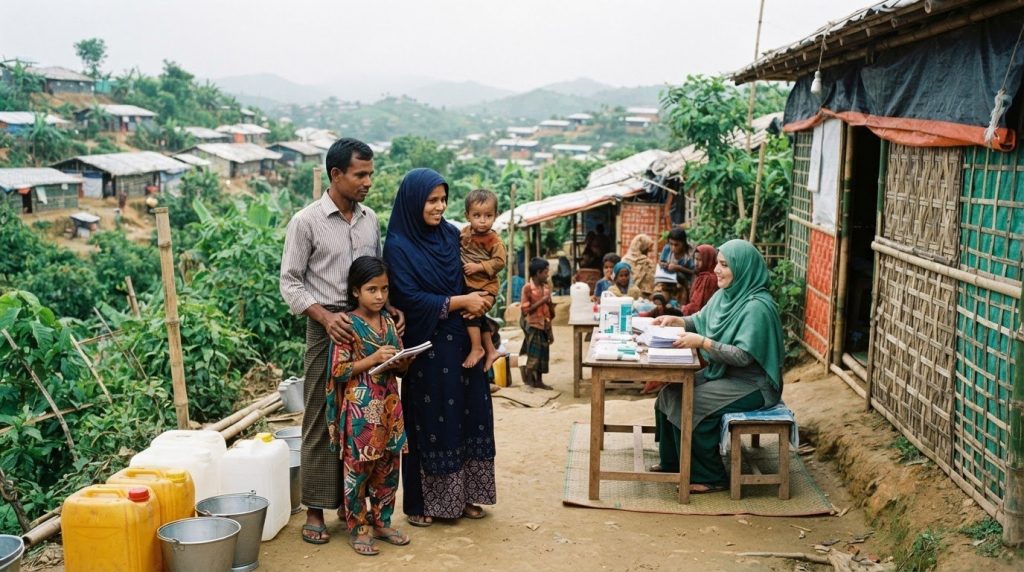
As of 31 July 2026, Bangladesh hosted 1.202 million Rohingya refugees, according to UNHCR data cited in recent humanitarian reporting. That figure is only one part of the Rohingya refugee crisis current situation: conflict and displacement continue in Myanmar, while families in Bangladesh face prolonged uncertainty and pressure on essential support.
If you’re finding that updates differ or become outdated quickly, your concern is justified. Conditions vary sharply by country, and a headline or single statistic can’t explain the whole picture. This article offers a date-stamped overview of what is known as of September 2026, distinguishes the realities in Myanmar and Bangladesh, and explains how to check changing figures against sources such as UNHCR and humanitarian response updates.
It also looks at ways to support Rohingya people without reducing them to a crisis narrative. Rohingya Association UK is a community-led charity supporting Rohingya refugees, families and young people. Its work includes housing guidance, healthcare access, education, English language classes and skills development, alongside cultural events and advocacy. Donations support aid projects in the UK, Myanmar and Bangladesh.
Key Takeaways
- The Rohingya refugee crisis current situation varies by country, so distinguish conditions in Myanmar from displacement and refuge in Bangladesh.
- Learn what current reporting can confirm and where information remains incomplete or uncertain.
- See how immediate humanitarian assistance connects with longer-term needs, including education, healthcare and community support.
- Before sharing an update, check its publication date, source, geographic focus and whether the information is confirmed or provisional.
- Explore how community-led work can support Rohingya families through integration, education, cultural events and advocacy.
Rohingya refugee crisis: What is the current situation in 2026?
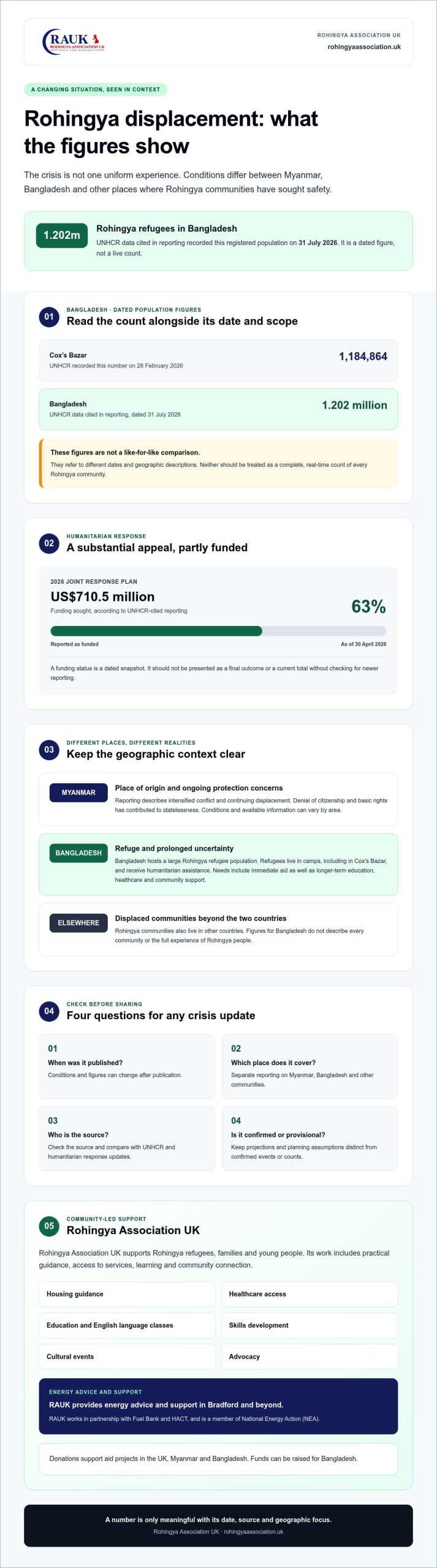
Reporting cut-off: 28 September 2026. The Rohingya refugee crisis current situation remains one of prolonged displacement, with Rohingya people facing very different conditions in Myanmar, Bangladesh and other countries where communities have sought safety. UNHCR data cited in reporting put Bangladesh’s registered Rohingya refugee population at 1.202 million on 31 July 2026. This is a dated figure, not a live count.
The crisis affects a people with a distinct identity, history and culture, not only people who have crossed a border. In Myanmar, the denial of citizenship and basic rights has contributed to statelessness and long-standing protection concerns. For historical context on persecution and violence, see this overview of the Rohingya genocide.
For a news report on conditions facing refugees, watch the video below. Its coverage reflects reporting at the time of publication; check the date and evidence before treating any individual claim as current.
What does “current situation” mean in a fast-changing crisis?
To judge whether an update is useful, check its publication date, location and level of certainty. Conditions can change after publication, and figures may cover different populations or reporting periods. Compare like with like before drawing conclusions.
- Dated events: UNHCR recorded 1,184,864 Rohingya refugees in Cox’s Bazar on 28 February 2026; its later Bangladesh figure was 1.202 million on 31 July.
- Continuing conditions: displacement and statelessness remain central concerns. The UNHCR-cited 2026 Joint Response Plan sought US$710.5 million; a ReliefWeb operational update reported it was 63% funded as of 30 April.
- Projections: distinguish forecasts and planning assumptions from confirmed events or counts. Don’t present them as outcomes that have already occurred.
The crisis is a protracted condition of displacement, statelessness and protection concerns, affecting Rohingya people in Myanmar, in refugee-hosting Bangladesh and across displaced communities elsewhere. Bangladesh borders Myanmar to the southeast and hosts the largest concentration of refugees described in the figures above; Rohingya communities also live in other countries. Available figures don’t provide a complete, real-time picture of every community.
Who are the Rohingya, and where are people affected?
The Rohingya are a people with their own identity and shared heritage. The crisis’s roots lie in Myanmar, whilst Bangladesh is a principal place of refuge. Consider reported developments separately in each location, and avoid assuming that a description of one community applies to all. For deeper background, read about the history of Rohingya people and resilience.
Myanmar and Bangladesh: How conditions differ for Rohingya people
Reporting cut-off: 28 September 2026. The Rohingya refugee crisis current situation cannot be described as one uniform experience. People in Myanmar face conditions in their place of origin, whilst refugees in Bangladesh live in displacement and depend on humanitarian assistance. Evidence varies by location and reporting period, so country-level summaries shouldn’t be mistaken for a complete account of every community.
| Setting | What current reporting establishes | What to bear in mind |
|---|---|---|
| Myanmar | UNHCR reporting attributes new Rohingya arrivals in Bangladesh since 2023 to intensified conflict in Myanmar. | This does not establish safety, access or freedom of movement across every area. Conditions and available reporting can differ by location. |
| Bangladesh | Refugees live in camps, including in Cox’s Bazar, and receive humanitarian assistance. The Danish Refugee Council recorded 455 serious security incidents across the camps in January to March 2026. | That incident figure covers a defined period; it should not be read as a complete measure of every camp resident’s experience or current risk. |
What is happening to Rohingya people in Myanmar?
Myanmar is the country of origin for the Rohingya, but a careful update must distinguish documented developments from claims that cannot be verified across the country. UNHCR data reported for 28 February 2026 recorded 154,690 new Rohingya refugee arrivals in Bangladesh since 2023, linked to intensified conflict in Myanmar. This shows the continuing cross-border consequences; it does not, by itself, describe present safety or movement in each area.
For political and humanitarian context across both countries, consult the Council on Foreign Relations’ The Rohingya Crisis, checking the page’s update date alongside other reporting. Avoid turning limited or contested reports about access and security into a blanket statement about all of Myanmar.
What is the situation for Rohingya refugees in Bangladesh?
Bangladesh is a place of refuge, but displacement brings sustained protection and service needs. The Danish Refugee Council’s 25 August 2026 update documented 455 serious security incidents in the camps during the first quarter of 2026, a 40% increase on the previous quarter. This dated evidence points to protection concerns, not a prediction that every resident faces the same risk.
For food assistance, a UNHCR operational update published on ReliefWeb on 29 June 2026 reported that WFP’s April rations ranged from US$7 to US$12 per person each month, according to assessed household food insecurity. For more camp-specific context, read this Rohingya refugee camp guide.
Local community support is another part of the picture. Rohingya Association UK supports Rohingya refugees, families and young people through integration support, education, cultural events and advocacy. Explore its community-led work at Rohingya Association UK.
Displacement, protection and humanitarian aid: What the evidence shows
Displacement shapes daily life well beyond the loss of a home. Statelessness and prolonged uncertainty can restrict people’s ability to secure safety and access essential services. In refugee settings, those needs sit alongside the practical realities of crowded communities and limited resources. Experiences differ between households, so broad descriptions should not be mistaken for every person’s circumstances.
Which humanitarian needs should readers understand?
Emergency assistance addresses immediate needs, including food, healthcare and protection. Longer-term support matters too: education, continuity of care and community support help families and young people build stability, even whilst the prospect of a safe, voluntary and dignified return remains uncertain.
UN News reported in September 2026 that an estimated 30,000 to 32,000 children are born in the refugee camps each year. This estimate points to the importance of sustained services for children and families, not only short-term relief. It is an estimate, not a precise count of births in a particular year.
Funding figures also need careful interpretation. UNHCR’s 2026 Joint Response Plan appealed for US$710.5 million, 26% less than the 2025 appeal. An appeal describes the resources agencies sought for planned work; it should not be read as money received or proof that every service has been cut. The US Department of State’s announcement on humanitarian aid for Rohingya refugees is another source to check, including its publication date, intended recipients and stated scope.
What is known, and what remains unresolved?
Humanitarian reporting documents needs and protection concerns, but it doesn’t settle every disputed account or legal question. Keep distinctions clear: a reported allegation, a documented human-rights concern and a finding by a court or other competent body are not interchangeable. Conditions can also change, while access and reporting gaps may leave parts of the picture incomplete.
Aid can help meet urgent needs and sustain services; on its own, it cannot resolve questions of citizenship, rights or durable protection. Those require action beyond relief provision. For a focused discussion of accountability, see justice for Rohingya people, which explores that wider context without making humanitarian updates a substitute for legal findings.
For readers looking to connect informed concern with community-led work, Rohingya Association UK’s community support offers a point of reference for its work with Rohingya families.
How to follow the Rohingya refugee crisis and respond responsibly
The Rohingya refugee crisis current situation can shift, and updates may describe different countries, populations or time periods. Before sharing a headline, statistic or social media post, check what the report actually says. That pause helps prevent outdated figures or unverified claims from travelling further.
How can readers check whether crisis information is current?
Use this short check whenever you encounter an update:
- Check the date. Find when the information was published and the period it covers. A newly published article may still cite older figures.
- Check the source. Trace the claim to its original source, such as a UNHCR or OCHA update, rather than relying on a post that repeats it without attribution.
- Check the geography. Confirm whether the report concerns Myanmar, Bangladesh, a particular camp or Rohingya communities elsewhere. Don’t apply a local update to everyone.
- Check the certainty. Notice whether information is confirmed, an estimate, a projection or a reported allegation. If credible sources disagree, describe the difference and leave it unresolved unless further evidence clarifies it.
Compare updates from more than one reputable humanitarian or human-rights organisation, paying attention to each source’s reporting date and methods. If you can’t verify a figure or its context, don’t share it as settled fact. This matters especially for fast-changing security reports, where access and independent confirmation may be limited.
What can people in the UK do constructively?
Responsible support is broader than emergency relief. It can include learning from Rohingya voices, challenging dehumanising language, supporting community-led work and advocating for dignity, rights and lasting solutions. Practical support for displaced families also includes integration and access to services, not only immediate aid. No single donation, campaign or individual action can resolve a crisis rooted in prolonged displacement and denied rights.
For a wider look at practical support for displaced families, read this community support guide. Rohingya Association UK is a community-led charity supporting Rohingya refugees, families and young people. Its work includes housing guidance, healthcare access, education, English language classes and skills development, alongside cultural events and advocacy. Donations support aid projects in the UK, Myanmar and Bangladesh.
To learn more about its community-led work and ways to support it, visit Rohingya Association UK.
How Rohingya Association UK supports families in Bradford and beyond
The Rohingya refugee crisis current situation spans countries and communities, but support also has a local dimension. Rohingya Association UK (RAUK) is a community-led registered charity based in Bradford, supporting Rohingya refugees, families and young people. Its work brings together practical community support, education, cultural life and advocacy, recognising that people need opportunities to participate and shape their futures, not only assistance during moments of crisis.
What support does RAUK provide to Rohingya families?
RAUK’s work includes community integration, education and youth empowerment, cultural and community events, crisis intervention, humanitarian aid and human-rights advocacy. Its practical support includes housing guidance and help accessing healthcare. English language classes and skills development programmes offer further ways for people to build connections and develop their skills.
Education supports young people’s development, whilst cultural and community events create space to share heritage and strengthen bonds. These activities matter because belonging and participation are part of building a stable life. They also help ensure Rohingya identity is recognised beyond the experience of displacement.
Alongside its work in the UK, RAUK’s aid projects operate in Myanmar and Bangladesh. Its advocacy and awareness campaigns promote human rights protection and justice for the Rohingya people. These activities complement humanitarian assistance, but they are not a substitute for real-time reporting on conditions in Myanmar or Bangladesh. Check current humanitarian sources for updates on those conditions.
How can readers learn more or support the work?
People who want to help can start by learning about Rohingya experiences from community-led sources, sharing carefully sourced information and exploring organisations’ work before deciding whether to support it. Giving can contribute to humanitarian work, but no single donation or campaign can resolve the wider causes of displacement. Donations support aid projects in the UK, Myanmar and Bangladesh; check RAUK’s own information for current priorities and giving options.
RAUK’s approach brings together community integration, education, cultural connection and advocacy. As a registered charity based in Bradford, it supports Rohingya families and young people, with projects operating in the UK, Myanmar and Bangladesh. The most useful next step is to learn directly from the organisation about its work and how people can take part.
Explore RAUK’s work and ways to support it.
Stay informed, stand alongside Rohingya communities
The Rohingya refugee crisis current situation spans Myanmar, Bangladesh and communities displaced elsewhere, with conditions and humanitarian needs differing across locations. Dated, carefully sourced updates help separate verified developments from estimates and uncertainty. They also make clear that emergency assistance matters, but lasting safety, rights and opportunities require sustained attention.
Support should recognise Rohingya people as communities with identity, history and agency, not only as recipients of aid. Rohingya Association UK is a community-led registered charity based in Bradford, supporting Rohingya refugees, families and young people. Its work includes integration, education, cultural events and advocacy, as well as aid projects in the UK, Myanmar and Bangladesh.
Whether you want to understand its work, learn about current programmes or explore ways to contribute, take an informed next step: Learn about Rohingya Association UK and its community-led work. Respectful attention and steady community support can help uphold dignity and strengthen connections, today and over time.
Frequently Asked Questions
What is the current situation of Rohingya refugees in 2026?
As of September 2026, Rohingya people remain displaced across Myanmar, Bangladesh and other countries, with ongoing humanitarian and protection concerns. UNHCR data cited in reporting put Bangladesh’s registered Rohingya refugee population at 1.202 million on 31 July 2026. This dated figure is not a live count. The Rohingya refugee crisis current situation also includes continued conflict in Myanmar and no clear path to safe, voluntary and dignified return.
How many Rohingya refugees are there in Bangladesh?
Bangladesh hosted nearly 1.2 million registered Rohingya refugees as of 31 July 2026, according to figures cited in UN News and other humanitarian reporting. UNHCR reported 1,184,864 Rohingya refugees in Cox’s Bazar on 28 February 2026. These are figures from different dates and reporting scopes, so they shouldn’t be treated as contradictory or as a real-time count. Check the publication date whenever using a population figure.
Can Rohingya refugees return to Myanmar safely?
Current reporting indicates that conditions for a safe, voluntary and dignified return to Myanmar do not exist. Ongoing conflict and human-rights concerns remain, and there is no clear path to repatriation. A return should not be described as safe simply because it has been proposed or discussed. Check any update about repatriation against recent reporting from credible humanitarian organisations and distinguish it from confirmed changes on the ground.
Why are Rohingya people displaced from Myanmar?
Rohingya people have faced persecution and the denial of citizenship and basic rights in Myanmar since 1982, alongside insecurity and conflict. These longstanding conditions have contributed to displacement within Myanmar and flight to other countries, particularly Bangladesh. The causes are not limited to one recent event, and Rohingya identity is not defined by refugee status. Reliable accounts should distinguish established historical context from specific, current reports about events or locations.
What happens to Rohingya refugees in Cox’s Bazar?
In Cox’s Bazar, Rohingya refugees live in camps and rely on humanitarian assistance, including food support and services such as healthcare, education and protection. Conditions and access to services can vary, and needs extend beyond immediate relief. The Danish Refugee Council documented 455 serious security incidents across the camps between January and March 2026. That dated figure records incidents during a specific period, not every resident’s experience or current level of risk.
How can people in the UK support Rohingya refugees?
People in the UK can learn from credible, community-led sources, share dated and verified information, and support trusted organisations. Check RAUK’s information for current programmes and giving options.
Is the Rohingya crisis still happening?
Yes. Rohingya people continue to face displacement and protection concerns, while refugees in Bangladesh depend on humanitarian support and conditions in Myanmar remain uncertain. The crisis has not ended simply because some developments receive less attention in the news. For an accurate update, check publication dates, locations and original sources, and compare reporting from credible humanitarian organisations. Ongoing attention should recognise Rohingya people’s identity, resilience and agency, as well as their urgent needs.