
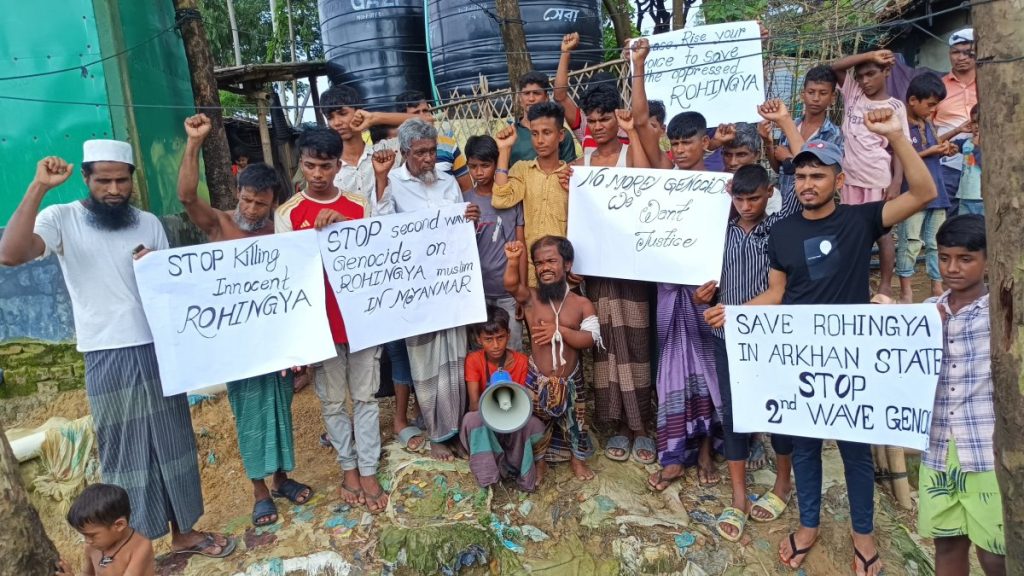
Imagine a population larger than many major European cities, yet legally, they do not exist in the eyes of any state. With over 1.2 million people displaced in Bangladesh and hundreds of thousands more confined to camps in Myanmar, the Rohingya remain the world’s largest stateless community. They’re a people without a country. It’s natural to feel overwhelmed by the scale of such suffering or confused by the legal complexities that refuse to recognise their identity. You’re likely seeking a clear path to help. You want to understand how your support translates into tangible human rights protection for Rohingya whilst they fight to reclaim their future.
This guide provides the clarity and direction needed to move from quiet concern to meaningful action. You’ll discover the critical frameworks, current challenges, and community-led solutions essential for securing the fundamental rights, safety, and dignity of the Rohingya people. We’ll examine the legal reality of statelessness, explore the latest international court hearings, and show how local UK organisations create a vital bridge to global justice, restoration, and hope.
Key Takeaways
- Recognise how the 1982 Myanmar Citizenship Law acts as the primary legal barrier to safety by enforcing systematic statelessness and exclusion.
- Identify the implementation gap between international UN resolutions and the daily reality of protection required within refugee settlements.
- Discover how education and youth empowerment initiatives provide vital human rights protection for Rohingya by fostering long-term resilience and self-advocacy.
- Understand the role of community-led organisations in the UK that bridge the gap between global crisis intervention and local integration.
- Learn actionable ways to support advocacy and awareness campaigns that prioritise the restoration of identity, dignity, and fundamental legal rights.
Understanding the Landscape of Human Rights Protection for Rohingya in 2026
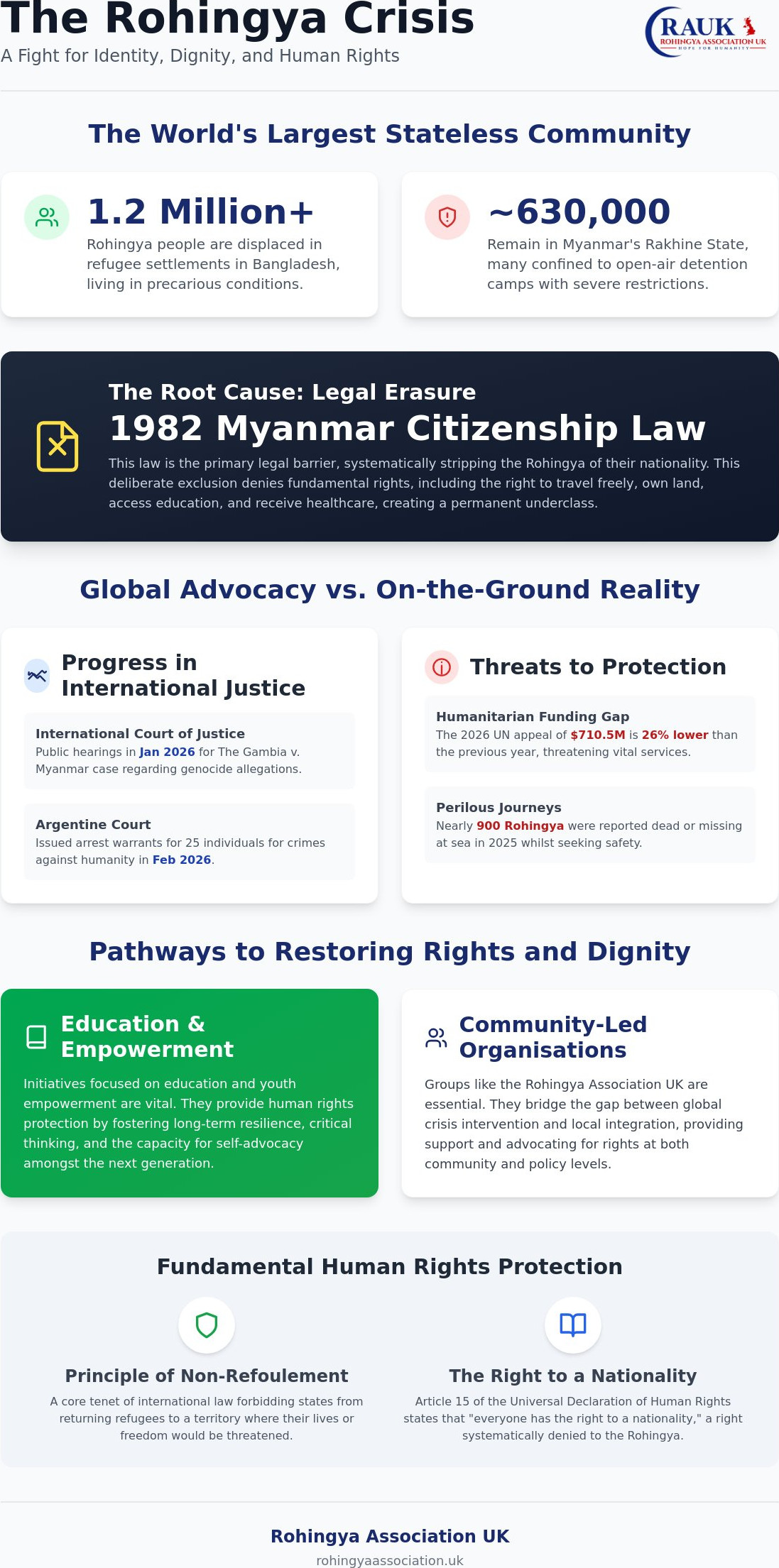
Human rights protection for Rohingya isn’t merely about the provision of emergency rations or temporary shelter; it’s a profound struggle for the right to exist as a recognised people. For a comprehensive overview of the Rohingya people, one must look at a history of systemic exclusion that has culminated in the current crisis. Today, over 1.2 million refugees reside in Bangladesh whilst approximately 630,000 remain in Myanmar’s Rakhine State, many of whom are confined to open-air detention camps. This landscape is defined by a precarious balance between international legal pressure and the harsh realities of life in the settlements.
The year 2026 has emerged as a watershed moment for international accountability and restorative justice. In January 2026, public hearings at the International Court of Justice in the case of The Gambia v. Myanmar brought the global spotlight back to the genocide allegations. This was followed closely in February 2026 by an Argentine court issuing arrest warrants for 25 individuals for crimes against humanity. These legal milestones offer a flicker of hope, yet they stand in stark contrast to the 2026 UN humanitarian appeal of $710.5 million, which is 26% lower than the previous year. This funding gap directly threatens the human rights protection for Rohingya, as international monitors struggle to document ongoing abuses amongst escalating conflict between the Myanmar junta and the Arakan Army.
The Core Pillars of International Protection
Effective protection rests on the right to life and the absolute freedom from persecution. A fundamental element is the Principle of Non-Refoulement, which forbids states from returning refugees to a territory where their lives are at risk. This is particularly critical given that nearly 900 Rohingya were reported dead or missing at sea in 2025. Without UN-led humanitarian corridors and consistent aid access, these populations are left vulnerable to forced recruitment and violence. True protection requires legal identity.
Why ‘Statelessness’ Changes the Protection Framework
Statelessness is a unique form of legal erasure that leaves an entire community without a recognised nationality. Under the 1982 Myanmar Citizenship Law, the Rohingya were stripped of their identity, a move that created a permanent underclass. This lack of documentation isn’t just a bureaucratic hurdle; it’s a barrier that hinders access to justice, education, and healthcare. In a world of borders, being stateless means being invisible to the law. Human rights protection for Rohingya must therefore address the root cause: the restoration of legal identity and the right to belong.
The Crisis of Statelessness: Why Legal Recognition is the Primary Barrier
The 1982 Myanmar Citizenship Law remains the cornerstone of the persecution faced by the Rohingya. By effectively stripping an entire ethnic group of their nationality, the state created a legal vacuum that persists today. This isn’t merely a matter of missing paperwork; it’s a deliberate system of exclusion that mirrors apartheid conditions. Without citizenship, the Rohingya are denied the right to travel freely, own land, or even marry without state permission. These restrictions aren’t historical relics but daily realities for the 630,000 people still in Rakhine State. For those seeking what you need to know about the crisis, the link between legal status and physical safety is undeniable. Legal invisibility is the weapon used to justify their displacement.
International legal efforts to restore Rohingya nationality are moving forward, yet the pace is slow whilst the suffering is immediate. In February 2026, an Argentine court issued arrest warrants for 25 individuals for crimes against humanity, a move that signals a growing global consensus that statelessness cannot be used as a shield for genocide. Human rights protection for Rohingya must address this root cause by demanding the repeal of discriminatory laws that treat an entire community as foreigners in their own ancestral home.
The Right to a Nationality: A Fundamental Human Right
Article 15 of the Universal Declaration of Human Rights states clearly that “everyone has the right to a nationality.” For the Rohingya, this fundamental right has been systematically violated for decades. Legal recognition is often called the “right to have rights” because, without it, an individual cannot access the protection of any state. The psychological toll is immense. Being told you don’t belong anywhere creates a sense of profound displacement that transcends physical borders. It’s a weight carried by every child born in the camps of Cox’s Bazar, where identity is a constant struggle for recognition, safety, and peace.
Vulnerability to Exploitation and Human Trafficking
Statelessness creates a dangerous level of invisibility. Without legal status, Rohingya families are frequently targeted by human traffickers and forced into modern slavery. In 2025 alone, nearly 900 people were lost or killed during irregular sea journeys, driven by the desperate hope of finding safety in a country that might recognise them. Women and children in the camps are particularly vulnerable, requiring specific protective measures to guard against abuse. True human rights protection for Rohingya must begin with the restoration of their legal identity and dignity. Whilst we wait for international courts to act, we can provide immediate support through advocacy and awareness campaigns that keep their struggle for justice in the public eye.
Global Advocacy vs Field Protection: Bridging the Implementation Gap
The distance between the air-conditioned halls of international diplomacy and the fragile shelters of Cox’s Bazar remains a profound chasm. Whilst UN resolutions offer a vital moral framework, they frequently lack the enforcement mechanisms required to halt the escalating violence within Rakhine State. In 2026, the UN humanitarian appeal for $710.5 million represents a 26% decrease from the previous year, a statistic that signals a worrying retreat in global commitment. This financial shortfall directly weakens the human rights protection for Rohingya, leaving non-governmental organisations to maintain ‘protection by presence’ in increasingly volatile environments. These teams act as witnesses, shields, and providers; they navigate a complex web of geopolitical tensions to ensure that survival is not left to chance.
Digital advocacy has fundamentally transformed how the world engages with this crisis. Social media platforms now allow for the rapid dissemination of evidence, bringing the stark reality of the camps directly to global audiences in real-time. For those seeking deeper context on the historical and political roots of this displacement, The Rohingya Crisis Explained by the Council on Foreign Relations provides an essential foundation. This increased transparency forces international actors to remain engaged, ensuring that the plight of the stateless cannot be easily ignored by those in power. It turns passive observers into active participants in the struggle for justice, restoration, and hope.
International Courts and the Road to Accountability
The January 2026 hearings at the International Court of Justice represent a critical step toward ending the culture of impunity that has long shielded perpetrators of violence. Evidence collection is no longer a task reserved solely for legal experts; it’s a collective effort to document history and preserve the truth for future trials. Global citizens play a vital role in this process. By supporting advocacy and awareness campaigns, individuals help maintain the political pressure required to see these complex legal proceedings through to their conclusion. Justice is a long-term commitment that requires persistence, documentation, and unwavering support.
The Importance of Localised Humanitarian Response
Policy is often crafted in distant capitals, yet its true impact is measured in the dignity of the individual. Community-led organisations serve as the primary line of defence, delivering culturally sensitive aid that honours the specific heritage and social structures of the Rohingya people. These groups are essential for bridging the gap between abstract international policy and the immediate, practical requirements of displaced families. By prioritising youth empowerment and crisis intervention at a local level, we ensure that human rights protection for Rohingya is not merely a top-down mandate but a resilient, community-driven movement that fosters long-term restoration.
Securing Fundamental Rights Through Education and Social Integration
Education serves as the most resilient shield against the cycles of poverty, exploitation, and radicalisation. For the Rohingya, a people whose history is marked by the systematic denial of their identity, the classroom represents a space of profound restoration. Whilst international focus often remains on the immediate survival needs in Myanmar and Bangladesh, true human rights protection for Rohingya necessitates a transition from aid to agency. This shift begins with the recognition that education isn’t a luxury; it’s a fundamental right that empowers individuals to advocate for their own future. When a refugee masters the English language, they gain more than a skill; they’ve acquired the tools to speak directly to the world about their struggle for justice.
Integration within host countries represents the next phase of this protective framework. For those who have reached the United Kingdom, the struggle for rights doesn’t end at the border. It evolves into a quest for belonging, stability, and equal access to the social fabric of their new home. Integration is a human right. It requires a collective effort to dismantle the barriers of language and bureaucracy that often keep refugees on the margins of society. By fostering skills development and cultural exchange, we move beyond the narrative of the ‘victim’ and towards the reality of the ‘contributor’. For many displaced professionals, gaining recognition for their existing skills is a crucial step towards independence; those looking at opportunities in Australia can learn more about Right Pathway and how such services help migrants convert their extensive work experience into formal qualifications. Restoration of agency is the ultimate goal of any humanitarian mission.
Empowering the Next Generation of Rohingya Leaders
The data from July 2026 is sobering: over 235,000 Rohingya children in refugee camps still lack access to formal education. This gap represents a critical threat to the future political representation of the community. Without higher education and leadership training, the voices of the stateless risk being perpetually silenced. However, success stories are emerging. Young Rohingya leaders are increasingly spearheading community initiatives, demonstrating that when the barriers to learning are removed, the potential for renewal is limitless. We must prioritise youth empowerment to ensure the next generation can lead their own fight for justice and recognition.
Integration and Welfare Services in the UK
Navigating the UK’s housing and healthcare systems can be a daunting experience for any refugee family. The complexity of these structures often leads to social isolation, which further undermines their fundamental dignity. Community centres act as vital hubs, providing the guidance and companionship necessary to build a new life. Within this context, RAUK plays a central role by offering practical housing guidance to families in Bradford. This local support ensures that human rights protection for Rohingya is realised through stable homes, healthy families, and secure futures. We invite you to join our mission of Education & Youth Empowerment to help build these vital bridges to integration.
Dignity and Defence: How the Rohingya Association UK Upholds Human Rights
Whilst international courts debate the legalities of genocide, the daily work of restoration happens within the community. The Rohingya Association UK (RAUK) operates on a fundamental principle: that true human rights protection for Rohingya must be led by the Rohingya themselves. We serve as a protective shield and a guiding hand for families navigating the challenges of displacement in the United Kingdom. Our mission encompasses more than just crisis intervention; it’s about building a future where our people are not merely survivors, but leaders, advocates, and citizens. By providing community support and integration, we ensure that the weight of the past does not extinguish the potential of the future. We are a dedicated partner in the journey toward safety.
Preserving our heritage is a powerful form of resistance against those who sought to erase us. In April 2026, the world’s first permanent memorial to the victims of the Rohingya genocide was unveiled in Newcastle upon Tyne, UK. This act of remembrance, coupled with the preservation of the Rohingya language, ensures that our identity remains vibrant amongst the diaspora. We believe that cultural pride is the foundation of mental wellbeing and social cohesion. It’s a statement of existence. By documenting our history and celebrating our traditions, we protect the collective memory of a people whom the world once tried to make invisible.
Cultural Preservation as a Human Right
How to Support Human Rights Protection for Rohingya
Real change requires a collective effort and a long-term commitment. Your support translates directly into tangible human rights protection for Rohingya through our advocacy and awareness campaigns. Whether you’re a local resident in Bradford or a global advocate for justice, your participation makes a difference. We invite you to contribute through voluntary charitable donations, which fund our education, youth empowerment, and integration projects. You can also join local support groups to help foster a welcoming environment for refugees. Together, we can act as a principled leader in the fight for systemic change, restoration, and lasting peace. Every action helps secure the dignity of a community that refuses to be forgotten.
Restoring Identity and Securing a Future of Dignity
The path toward justice and restoration for the Rohingya people requires a steadfast commitment to dismantling the legal barriers of statelessness and bridging the gap between international policy and local reality. True human rights protection for Rohingya is achieved through the restoration of identity, the empowerment of the next generation through education, and the preservation of a culture that refuses to be erased. We’ve explored how legal recognition serves as the “right to have rights” and how community-led advocacy provides a vital shield for those on the margins of society.
As a community-led organisation based in Bradford, the Rohingya Association UK (Registered Charity number: 1211433) delivers direct impact projects across the UK, Myanmar, and Bangladesh. We act as a protective shield and a guiding hand for families seeking a life of dignity and safety. Your personal agency can drive systemic change. Support our advocacy and help protect Rohingya human rights by donating to RAUK today. Together, we can ensure that the resilient spirit of the Rohingya people leads to a future defined by belonging, justice, and peace.
Frequently Asked Questions
What are the most basic human rights being denied to the Rohingya?
The Rohingya are primarily denied the fundamental right to a nationality, which serves as the foundation for all other legal protections. This state-enforced invisibility leads to the systematic deprivation of freedom of movement, the right to own property, and access to life-saving healthcare. Without a legal identity, they remain vulnerable to arbitrary detention and exclusion from the formal economy in both Myanmar and host countries.
How does statelessness affect Rohingya children’s future?
Statelessness creates a cycle of legal erasure that prevents children from obtaining birth certificates or recognised school qualifications. Currently, over 235,000 Rohingya children lack access to formal education, a gap that severely limits their future employment prospects and political representation. This lack of legal standing leaves them trapped in a state of permanent displacement, making them easy targets for exploitation and child labour.
Is there any legal protection for Rohingya refugees in the UK?
Rohingya refugees in the UK are protected under the 1951 Refugee Convention and domestic asylum laws, which provide the right to safe haven and essential welfare services. Whilst they don’t have a unique legal status, their recognition as refugees allows them to access the NHS, housing support, and the legal right to work. Organisations like RAUK help families navigate these complex systems to ensure their rights are fully realised.
How can I contribute to human rights protection for the Rohingya?
You can contribute to human rights protection for Rohingya by supporting community-led advocacy, donating to crisis intervention projects, and raising awareness of the ongoing crisis. Direct financial support to registered charities like RAUK enables the provision of education and integration services that restore dignity to displaced families. Contacting your local MP to advocate for international justice also helps maintain the political pressure necessary for systemic change.
What is the current situation in the Cox’s Bazar refugee camps?
The situation in Cox’s Bazar remains dire, with over 1.2 million people living in overcrowded, temporary shelters that are highly vulnerable to monsoon weather and fires. A 26% decrease in international funding for 2026 has forced many NGOs to reduce essential services, leading to increased food insecurity and protection risks. These camps, whilst providing a temporary refuge, cannot offer the long-term safety or legal recognition the community requires.
Why is education considered a human rights protection tool?
Education is a vital protection tool because it equips displaced individuals with the literacy and critical thinking skills needed to advocate for their own legal rights. By providing a safe environment for learning, it acts as a shield against radicalisation and the economic desperation that leads to human trafficking. Language proficiency also allows refugees to navigate host societies and communicate their experiences directly to international human rights monitors.
How does the Rohingya Association UK use donations for advocacy?
Donations are utilised to fund youth empowerment programmes, cultural preservation events, and direct integration support for families settled in the UK. These funds allow us to act as a principled leader in the community, providing the resources necessary for Rohingya individuals to lead their own advocacy efforts. Every contribution supports our mission to bridge the gap between global policy and the practical needs of our community.
What can the international community do to stop human rights violations in Myanmar?
The international community must prioritise the enforcement of targeted sanctions against the Myanmar military and provide consistent support for the International Court of Justice hearings. Establishing secure humanitarian corridors and demanding the repeal of the 1982 Citizenship Law are essential steps toward ending systematic persecution. Collective diplomatic pressure remains the most effective tool for ensuring that human rights protection for Rohingya becomes a permanent reality.