
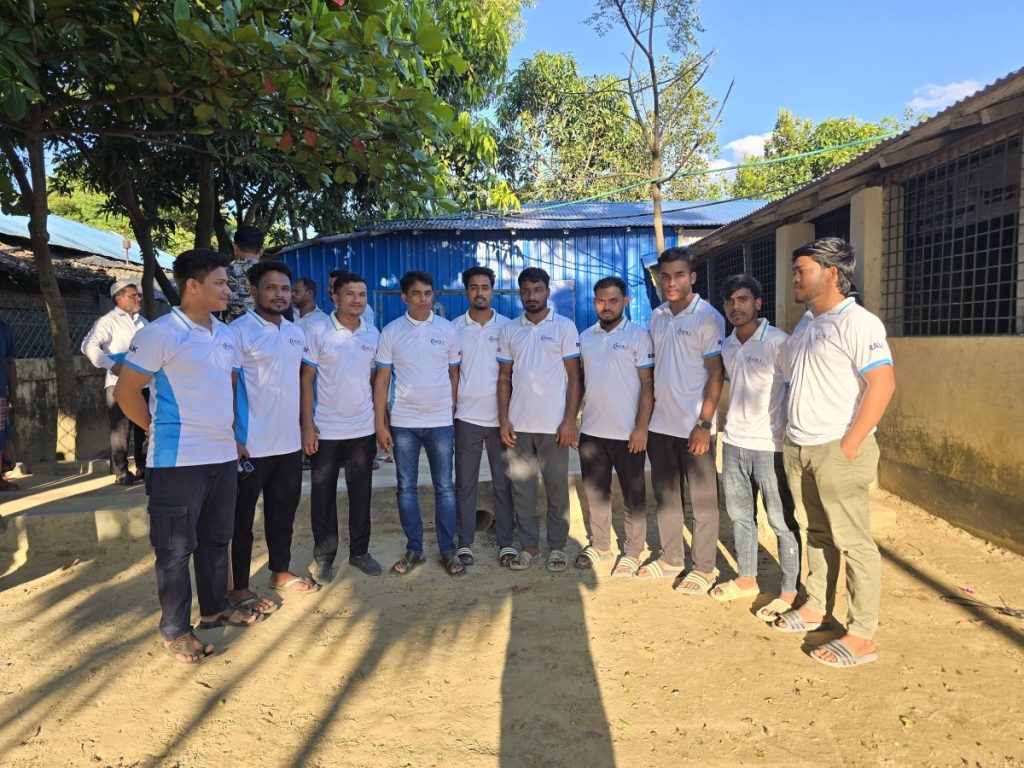
For decades, the narrative of the Rohingya people has been written by others, often reducing a rich heritage to a list of humanitarian requirements. The true story of resilience is currently being authored from within the camps of Cox’s Bazar and throughout the UK diaspora. Authentic Rohingya community leadership is not merely a goal for the future; it’s a vital, present force that is transforming refugees from passive recipients of aid into the primary architects of their own destiny.
It’s understandable to feel that support is frequently something done to a community rather than created with it, particularly when your voices are absent from the wider public conversation. This article demonstrates how Rohingya-led initiatives are reclaiming agency, restoring dignity, and rebuilding the social structures that historical persecution sought to dismantle. We will examine the shift towards elected representation, the rise of youth-led advocacy, and the ways you can support a model of change that honours cultural preservation, communal safety, and long-term justice.
Key Takeaways
- Understand how the transition from aid recipients to active stakeholders is redefining the concept of Rohingya community leadership within the modern diaspora.
- Explore the “Bradford Model” to see how localised service delivery in housing and education builds the essential trust required for successful community integration.
- Discover the vital role of youth empowerment in cultivating bilingual leaders who can bridge the gap between traditional heritage and British civic life.
- Learn how grassroots community bonding for refugees serves as a powerful foundation for global human rights advocacy and the pursuit of systemic justice.
- Recognise why it’s vital to support community-led organisations to ensure that refugee assistance remains culturally sensitive and truly transformative.
The Foundation of Rohingya Community Leadership: Reclaiming a Stolen Voice
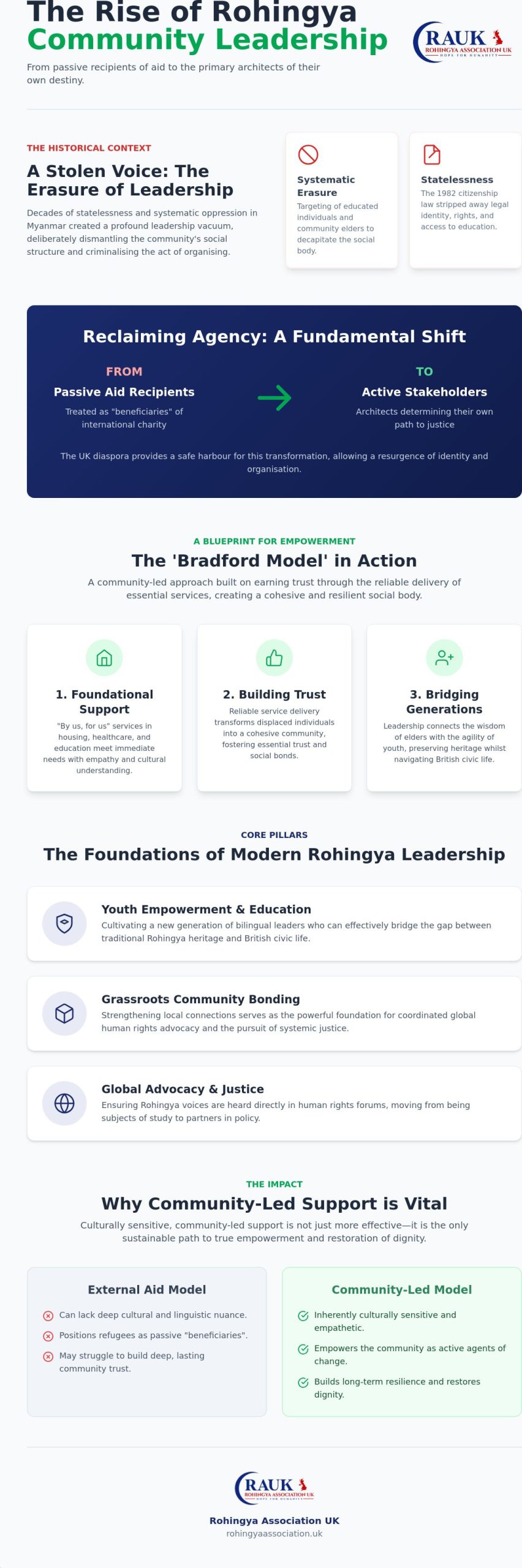
The concept of leadership is often defined by the presence of institutions, titles, and recognised authority. For the Rohingya, however, leadership has been an act of quiet defiance against a backdrop of systematic erasure. Decades of statelessness, rooted in the 1982 citizenship law that stripped them of their legal identity, forced a community to survive without a formal voice. Reclaiming Rohingya community leadership today is not just about management; it’s about the restoration of a stolen agency. It represents a fundamental shift from being treated as “beneficiaries” of international charity to becoming active stakeholders who determine their own path toward justice and integration.
Historical Context: The Denial of Agency
The path to the current crisis was paved by the deliberate dismantling of communal structures. In Myanmar, the state targeted educated individuals and community elders first; they effectively decapitated the social body to ensure compliance. This was exacerbated by educational barriers that left generations in a state of enforced pre-literacy. To understand the history of Rohingya political leadership, one must recognise that the state didn’t just deny rights; it actively criminalised the act of organising. Decades of statelessness and the deliberate suppression of intellectual life created a profound leadership vacuum that left the community vulnerable to exploitation and external control.
The Diaspora as a Catalyst for Change
Whilst the situation in the camps remains precarious, the UK diaspora has emerged as a critical laboratory for new forms of representation. Here, the freedom of speech provides a protective shield that was entirely absent in Rakhine State. Organisations like RAUK serve as more than just service providers; they act as safe harbours for communal organisation and political maturation. By moving amongst the community in cities like Bradford, we identify emerging voices that possess the unique ability to navigate both their traditional heritage and the complexities of British society. This environment allows for a resurgence of identity that is both resilient and forward-looking.
There is a moral urgency in ensuring that Rohingya voices are heard directly in human rights forums. For too long, the narrative of the crisis has been filtered through the lens of external observers. Authentic Rohingya community leadership ensures that the community is no longer a subject of study but a partner in policy. This self-representation is the only sustainable way to address the unique pains of displacement and the long-term goal of restoration. It’s a journey from survival to influence, ensuring that the next generation doesn’t just inherit a legacy of trauma, but a tradition of strength.
Cultivating Grassroots Agency: How Local Leadership Transforms Lives
The “Bradford Model” represents a sophisticated blueprint for how Rohingya community leadership functions in a modern, urban setting. It’s built on the fundamental principle that communal trust is earned through the tangible, reliable delivery of essential services. When families first arrive in the UK, their immediate concerns are often overwhelming. They need secure housing, accessible healthcare, and consistent education for their children. Mainstream services, whilst well-intentioned, frequently struggle with the deep linguistic and cultural nuances of the Rohingya experience. By providing “by us, for us” welfare services, community leaders ensure that these basic needs are met with a level of empathy and efficiency that external agencies cannot replicate. This foundational support transforms the community from a collection of displaced individuals into a cohesive, resilient social body.
Maintaining cultural continuity requires a delicate balance between the generations. Elders hold the precious memories of the homeland and the weight of historical truth, whilst the youth possess the linguistic tools and cultural agility to navigate British civic life. Leadership in this context acts as a vital bridge. It ensures that the transition into a new society doesn’t result in the erasure of heritage. As highlighted by the Council on Foreign Relations on the Rohingya Crisis, the ongoing political instability in Myanmar makes the preservation of identity a key pillar of global advocacy. This internal strength is what allows the community to speak with authority on the international stage.
Faith and Heritage: The Glue of Communal Authority
Islamic community events provide the essential social fabric that holds the diaspora together in times of both celebration and grief. These gatherings serve as more than religious observances; they are spaces where trust is reinforced, stories are shared, and collective identity is celebrated. By organising cultural festivals and prioritising the preservation of the Rohingya language, leaders project an image of resilience that counters the mainstream narrative of victimhood. Language is more than a means of communication; it’s a tool for leadership that allows for the transmission of values, the protection of heritage, and the coordination of collective effort.
Navigating UK Systems Through Peer Support
Mainstream housing and welfare guidance often misses the specific traumas and multi-generational requirements of refugee families. Peer support fills this critical gap. Leaders who share a lived experience of displacement help families navigate the complexities of the NHS, enrol children in local schools, and master the English language. This peer-to-peer support significantly reduces the profound sense of isolation and disorientation that newly arrived families often face when settling into unfamiliar urban environments. You can explore our community support and integration initiatives to see how this model of peer-led guidance is transforming lives and fostering long-term stability.
The Role of Youth and Education in Sustaining Leadership
Youth empowerment is not merely a social objective; it’s a strategic safeguard against the long-term marginalisation that has historically defined the Rohingya experience. For a community that has faced systematic exclusion from formal institutions, the next generation represents the most potent tool for communal restoration. Developing bilingual leaders who are equally comfortable navigating the nuances of Rohingya heritage and the complexities of British society is essential for long-term stability. Modern Rohingya community leadership now requires a sophisticated mastery of digital literacy and modern advocacy tools, allowing young people to bypass traditional gatekeepers and project their voices directly onto the global stage. Through structured mentorship, established diaspora leaders are currently transferring their wisdom, ensuring that the flame of advocacy remains bright and purposeful.
Skills Development Beyond Resilience
The transition from survival to influence begins when the focus shifts from basic English proficiency to advanced leadership training. We are seeing a vital move toward public speaking, policy analysis, and community organising as core components of youth development. Empowering young women within the community is particularly transformative; it ensures that the narrative of the diaspora is inclusive, representative, and resilient. Furthermore, increasing access to university education provides the community with the intellectual authority required to challenge systemic biases and contribute meaningfully to human rights discourse. These young scholars are not just students; they are the future architects of justice.
Education as a Form of Resistance
For the Rohingya, education has always been an act of resistance against a state that sought to keep them in a condition of enforced ignorance. By pursuing academic excellence, young people effectively dismantle the “pre-literate” label that was historically used by the Myanmar state to justify their exclusion from civil society. RAUK’s ongoing education projects in Myanmar and Bangladesh play a critical role here, fostering global links that connect the diaspora with those still living in displacement. Academic success serves as a definitive counter-narrative to the labels of inferiority used to justify decades of persecution. It proves that despite every attempt to erase their potential, the Rohingya spirit remains intellectually vibrant and unyielding. This commitment to learning ensures that the community’s future is built on a foundation of knowledge, authority, and shared purpose.
Advocacy and Justice: Bridging Local Action and Global Change
The strength of Rohingya community leadership lies in its ability to translate local cohesion into global influence. In cities like Bradford, the act of coming together for cultural or social support serves as the essential launchpad for international advocacy. This transition is driven by a model of “principled leadership” that refuses to choose between immediate crisis intervention and the long-term pursuit of justice. As the 2026 Joint Response Plan faces a significant 37% funding gap, community leaders are forced to manage the consequences of shrinking humanitarian aid whilst simultaneously preparing the legal and historical evidence required for international accountability. By collaborating with international NGOs, these leaders ensure that the Rohingya are no longer just the subjects of reports, but the primary authors of their own liberation strategy.
Storytelling plays a pivotal role in this process. Beyond the dry statistics of displacement, personal narratives humanise the crisis and challenge the donor fatigue that often plagues protracted conflicts. These stories are not just accounts of suffering; they are testimonies of resilience that demand a response. Through our advocacy and awareness campaigns, we amplify these voices to ensure that the global community remains confronted with the moral urgency of the Rohingya cause.
From Bradford to the International Court of Justice
The diaspora acts as a vital repository of memory and evidence. By meticulously documenting community history and personal testimonies, local leaders in the UK provide the evidentiary backbone for international accountability mechanisms. This documentation is essential for supporting justice claims at the International Court of Justice and other global forums. Furthermore, local fundraising efforts within the UK are not merely about charity; they are strategic investments that support advocacy missions and crisis support for the 1.2 million refugees currently residing in Bangladesh. This creates a direct link between the safety of a community centre in the North of England and the pursuit of rights in Rakhine State.
Building Strategic Alliances
No community can fight for justice in isolation. Rohingya community leadership involves building strategic alliances with other refugee support groups and human rights organisations across the UK to amplify the call for systemic change. The Rohingya Association UK plays a critical role in this ecosystem, frequently advising government bodies on refugee welfare and integration policies to ensure they are culturally sensitive and effective. This collaboration ensures that the specific needs of the Rohingya are integrated into broader human rights agendas. A stable and well-integrated local community provides the financial, emotional, and intellectual resources necessary to exert meaningful pressure on the global political stage. By securing our place within British society, we strengthen our ability to fight for our place in the world.
Supporting Community-Led Initiatives: The Path to Sustainable Empowerment
Empowerment is not a finite resource; it’s a structural transformation that requires consistent, principled investment. Supporting community-led organisations like the Rohingya Association UK (RAUK) ensures that every contribution is directed by those who possess the deepest understanding of the community’s needs and aspirations. This approach moves beyond the limitations of traditional, top-down charity, where decisions are often made by distant actors who lack lived experience. Instead, it prioritises cultural sensitivity and long-term agency. Within the Islamic tradition, this form of support is often viewed through the lens of “Sadaqah Jariyah”, a perpetual charity that continues to provide benefits long after the initial gift. By investing in Rohingya community leadership and education, you are planting seeds of resilience that will flourish for generations, ensuring that the community remains the master of its own recovery.
For individuals looking to manage their wealth in a way that supports long-term philanthropic goals, you can visit MRA Advisory Group for professional financial planning and investment management services.
The Impact of Your Contribution
Financial support facilitates the professional training of community organisers, equipping them with the skills needed to navigate complex social and legal frameworks in the UK. There is a profound multiplier effect at play; when one leader is trained and empowered, they possess the capacity to uplift an entire neighbourhood. This support ensures the longevity of vital cultural and heritage preservation projects, protecting the very identity that persecution sought to erase. Whether it’s through funding youth education initiatives or supporting crisis intervention, your contribution provides the stable foundation upon which a community can rebuild its shattered social structures. Understanding the principles of effective community bonding for refugees is essential to appreciating why this investment in social cohesion yields such lasting results.
Joining the Movement for Justice
True partnership involves more than financial assistance; it requires a shared commitment to the principles of justice and human rights. Public awareness is a powerful shield that protects the vulnerable by ensuring their plight is never forgotten by the global community or buried under the weight of competing crises. We invite you to become a partner in this journey of restoration and renewal. Whether you choose to volunteer at our community centre in Bradford, participate in our global advocacy efforts, or support our local integration programmes, your involvement is a vital act of solidarity. Together, we can ensure that the Rohingya people are no longer defined by their displacement, but by their strength and their voice. Support Rohingya community leadership by donating to RAUK today.
Rebuilding a Future Through Collective Agency
The journey from the margins of statelessness to the centre of global advocacy is a profound testament to the unyielding spirit of the Rohingya people. We’ve seen how the restoration of agency begins at the grassroots level, where local support provides the essential stability required for broader political influence. By prioritising youth education and fostering bilingual advocates, the community ensures that its heritage is preserved whilst its future is secured. Authentic Rohingya community leadership is the only sustainable mechanism for transforming systemic trauma into a legacy of strength, justice, and renewal.
As a community-led organisation with direct lived experience, we manage active projects across the UK, Myanmar, and Bangladesh. Your support allows us to maintain our role as a principled advocate for those whose voices have been historically silenced. We invite you to empower the Rohingya community: Donate to our leadership and education projects. Every contribution to our work (Registered Charity number: 1211433) represents a vital investment in a future where the Rohingya are finally the architects of their own destiny. Stand with us as we continue the essential work of restoration, protection, and growth.
Frequently Asked Questions
What is the role of community leadership in the Rohingya diaspora?
Community leadership serves as the vital link between grassroots survival and the global pursuit of fundamental human rights. It moves the diaspora beyond the status of passive aid recipients, allowing individuals to become active stakeholders in their own social and political development. This leadership is essential for navigating the complexities of displacement whilst maintaining a cohesive communal identity that can withstand the pressures of long-term exile.
How does the Rohingya Association UK support local leaders in Bradford?
RAUK supports local leaders by providing a structured platform for communal organisation and professional development. We work closely with individuals in Bradford to identify emerging voices of influence, offering them the resources needed to coordinate essential services like housing guidance and educational support. This localised approach ensures that leadership is deeply embedded within the community, fostering a level of trust and accountability that external agencies often struggle to achieve.
Why is it important for the Rohingya to lead their own advocacy efforts?
Self-led advocacy is critical because it ensures that the Rohingya narrative is authored by those who have lived through the crisis. It prevents the community’s history and current struggles from being filtered through external perspectives, which can often overlook vital cultural nuances. Authentic Rohingya community leadership provides the moral authority required to challenge systemic injustices and demand meaningful change on the international stage.
Can I volunteer to help with Rohingya community projects in the UK?
We welcome volunteers who are committed to the principles of restoration, protection, and communal growth. Opportunities range from supporting our youth empowerment programmes in Bradford to assisting with global advocacy and awareness campaigns. By volunteering, you become a dedicated partner in our mission, helping to bridge the gap between local action and the systemic changes required to secure a just future for all Rohingya people.
How do community-led organisations differ from international NGOs?
Community-led organisations are rooted in direct lived experience, whereas international NGOs often operate as external benefactors. This distinction is vital; it means our interventions are naturally aligned with the community’s cultural values, linguistic needs, and social structures. Whilst NGOs provide essential large-scale aid, community-led groups offer the nuanced, long-term commitment necessary for true empowerment and the restoration of communal agency.
What are the main challenges facing Rohingya youth leaders today?
Youth leaders face the significant challenge of navigating dual identities whilst overcoming the educational barriers imposed by historical persecution. They must master modern advocacy tools and digital literacy to communicate their message effectively to a global audience. Additionally, they work to dismantle the “pre-literate” labels used to marginalise their elders, proving that the next generation is intellectually vibrant, politically engaged, and ready to lead.
How does RAUK ensure cultural preservation whilst promoting integration?
We ensure cultural preservation by integrating traditional language and faith-based events into our broader integration programmes. By celebrating Rohingya heritage through cultural festivals and communal gatherings, we provide a secure psychological foundation for our members. This cultural pride acts as a protective shield, allowing individuals to integrate into British society with confidence rather than feeling forced to abandon their unique identity.
How can my donation help build long-term leadership within the community?
Your donation directly funds professional training for community organisers and supports essential education projects in the UK and overseas. This investment creates a multiplier effect; a single trained leader possesses the capacity to empower an entire neighbourhood and mentor the next generation. By supporting Rohingya community leadership, you are contributing to a sustainable model of change that prioritises long-term restoration over fleeting emotional reactions.